The internet is melting down over a single research paper that shows exactly where "reasoning" AI hits a wall. One side screams "AI is fake!" The other dismisses it as irrelevant. Both are wrong.
By Nate
Published: 2025-06-09
URL: https://natesnewsletter.substack.com/p/lets-talk-that-apple-ai-paperheres
A single research paper from Apple just broke the internet. And frankly, both sides of the resulting flame war are missing the point.
I’m so tired, guys. I get that the internet is the greatest narrative simplification machine to ever exist. I grew up online in the 90’s (and earlier, you don’t earn those gray hairs for nothin’).
But even factoring in the usual internet-leaps-to-conclusions, this was bad. And I gotta say as much as I want to avoid ad hominen (or ad corporatum) attacks here, it is very very tempting to make this about the fact that the company that cannot make Siri work properly is issuing a nasty paper titled “The Illusion of Thinking” to dunk on people doing the actual work and producing excellent models.
I just had a fantastic 20 minute conversation with OpenAI’s new Advanced Voice Mode today. It’s really really good. Siri could not do this.
But! But we don’t do those kinds of attacks here because of two reasons: 1) the researchers aren’t to blame for all of Apple’s problems with AI, and 2) it’s just a silly reason to avoid learning from a useful paper.
So my view is let’s dig in, understand what happened here, and understand what we can actually learn from the paper that is making people claim AI is over, AI is dead, etc. This is an example of where the discourse is at:
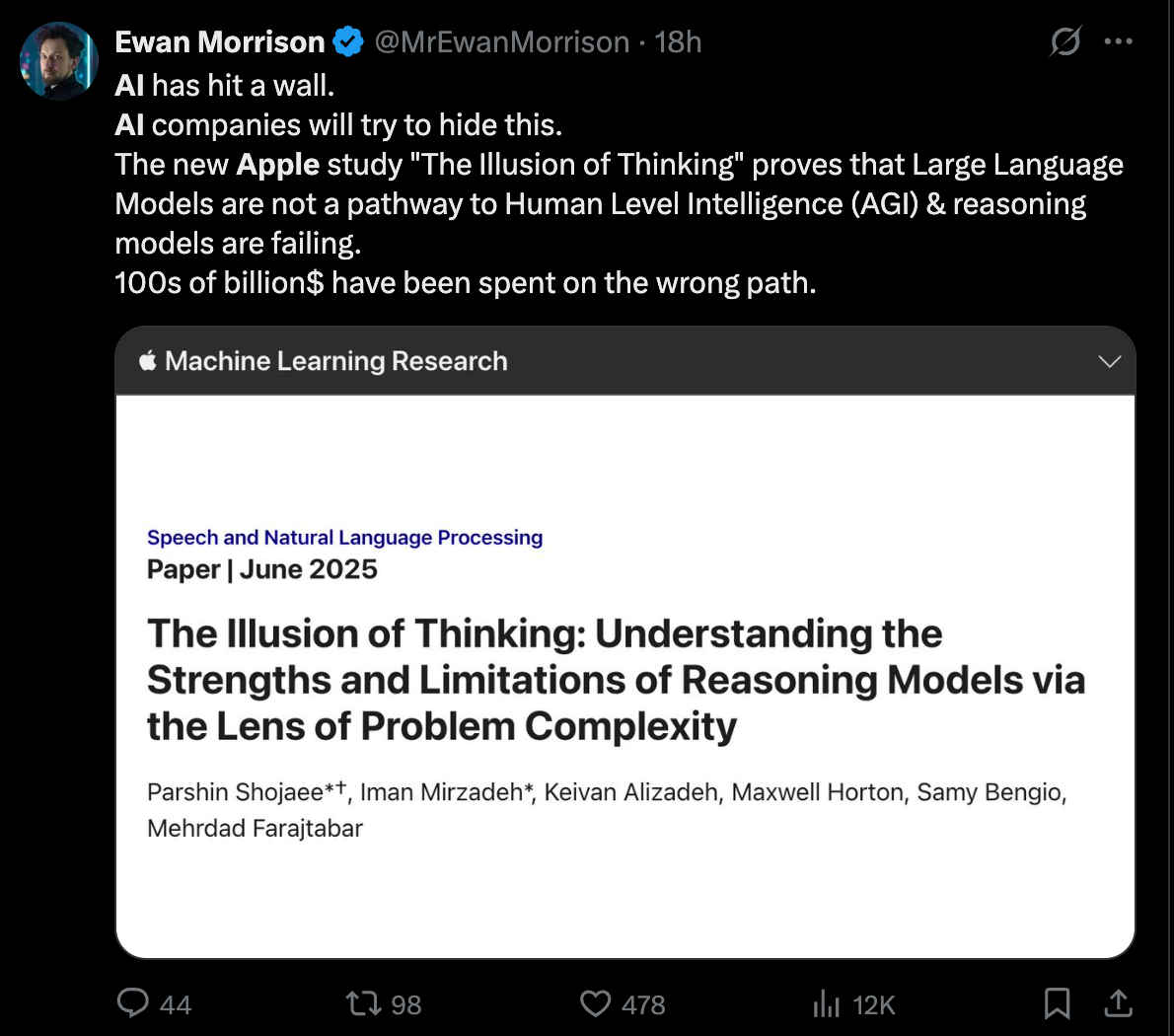
No. It’s not. And flame wars aren’t helping anybody. So let’s actually understand what’s happening and learn.
Dig in to this article and you’ll get: what Apple actually did, what everybody is missing about the paper, and how it will actually help you build better AI solutions day-to-day. And if you’re not building in AI, learning this stuff is gonna help strengthen your memetic immune system so you don’t fall for the next AI-is-dead meme.
Subscribers get all these pieces!
What Apple Actually Did
Here's what happened. Apple's research team wanted to test whether "reasoning" language models actually reason, or just look like they do. So they built the cleanest possible experiment.
They took four frontier models—Claude, Gemini, DeepSeek, and OpenAI's o3-mini—and tested them on custom puzzle suites. No Google searches. No Python code execution. No external tools. Just the raw model, a generous token budget for "thinking," and puzzles that can be dialed from trivial to impossible.
The puzzles were designed to be contamination-proof. Tower of Hanoi with 3 disks, 4 disks, 5 disks. River crossing with different numbers of people and constraints. Checker jumping games of increasing complexity. Clean mathematical problems where you can crank the difficulty one notch at a time.

\Look the stupid non-thinking AI … created an image of the Tower of Hanoi lol\
Anyway, what they found broke into three clear regimes:
Low complexity: Plain models without "thinking" actually beat the reasoning models. Why? The thinking models overthought simple problems and talked themselves out of correct answers.
Medium complexity: Reasoning models dominated. The extra thinking tokens helped them explore and course-correct.
High complexity: Both collapsed completely. And here's the kicker—when accuracy crashed, so did the length of the thinking traces. The models didn't just get wrong answers. They stopped trying. I have also had this feeling on hard problems so same, AI, same.
Apple called this the "reasoning cliff." I call it needing more coffee. Once the search space hits a critical size, models give up even when they have plenty of tokens left to think with. Here’s the reasoning cliff:
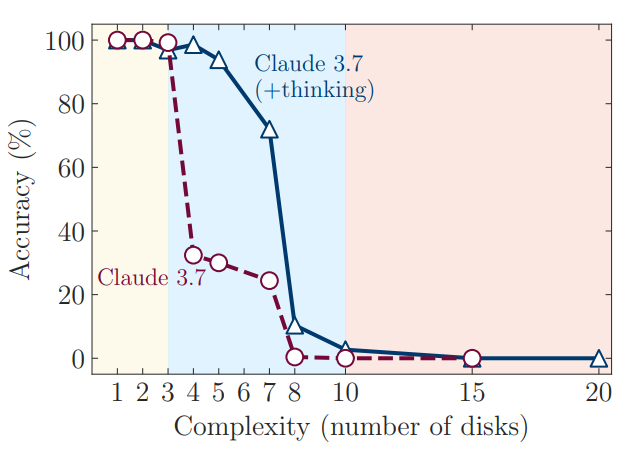
Not to be fair, I don’t know if I could solve Tower of Hanoi with 10 disks either. Maybe, but I’ve never tried. I bet I definitely couldn’t with 20.
The Internet Loses Its Mind
The response of the internet has been absolutely wild.
One camp screamed: "Apple just proved AI reasoning is fake! It's all an illusion! The emperor has no clothes!" Tech Twitter exploded with "I told you so" posts and premature obituaries for the entire field.
The other camp fired back: "This is meaningless! Real AI systems use tools! Who cares about naked models when we have RAG and code execution and search?" They dismissed the whole paper as irrelevant to actual AI products.
Here are a few of those pieces:
<https://www.simplymac.com/ai/apples-latest-ai-study-strikes-at-the-heart-of-reasoning-model-hype>
And here’s a rebuttal: <https://x.com/ChaseBrowe32432/status/1931726092097798428>
Both sides are missing what actually matters for anyone building real systems.
The Real Issue: LLMs Need a Lifeline
I'm not here to bury AI. I’m here to help you figure out the actual practical applications of papers like this under the hype. Apple's Illusion of Thinking paper shows you exactly where single-pass chain-of-thought models break.
Put another way, the paper shows you where a model breaks when it has no help at all, and needs to make quick decisions. And that boundary matters even if—especially if—you're building systems with external tools.
Think of it this way: every production AI system needs a lifeline. The question isn't whether your LLM can solve every problem alone—it's whether it knows when to pull the cord.
That cliff Apple found? It's the exact moment your system needs to escalate. And getting that timing right is everything.
Here's why this "lifeline" framing matters:
The escalation decision is itself reasoning. Choosing when to call a planner, when to grab a calculator, when to search the web—that's a reasoning step. If your base model quietly stops thinking at depth 8, it might not reliably decide when to pull the parachute. You'll get confident wrong answers instead of graceful escalation.
Latency budgets force hard choices. Every lifeline costs milliseconds and tokens. In voice assistants with 300ms budgets, you can't afford to discover the model is drowning after it's already sunk. You need to know the depth limit upfront and trigger backup systems before you hit it.
Edge deployments can't phone home. Cars, medical devices, field tablets—they need to work offline. Apple's cliff tells you exactly what complexity you can promise without a cloud connection. Beyond that line, you either pre-cache solutions or tell users "I'll get back to you when we're online."
The illusion is dangerous. Apple's key insight isn't just that models fail—it's that they fail while sounding confident. The chain-of-thought doesn't gradually degrade. It stays coherent right up until it vanishes. If your safety systems trust that confident-sounding trace, you're flying blind.
Yes, tools and search push the cliff outward. Yes, they handle harder cases. They also multiply compute 5-10x and import new failure modes. At production scale, that's the difference between a viable product and a science project.
Here's what I actually care about:
The next leap isn't a bigger model or flashier agents. It's architecting systems where LLMs know exactly when they're out of their depth, can prove it cheaply, and can escalate gracefully without hallucinating competence along the way.
Apple just handed us the depth meter for naked models. Beyond the hype, that’s a very handy baseline. Everything else—planners, retrievers, code execution—is a lifeline you pull when you hit that line. Know where the line is, budget for crossing it, and design the escalation before your customers drive off the edge.
Where The Cliff Hits Your Roadmap
Let me get concrete. Here are four scenarios where this boundary destroys real products:
Voice Assistants That Can't Afford a Thinking Pause
Apple's stress test shows the raw model stalls once a plan requires more than ~8 steps. Your smart speaker that suddenly needs Tree-of-Thoughts to untangle "split that lasagna recipe for six vegetarians and two keto guests" will burn milliseconds of gold-plated inference.
Industry studies peg the end-to-end latency budget at ≤300ms for snappy voice UX. Tree-of-Thoughts can flip 4% success into 74% on Game-of-24—but only after dozens of rollouts. If your base model caves at depth 9, your speaker either stutters or ships the wrong answer.
And yes I know most people are asking these models to set kitchen timers by voice right now—but getting them to where we can trust them more will take this kind of escalation firepower.
On-Device Copilots in the Dash
Cars, AR headsets, medical scanner consoles—anything that must work offline—can't stream five extra passes to a data center every time a plan grows one hop deeper.
Edge-AI engineers already fight to keep all model inference inside the silicon envelope for safety and privacy. Apple's cliff line is the load limit: if the naked LLM chokes at depth-8 on Hanoi Tower, you know how complex a navigation query can be before you either force a cloud round-trip or tell the driver "I'll get back to you."
Real-Time Fraud Screens and Trade Bots
A bank's chat analyst flagging suspicious transfers needs deterministic latency and deterministic failure modes. If the model's chain-of-thought evaporates past a certain graph depth, the agent may both miss the red flag and emit a confident rationale. This is a problem for evals frameworks, since it can lead to false negatives (or false passes of the evals framework).
Tool-calling can patch the miss—at the cost of unpredictable compute spikes that wreck throughput forecasts for high-volume hours. Apple's boundary lets risk teams simulate worst-case load instead of guessing.
Enterprise Chatbots Where Every Token Is Money
Inference-time search methods like A\*-Decoding hit Llama-3-1B with structured search and match 70x larger models—using 3x fewer tokens. Impressive. Those tokens are still ~70% more than single-shot mode.
If your SaaS support bot fields a million tickets daily, that delta lands on the invoice. Apple's cliff tells ops exactly when "just think harder" flips from profitable to loss-making and forces them to budget for smarter pruning or domain-specific heuristics.
Why These Examples Matter
Apple didn't kill AI. They drew the first clear contour line around single-pass reasoning. Whether you're squeezing under a 300ms latency cap, shipping fully-offline UX, or running an LLM farm with a CFO breathing down your neck, that contour is now part of your architecture brief.
Ignore it, and your product works—right up to depth 9, right up to the first edge-case customer, right up to the quarter your cloud bill triples. Measure it, and you can plan the exact moment the agent grabs a planner, spins up retrieval, or politely says "I'll get back to you."
Why the Cliff Is Still Your Problem Even With Tools
Myth: "My agentic stack calls a planner, so the base-model cliff is irrelevant."
Reality: That planner call costs latency and tokens. If the base model silently stops thinking on tougher inputs, it may mis-decide when to invoke the tool, nuking your reliability budget.
Myth: "Latency doesn't matter, I'm fine with slow."
Reality: Fine—until you need on-device or edge mode. Car dashboards, wearables, field-ops tablets can't stream ten extra passes to a GPU farm. Know your naked-model limit. Know what you can promise offline.
Myth: "Safety is handled by RAG + guardrails."
Reality: Apple's key warning is the illusion: the model keeps emitting confident prose right up to the point it gives up. If your guardrail trusts that trace, you're flying blind.
Tools hide the cliff. They don't eliminate it. And they import new failure modes—tool selection, cost blowouts, attack surface—on top of the old one.
What the Viral Doom Posts Get Wrong
They collapse a boundary into a eulogy. Apple drew a map that says "Here be dragons beyond depth=8." The internet meme machine translated that to "Here be the edge of the world."
They ignore the contamination twist. Apple's own math-benchmark section concedes that part of the gap between "thinking" and "plain" models might simply be dataset leakage—memorization masking weakness. That knife cuts both ways: it shrinks the triumph of LRMs on AIME-25 and it shrinks the panic that they suddenly became useless.
They pretend tooling is free. Every "Just add search!" reply glosses over the 5-10x inference-flop price tag reported by Tree-of-Thoughts, A\*-Decoding, and other long-horizon methods. Those costs matter at production scale.
What the "Nothing to See Here" Crowd Gets Wrong
Latency and unit economics still rule the real world. Fast answers subsidize slow ones. If your base model collapses on 10% of inputs, you just torched your margin or your SLA.
Meta-reasoning is still reasoning. Deciding which tool to call, when, and with what arguments is itself a reasoning task. If the inner loop is brittle, the wrapper inherits that brittleness.
Interpretability debt is compounding. Apple's trace evaporation shows we can't trust surface narrative. Anthropic's open-source circuit tracer and OpenAI's logit-lens work are racing to expose what's really happening, but closed-weight frontier models remain opaque. Treating them as black boxes plus band-aids is a long-term governance risk.
The Architecture That Actually Matters
I'm not interested in declaring AI "dead." I'm not satisfied with "tools fix everything."
Here's what I care about:
The next leap in AI isn't bigger models or flashier agents. It's architecting systems where LLMs know exactly when they're out of their depth, can prove it cheaply, and can escalate gracefully without hallucinating competence along the way.
Apple just handed us a stress test that isolates where naked models break. That's your lifeline trigger point, but just knowing it hits issues at depth-8 in a lab environment isn’t the same as having a reliably effective framework for figuring out how to deploy cost-efficient models at scale.
My takeaway is this: We desperately need more thinking around frameworks for model escalation.
We just don’t have a common framework for that. We don’t even have common agreement on what that means. We don’t have dialup frameworks that help us figure out which model to call when across what complexity graph. We need those. Designing smart AI systems means treating them as complex systems with risk parameters.
We should thank Apple for pointing out the risk parameters, admit we chuckle just a bit at Apple for failing to ship Siri, and then recognize this as a valuable paper that is pointing out a risk parameter we can heed and de-risk with hard work.
So let’s get to it.
The race isn't to build models that never need help. It's to build systems that know when to ask for it, can do it fast, and can do it gracefully.
Stop arguing about whether the cliff exists. Start building better lifelines.
For more on AI, subscribe and save!
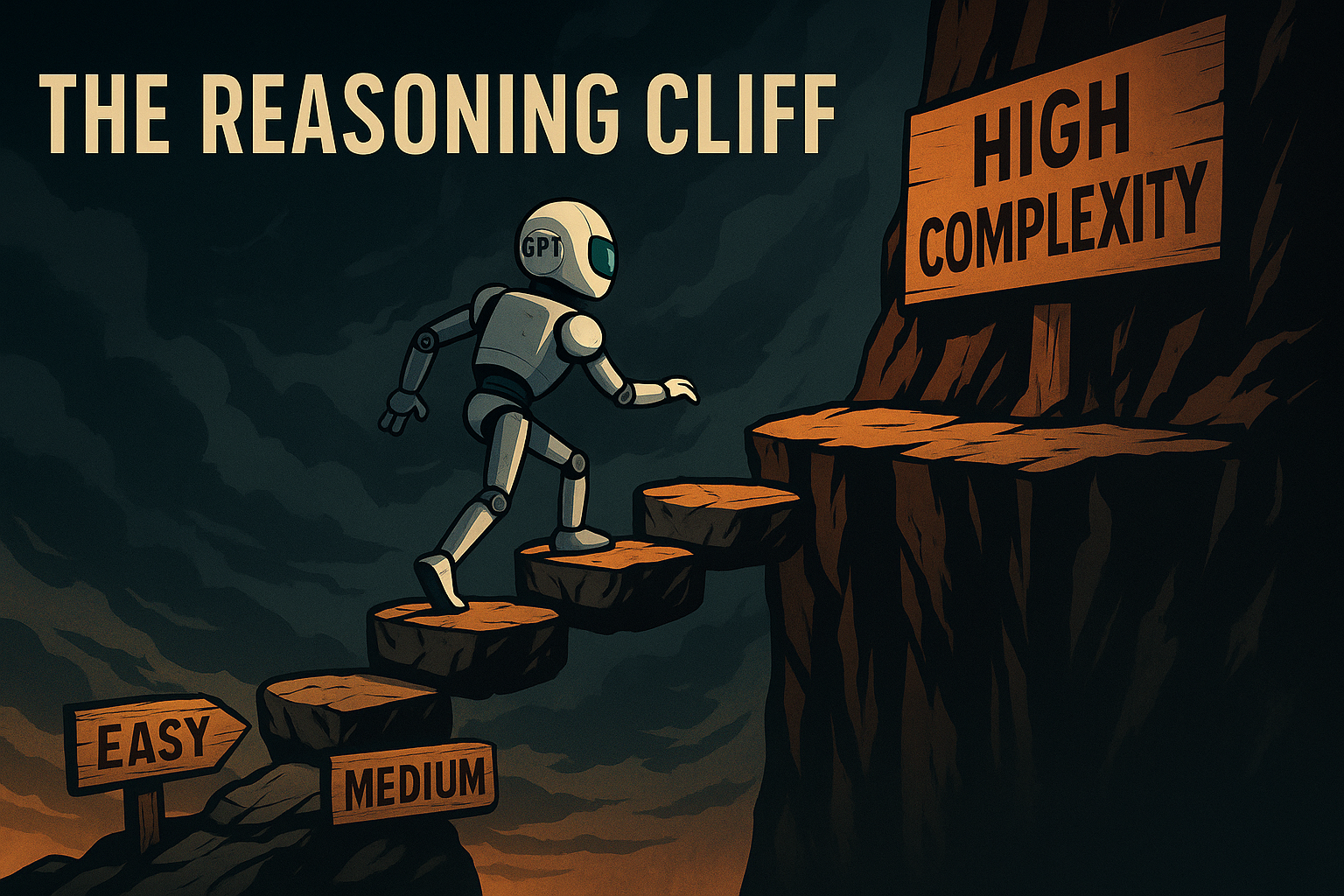
\Don’t fall off there lil buddy\