A quick strategy review from day one of Google I/O
By Nate
Published: 2025-05-21
URL: https://natesnewsletter.substack.com/p/quick-note-what-happened-at-google
So much is happening right now! Trying to bias toward quick notes this week that help you stay informed.
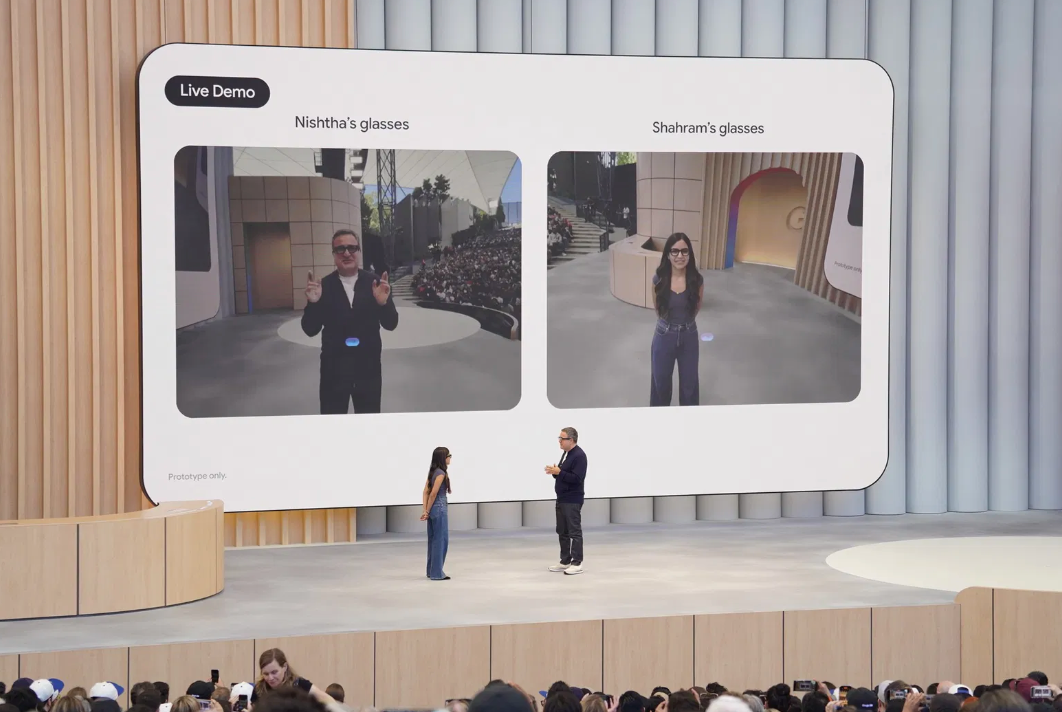
\Google does live translation now?!\
Below are the moves that will still matter a quarter (and probably a year) from now, once the demo reels fade.
1. Gemini becomes the new interface layer
Google’s “AI Mode” is rolling out to every U.S. user this week, putting a Gemini-powered conversational pane alongside classic search results. Deep-search, chart generation, and “shop inside AI Mode” features are already on the roadmap. This is the clearest sign yet that Google will defend its advertising moat by making Gemini the default way you query the web — not a separate chatbot.
2. A paid-tier business model takes shape
The new “AI Ultra” subscription ($250 / month) bundles the highest-end Gemini models, early feature access (e.g., Gemini-in-Chrome, Project Mariner agentic automation), and higher usage caps across Workspace apps. Expect Google to lean hard on this upsell, matching OpenAI, Microsoft, and Anthropic’s push toward premium AI productivity tiers. The price point for the fancy stuff is settling around $100-$250 per month.
3. Gemini everywhere
Gemini integrations all over the place:
- Chrome integration (May 21): one-click page summarization, clarification, and basic navigation.
- Gmail smart replies 2.0: context-aware, “sounds-like-you” drafts that pull facts from Drive and your inbox.
- Google Meet real-time speech translation and Search Live camera conversations extend Gemini’s multimodal reach.
Taken together, this is Google’s distribution advantage in action: flood every high-usage surface with a lightly agentic Gemini button before competitors can.
4. Reasoning depth, not just breadth
Gemini 2.5 Pro’s “Deep Think” mode (limited tester rollout) explicitly tackles multistep math and code questions by evaluating multiple hypotheses before answering. If the approach works, it could narrow the performance gap with OpenAI’s most recent models, with Claude 3.7 in Extended Thinking, and raise the floor for on-device or low-latency tasks.
5. First credible consumer XR story since Daydream
Google and Xreal’s Project Aura smart-glasses prototype runs the new Android XR platform with Gemini built in, while Samsung, Gentle Monster, and Warby Parker line up as partners. Google is finally seeding an ecosystem rather than a lone halo device, mirroring its early Android playbook. Zuck should be worried, and so should Tim.
6. Generative media tools graduate past gimmicks
- Imagen 4 (better text rendering, multi-aspect exports) and Veo 3 (video+audio generation, camera controls).
- Flow, a lightweight AI filmmaking app that chains Veo / Imagen clips into scenes.
These moves position Google as the “pro-am” creative suite alternative to Runway and OpenAI’s Sora — important for keeping creators in-house.
7. Early steps toward true agents
Project Astra now decides when to speak or act based on real-time camera input, and Project Mariner (inside the Ultra plan) can execute up to ten chained tasks. The capabilities are still gated to trusted testers, but they confirm Google is pursuing fully proactive agents rather than stopping at copilot-style assistants.
Why these points matter more than the rest
Google’s story at I/O 2025 isn’t just a new model play. It’s distribution economics:
- Lock in attention by embedding Gemini at the top of every daily workflow (Search, Chrome, Gmail, Meet).
- Monetize AI directly with an Ultra tier, hedging against ad cannibalization as conversational interfaces cut page views.
- Lower switching costs for creators and developers through upgraded generative tools and agentic APIs.
- Prime the next platform (XR) before Apple or Meta can own the narrative.
Everything else — password updates, UI-generator experiments, brand renames like Starline → Beam — supports that central agenda but doesn’t move the strategic needle on its own.
For product leaders and builders, the takeaway is clear: Google is betting that distribution plus incremental agentic glue will outweigh raw model horsepower. If your product depends on search traffic, browser extensibility, or everyday productivity surfaces, assume a Gemini button will sit next to your feature — and plan differentiation accordingly.
The five questions
Yesterday I wrote about asking five strategic questions of the hype this week. Here they are, for Google I/O day one.
Where did a vendor turn optional usage into a new default?
Google flipped the switch on “AI Mode”: every U.S. Search user can now swap the classic results column for a Gemini-generated answer pane with a single click, and that preference persists across sessions. In effect, chat-style search is no longer a side door—it’s the front lobby.
What proprietary feedback loop did today’s launch unlock?
Two new funnels start feeding Google’s training pipeline immediately:
- Project Mariner watches how users navigate the web, logging each keystroke-and-click macro it executes inside Chrome.
- Project Astra gets continuous camera, screen, calendar, and Gmail context from its testers so it can decide when to speak unprompted.
Both loops generate high-value, real-world task traces that rivals can’t scrape from the public internet.
Which stubborn bottleneck is each keynote really attacking—and is the attack coherent?
Google’s bottleneck is distribution, not model quality. Funny to say it that way, since they have massive distribution already, but look at what they’re attacking! Every marquee announcement—AI Mode in Search, Gemini buttons in Chrome and Gmail, Workspace drafting, Android XR with on-device Gemini—addresses the same constraint: surface area. Even the reasoning upgrade (Deep Think inside Gemini 2.5 Pro) shows up as a feature of the Ultra subscription rather than a stand-alone product, reinforcing the “one model, everywhere you already are” story. That coherence is hard to miss. Google is betting the model in your pocket matters.
What newly possible weekend hack now threatens an incumbent line of business?
Two people in a coffee shop can now:
- Chain Veo 3 → Flow to spit out a 30-second, fully scored video spot—something that used to keep mid-tier creative agencies paid.
- Point Mariner at a SaaS dashboard and automate routine workflows without touching Selenium or RPA tools.
Both hacks lower the talent and capital floor in markets (video production, browser automation) where incumbents still price for 2019.
Which price or capacity threshold quietly flipped the strategic scoreboard?
The $249 “AI Ultra” plan bundles best-tier Gemini access, early Mariner/Astra features, and 30 TB of cloud storage—effectively setting a market ceiling for what power users will pay and daring competitors to match the capacity/perks ratio. Just as important, Deep Think reasoning now ships inside that SKU, signaling Google’s willingness to hide its most advanced compute behind a paywall rather than a bespoke API price sheet.
That’s what I got. What’s your takeaway?
For more on AI, subscribe and share!
Links:
https://blog.google/technology/ai/io-2025-keynote/
https://www.theverge.com/google/670224/google-io-2025-live-blog-gemini