Why are all of these keynotes in the same week? What can we learn from them and what are the right strategic questions to be asking so we don't get swept away by the hype on stage?
By Nate
Published: 2025-05-20
URL: https://natesnewsletter.substack.com/p/this-is-ai-super-week-heres-whats
Like seriously the hype is going to be nuts this week.
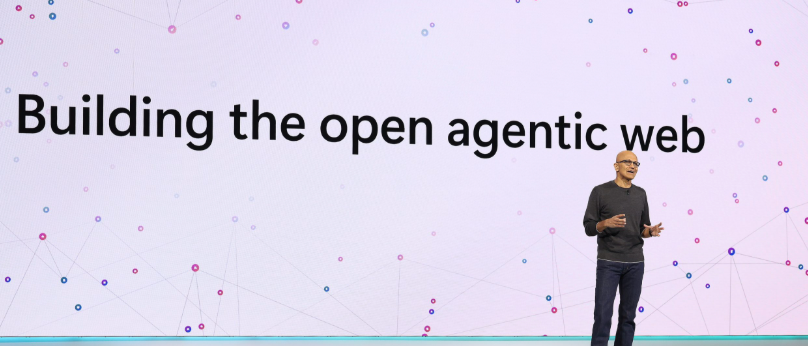
\LOTS of slides like this are coming\
Like I don’t know exactly what this means but cool cool, great job Satya. I am listening. If there was a budget for hype slides it would be blown out this week. Everybody who is anybody is making sure they get the word out specifically for developers this week on AI.
And yes, there’s a specific reason for that, and it all starts back in 1983…
I am only KIND OF kidding about that btw. These kinds of events have a tremendous calendar gravity that is very interesting to study on its own, even leaving aside all the cool AI stuff. Which we will not do because this is an AI substack lol
So read on for the full deets on the absolutely bonkers week from nearly all the major model makers, including what to watch for and the questions to ask to read under the hype cycle.
Subscribers get all these posts!
How we got to a nice May week for all this stuff…
So this really did start in 1983, when Apple did the first WWDC. We won’t belabor the entire history of WWDC, which is probably an entire book on its own. Suffice to say that because Apple has slotted WWDC in the first week of June in SF (for the weather) for ages, major companies had to pick another nice weather week nearby in the SF calendar for their own events.
Major companies such as…Google. Which has been doing Google I/O on this week in May since Sundar started leading Google. And it makes sense to go ahead of Apple, because he who goes first gets to frame the debate. Which is exactly why OpenAI put their Codex release on Friday last week. They wanted to pre-frame the week (or pre-game if you will). So everyone who releases this week has to be compared to Codex in the inevitable journo writeups, and they get lots of free press.
Well historically Google wanted the exact same thing vs. Apple when Google vs. Apple was about Android vs. iPhone. Now these days, Apple has been an also-ran on AI for a bit now, and so Google I/O has become less important for Android per se and more important for the AI game.
Which is why all the other model makers decided to crowd onto this week to get their word in edgewise. Microsoft wants something this week. Anthropic, ditto. AWS is settling for hosting a watch party because they have their own massive conference even earlier in the deal cycle.
And deal cycle is a key word here, because if you go later than June, you run into earnings calls, and you fall afoul of enterprise budgets for the FY2026 year, which are set in the middle of 2025. So as weird as it seems, this week is sort of the last change these big players have to catch major enterprise attention before 2026 budgets get locked…
AI Super-Week 2025 — master calendar (Pacific Time)
Monday · May 19
- 9 AM – noon · Microsoft Build opening keynote (Satya Nadella) and first-look demos of Windows AI Foundry, MCP in Windows 11 24H2, GitHub Copilot autonomous agent, Azure AI Foundry.
- Afternoon / evening · Deep-dive sessions on Windows AI, model routing, and Copilot Studio orchestration (streamed on the Build site).
Tuesday · May 20
- 10 AM – noon · Google I/O keynote (Sundar Pichai). Expect Gemini 2.x across Android 16, Project Astra “task graph,” Search + Workspace updates, early XR teasers.
- 1 :30 – 3 PM · Google developer keynote (Jeanine Banks & team) covering Gemini APIs, Firebase Genkit, WebGPU, and Flutter / Chrome announcements.
- All day · Microsoft Build Day 2 technical sessions (Azure AI pipelines, .NET 9 Preview, Model Context Protocol SDK labs).
Wednesday · May 21
- Google I/O Day 2 breakout streams (Gemini coding labs, Android 16 deep dives, Search governance roundtables).
- Microsoft Build Day 3 (Scott Guthrie’s cloud keynote, Power Platform agent workshops).
Thursday · May 22
- 9 :30 – 11 :30 AM · Anthropic “Code with Claude” keynote (live-streamed from The Midway, San Francisco). Road-map for Claude 3.x/3.8 mini, open-source MCP reference SDK, “Claude Code” IDE/CLI demos.
- Remainder of the day · Hands-on Claude workshops (prompt engineering, multi-agent orchestration) + AWS Bedrock watch-party downtown.
- Microsoft Build final day closing sessions and recap.
Already dropped last week
- May 14: OpenAI rolled GPT-4.1 and 4.1 mini into ChatGPT (plus API pricing cuts).
- May 16: OpenAI previewed a Codex autonomous coding agent that spins up sand-box VMs and opens PRs.
Deeper Analysis: What Super-Week Really Signals
1. The operating-system grab
Microsoft just turned Windows into an AI launchpad. By baking the Model Context Protocol (MCP) into the 24H2 developer preview, Windows now treats any compliant agent the way it treats a printer driver: plug in, request a scoped capability, run. Consent pop-ups and a curated MCP registry make the security story tangible, not theoretical. That shifts the distribution game—a Windows installer becomes an agent installer, and Microsoft owns the default runway for local + cloud workflows.
Google must answer immediately or cede terrain. I/O leaks point to “Project Astra,” a Gemini-driven task graph that lets Android apps hand structured jobs to Gemini across Gmail, Calendar, and Maps. If that graph launches as a closed API, Google keeps tight control but risks repeating the “Assistant versus Alexa” stalemate; if it’s open, the protocol war gets interesting.
Anthropic’s Thursday keynote is smaller but pointed: it promises an open-source MCP reference SDK that shows Claude requesting and validating scopes step-by-step. If that code drops as advertised, Anthropic positions itself as the neutral glue that can speak both Microsoft’s and Google’s dialects—insurance for developers wary of vendor lock-in.
2. Protocols are leverage; demos are garnish
Build’s fashion-show of Copilot features matters less than the underlying handshake rules. Once a user grants an MCP token, every tool that respects that standard can ride along without re-prompting. That is exactly how Microsoft captured enterprise identity with Active Directory two decades ago. Google will try to lace the same dynamic into Android 16; watch whether third-party devs can embed Gemini tasks without begging for blanket Drive or Location access.
3. Economics are being rewritten in real time
OpenAI’s surprise GPT-4.1 mini cut input costs to roughly $0.80 per million tokens—less than a third of Claude Sonnet’s current rate. If Google undercuts that with a new Gemini tier (it almost certainly will), or Anthropic unveils a cheaper “Claude 3.8 mini” or similar, every product running summarization, coding, or retrieval at scale will have to rerun its margin math by Friday afternoon. The first vendor to combine a low price with a permissive protocol will set the floor for everyone else.
4. The hidden constraint: silicon
Every grand vision still lives or dies on GPU allocations. Nadella name-dropped GB200 clusters and flagged Windows AI Foundry as “local-model ready” because Microsoft has lined up supply from AMD, Intel, Nvidia, and Qualcomm. Nadella keeps leaning on his cloud buying chops as a way of signaling he can actually serve models at scale. Jensen (who also gave a big speech this week) is no doubt happy headed into earnings May 28. If Google and Anthropic don’t flash comparable numbers—or announce fixed-price reserved compute—expect wait-lists and throttling to linger. Remember: protocols without hardware are traffic laws without roads, and where you gonna drive? This isn’t James Bond.
6. Strategic synthesis
This week is not just a series of launches; it’s a referendum on who will own the agent runtime layer for the next decade. Microsoft is betting on an open standard embedded in the dominant desktop OS. Google believes ambient mobile intelligence plus cross-app reach can keep Android at the center. Anthropic wants to be the Switzerland that speaks every dialect and sells trust. OpenAI, by dropping cheaper models ahead of the conference rush, is trying to make every keynote feel like a response to its pricing curve and model intelligence (Codex). Watch how these threads converge: the winner will probably be the company that marries an open (or at least developer-friendly) protocol with a cost profile that makes large-scale agent use economical.
That lens—protocol leverage, real cost, governance credibility, and hardware reality—will keep you anchored when the demo fog rolls in.
Five high-altitude questions to keep on your notepad during Super-Week
- Where did a vendor turn optional usage into a new default? When Microsoft bakes Model Context Protocol into Windows or Google folds Gemini straight into Android system services, they’re not just rolling out features—they’re changing what happens automatically. Ask which announcement, if widely adopted, rewrites user behavior without further friction. Default status is the ultimate moat.
- What proprietary feedback loop did today’s launch unlock? A slick demo matters less than the steady stream of user data, domain context, or tool-usage telemetry it generates. Identify whose new agent, SDK, or cloud tie-in will pour the most valuable data back into its creator’s training pipeline. Feedback loops, not one-time launches, determine compounding advantage.
- Which stubborn bottleneck is each keynote really attacking—and is the attack coherent? Strip away the showmanship and name the single constraint a company is trying to smash (distribution, safety trust, mobile context fragmentation, GPU scarcity). Then test whether every major element of the keynote reinforces that aim or drifts into grab-bag territory. Coherence signals durable strategy; scattershot signals opportunism.
- What newly possible weekend hack now threatens an incumbent line of business? Pricing drops and open protocols don’t just trim costs—they lower the barrier for two smart people in a coffee shop to build something that used to require a team and a Series A. Note the first “aha” idea that pops into your head when you hear a model price or SDK availability; that’s exactly where a disruptive startup will appear.
- Which price or capacity threshold quietly flipped the strategic scoreboard? A token price falling below your current cost to serve, or a public guarantee of Blackwell-class GPU capacity, is more than a footnote—it can invalidate existing plans overnight. Mark any slide that moves a hard number (cost, latency, context size, reserved compute) past a line that once felt safe. Those threshold moments are where strong strategies pivot fast.
Don’t count your chickens until the end of the week
AI Super-Week isn’t just a calendar oddity; it’s the moment the platforms wars come out in the open. Microsoft grabbed for distribution by wiring MCP into Windows. Google will likely double down on mobile context with Gemini-everywhere and flash some headset stuff to take a shot at Meta. Anthropic will try to make trust and neutrality the killer feature, plus hint at more intelligence on the near-term roadmap (they will have some juice stuff for indie devs to play with right away). OpenAI will sit back and watch everyone get compared to them all week.
Just keep in mind: defaults, feedback loops, bottlenecks, weekend-hack opportunities, and threshold flips. That’s the shorthand for the week.
- Defaults tell you where users will drift without thinking.
- Feedback loops reveal who will compound fastest.
- Bottlenecks show which bets are grounded in real constraint-breaking.
- Weekend hacks foreshadow the startups incumbents will soon pretend to ignore.
- Threshold flips warn you when yesterday’s safe assumptions just expired.
Spend some time on Friday answering those five questions in plain English. Anything that lights up across the board is worth paying attention to as part of your roadmap or investment thesis.
I’ll be keeping an eye on things through the week and bringing some perspective here too. Get out the popcorn and have fun!
For more on AI, subscribe and share!
\the hype people\