I realized we have no real record of where AI is delivering innovation—not PR hype but real innovation where AI is extending our horizon of knowledge as a species—so I made one!
By Nate
Published: 2025-05-18
URL: https://natesnewsletter.substack.com/p/sunday-edition-yes-true-innovation
So the New York Times decided to spend Friday getting me vaguely riled up and that motivated me in a positive way to start reflecting on the fact that the innovation side of the AI story isn’t told very well.
Like honestly most of what passes for innovation news is viewed through self-serving press releases from big companies, and everyone claims everything is innovative, so what actually is?
Are there examples where we can reasonably say AI has already extended the cutting edge for humans? Where our horizon of knowledge is wider because of AI already? Because if so, that’s a really big deal.
But there’s not really been a comprehensive list of those kinds of advances in one place. Until now. I made one so at least we have a record of what looked innovative to us humans in 2025. I have a feeling this space is going to accelerate fast, and I’d like to write down some of those advances so we can check back in a few months and see what’s changed.
I don’t usually do a Sunday piece, but this felt like a nice blue sky read—sit back, reflect on the possibility of AI innovating, think a bit about what that means for us and how AI innovation changes the way we think about our own species’ role in all this stuff.
I’ll give you my cheat code there—if you look a bit more carefully at the way a lot of these innovations are getting done by AI, I don’t view them as inherently human discoverable at all, and I think that presents the interesting possibility that humans and AI have fundamentally different innovation modes that may prove complimentary if we allow that.
Sunday thinking!
Subscribers get all these pieces!
Yes, AI can innovate…
On Friday the New York Times dismissed artificial general intelligence as a Silicon Valley fantasy, and I felt like I’d been personally taken behind the woodshed and shot.
I had literally just finished making the point to a colleague by email that yes, AI can be innovative. And here the Grey Lady was insisting that just couldn’t be. Along with a lot of other rather vaguely founded statements that amounted to an assessment that my entire industry was out in fantasy land.
Look, it’s fair to ask in good faith! If you’re going to make world-changing claims like machines can innovate you should be held to a high standard. Entirely fair.
But what if you meet that bar (as an industry—not me personally) and the media still doesn’t pay attention? What if the narrative that AI is somehow a fake persists?
I am normally reasonably good about ignoring splashy media takes, but in this case I think it’s actually constructive to respond. I am actively trying to respond with facts to exactly the confusion this kind of narrative produces. And it just is simpler to write it down here, for everyone to see. So let me recap, in one coherent arc, a few of the facts that undercut the idea that this whole AI thing is basically a fake. And yes, I will be putting citations further down.
First, the science: we already have AI systems that originate knowledge humans never conceived. DeepMind’s AlphaDev discovered brand-new sorting algorithms that now ship in mainstream C++ libraries. MIT’s model surfaced halicin, an antibiotic that kills drug-resistant bacteria. AlphaFold released 200 million protein structures, opening new vaccine and antibody paths. GNoME generated 380 thousand stable crystals and a lab built forty-one of them in two weeks. IBM’s battery twins compress years of cathode R&D into simulations, and NASA’s evolutionary design grows titanium mounts lighter and stronger than any engineer sketched. Those aren’t incremental tweaks; they’re proofs that modern models search vast, sparsely labeled spaces and deliver artifacts beyond human intuition.
Second, the everyday impact: AI is already paying rent in the real economy. UPS’s machine-learning route engine re-plans 55 thousand drivers’ stops each morning, saving 100 million miles and 10 million gallons of fuel every year. Microsoft’s Copilot rollouts show employees clawing back hours of drudgery each week. Multimodal systems like GPT-4o read a scribbled algebra problem through a phone camera, solve it conversationally, and switch languages mid-stream. Apple’s forthcoming Magnifier feature lets low-vision users strap an iPhone to a Mac and zoom any corner of a room. These are measurable gains, not speculative forecasts.
Do these systems have flaws? Absolutely. Bias, brittleness, insatiable data appetites—they’re real, and I call them out whenever I can. But the capacity for innovation is no longer a hypothesis; it’s an empirical fact. That’s why blanket statements like “AI can’t invent” are not just wrong, they’re actively unhelpful. They derail the conversation from questions that matter—how we verify outputs, how we source fresh training data, how workplace dynamics shift as models grow more capable.
What frustrates me most is the media’s habit of recycling outdated tropes. Every time a headline claims AI is merely remixing text, my inbox fills with reasonable people asking if the last two years of breakthroughs were smoke and mirrors. They deserve better. We can—and should—interrogate AI’s limitations, but we need to do it with current facts in hand, not with talking points from 2019.
So I’m asking for a higher-resolution conversation. Let’s debate why models advance faster in domains with provable ground truth. Let’s examine data-scarcity bottlenecks and the economics of compute. Let’s map how company culture changes when a model can draft a legal brief or design a circuit overnight. Those questions are thorny and urgent. Arguing about whether AI can create at all is yesterday’s fight—and the data has already decided it.
And yes, here’s a list that gets at some of the stories I reference above, along with even more facts…
And here are the receipts…
1. AI is inventing genuinely new things
- New algorithms — AlphaDev uncovered faster C++ sort routines now shipping in LLVM, up to 70 % faster on short sequences. (Google DeepMind)
- Novel antibiotics — Halicin was found by an MIT deep-learning screen; it kills drug-resistant pathogens in vivo and shares no scaffold with known drugs. (MIT News)
- Planet-scale protein atlas — AlphaFold has predicted 200 M+ structures, compressing centuries of wet-lab work. (Nature)
- 380 k stable materials in hours — GNoME used GNNs + DFT to expand the inorganic-crystal playbook by two orders of magnitude. (Google DeepMind)
- AI-grown spacecraft parts at NASA weigh one-third less and pass flight stress tests after a day of generative design. (NASA)
- Battery digital-twins from IBM’s April 2025 foundation model cut chemistry iteration cycles for EV cells. (IBM Research)
2. Real-world productivity & the economy
- UPS ORION dynamic routing avoids 100 M miles and 10 M gallons of fuel every year across 55 000 drivers. (productmonk.io)
- Microsoft 365 Copilot: Grant Thornton users now save 3-4 h per week on average, with >18 % saving 7.5 h. (Source)
- St Louis Fed survey (Feb 2025) finds AI users are 33 % more productive in each hour they actively use generative AI; the authors translate that to a 1.1 % aggregate-productivity bump. (HR Dive)
3. Reasoning & long-context breakthroughs
- OpenAI o3 scores 75.7 % on ARC-AGI-Pub under the public $10 k compute cap—triple GPT-4-Turbo. (ARC Prize)
- GPT-4.1 ships a 1 M-token context window; in the launch demo it parsed a 450 k-token NASA server log and flagged an anomaly. (VentureBeat)
4. Real-time multimodal perception
- GPT-4o live demo: the model saw a hand-written algebra problem via phone camera, solved it conversationally, and switched languages at human latency. (YouTube)
5. Embodied AI & robotics
- Gemini Robotics (Mar 2025) lets off-the-shelf arms fold origami, unscrew bottle-caps, and pack lunchboxes after a single live demonstration. (Google DeepMind)
6. Accessibility & social impact
- Meta Ray-Ban smart-glasses add “detailed responses” plus a Call-a-Volunteer link to 8 M Be My Eyes helpers (GAAD 2025). (The Verge)
- Apple Magnifier for Mac (announced May 13 2025) lets low-vision users pipe an iPhone camera into macOS, zoom any part of a scene, apply filters, and freeze frames—turning a Mac into a powerful visual aid. (Apple, AppleVis)
Stepping back from the catalog of breakthroughs, I’m reminded that the core question—whether today’s AI can genuinely create—remains very much alive. The evidence I’ve laid out does not end the debate; it reframes it. When reinforcement-learning agents discover faster algorithms, when a model proposes an antibiotic that defeats pan-resistant bacteria, or when a routing engine quietly saves a hundred million truck-miles, we can no longer treat innovation as a theoretical benchmark. It is already part of the texture of our scientific labs, supply chains, and assistive tools. Acknowledging that reality does not trivialize concerns about bias, brittleness, or data scarcity; it simply grounds those concerns in a world where AI-led invention is already underway.
From that starting point, the work ahead becomes both clearer and harder. If models can originate solutions we didn’t foresee, how do we validate those solutions at scale and under uncertainty? What safeguards ensure that speed does not outrun rigor, or that new capabilities reach beyond the early adopters who can most easily afford them? These are open, urgent questions, and they deserve more than a binary yes-or-no framing.
My hope is that by grounding the discussion in concrete progress—and by staying honest about the technology’s faults—we can move toward a conversation focused on stewardship: directing AI’s creative power where it is most needed, building oversight that matches the pace of discovery, and widening the circle of beneficiaries. That is a challenge worth wrestling with, and it begins by facing the facts, not the headlines.
For more on AI, subscribe and save!
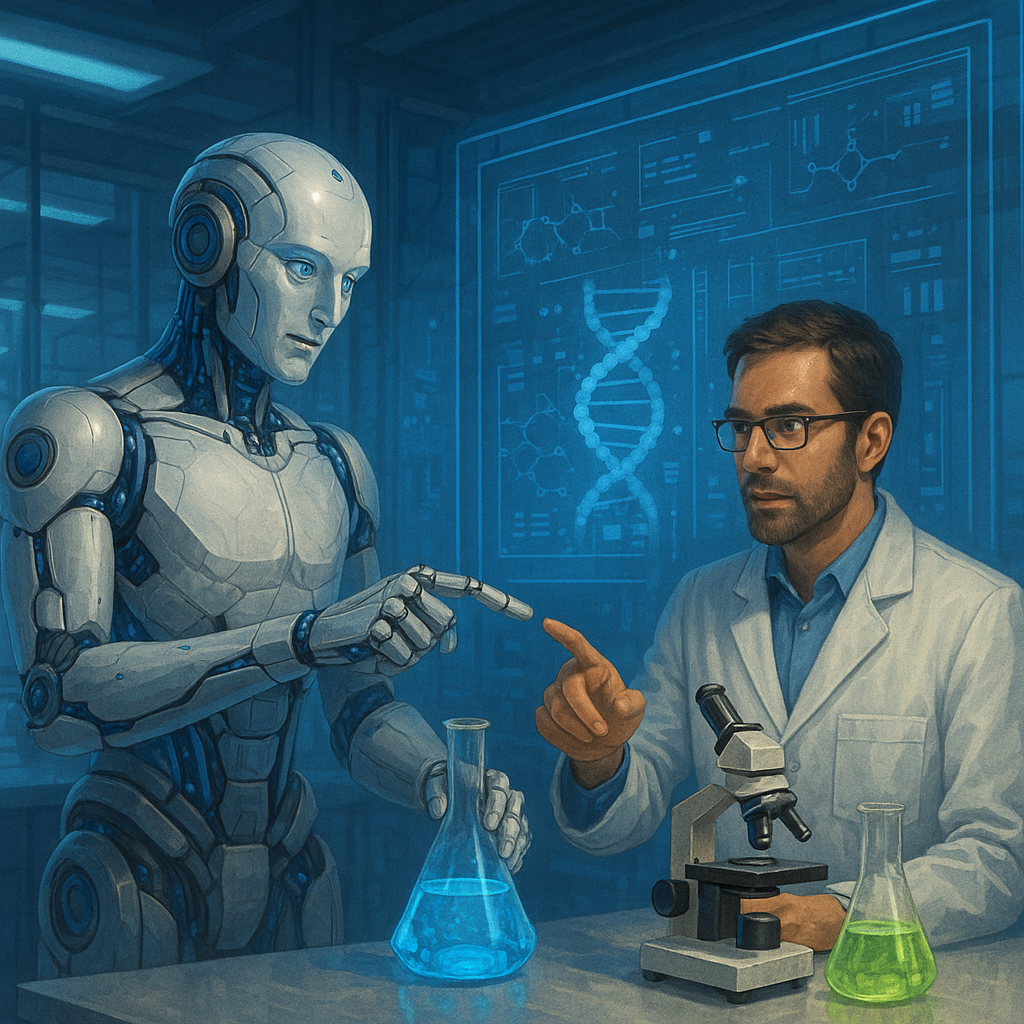
\I did not ask it to do the whole Michelangelo thing and I think it’s very interesting\