We need to stop thinking that AI is going to get better at work (or at home) if the models get better. It DOES help (a bit), but the real value comes from getting the data right (glamorous I know)
By Nate
Published: 2025-05-14
URL: https://natesnewsletter.substack.com/p/stop-waiting-for-new-ai-models-heres
Look this is just straight up a spicy take and lots of people will disagree.
Everyone wants to ooh and ahh about the latest model. The model makers themselves encourage you to think like this. Wait and the additional intelligence will fix everything!
Next month’s models will matter! o3 Pro coming out will change it! (That is probably coming this week by the way.) Great. Fine. I’m not here to say intelligence scaling doesn’t matter—if you read this Substack you know I take the search for a new everyday model very seriously.
But, my observation is that the best model in careless hands is worse than useless. Work doesn’t get done faster. Rewriting customer emails to make them 10% more professional isn’t really adding value at this point.
The value is in actually thinking about how we handle data inputs to AI, but that takes work and to be honest it’s not as popular. If we took 50% of the passion we put into the latest model and put it into getting our data inputs right we’d get twice the leverage. Or more. So yes, prompts matter (I’m working on that here). But so does your actual data! And that’s what this post is about. How can you practical use your data with AI?
I give you a real life example, and some principles to think about, and I call out where I think this highlights the need for more human judgement, not less. Enjoy!
Subscribers get all these posts!
The Narrow-Pipe Law
Feed a narrow, noise-free stream into any off-the-shelf language model and its value explodes relative to cost. That single observation has reordered how I think about “AI at work” more than every white-paper curve and benchmark combined.
I learned it the hard way on a Monday that should have been routine. Our product-planning spreadsheet—fifty rows of roadmap bets, metrics, and owner initials—had been circulating for a week. By 9:00 a.m. the doc looked like a street market after closing: colors everywhere, cells overwritten mid-formula, six comment threads arguing past each other.
While I chased conflicting revenue figures, Slack pinged with something different: an auto-generated digest of last week’s customer calls. Three paragraphs, perfectly framed, zero hallucinations, produced in less time than it took me to scroll to row twenty-seven of the spreadsheet.
The contrast slapped me awake. The spreadsheet contained every scrap of data we thought might matter; the call digest contained only the things that did. Because the input stream feeding Slack was brutally narrow—just three mandatory fields posted after each call—the summarizer spent zero energy guessing context and all its energy producing insight. My bloated Google Sheet, by comparison, asked humans to separate wheat from chaff before the model ever had a chance.
That’s what I call the Narrow-Pipe Law in action. The potency of an AI engine is limited less by its architecture than by the messiness of what you pour into it. Tighten the pipe, kill the noise, and even a commodity model behaves like a bespoke analyst. Leave the pipe wide open and the smartest system in the world will cough up hedges and half-truths.
Everything else in this essay—clean-input culture, AI-ready channels, the new shape of product leadership—flows from that realization.
From Craftspeople to Curators — Why Clean Inputs Change the Culture, Not Just the Output
If the narrow-pipe law feels mechanical, the cultural shock it triggers is anything but. The moment a model can pull crisp insight from a sliver of text, the old heroics of “owning the deck” or “perfecting the doc” stop making sense. I’ve lived through that adjustment, and I’ve noticed it rewires four long-standing reflexes:
- Signal over artifact.
A decade of PM muscle memory tells us the polished document is the deliverable. In an AI-first flow, the deliverable is a decision-ready signal—a one-sentence risk call-out, a flagged revenue anomaly, a verbatim customer quote tied to ARR. Anything bulkier is latent debt that someone (often you) will pay down later.
- Public flow instead of private work.
Half-baked drafts hidden in Drive once felt polite; now they starve the model of context and force colleagues to beg for status. When transcripts, query logs, or snapshot metrics land in an open, single-purpose stream, both humans and machines can act on them instantly.
- Perpetual pilots beat perfect plans.
When iteration costs pennies, waiting to polish a grand rollout is riskier than shipping a safe-to-fail slice today. The teams that internalise this rhythm accumulate prompt libraries, schema conventions, and trust in their feedback loops—assets late adopters can’t copy overnight.
- Humans as quality gates, not assembly lines.
Someone still owns tone, accuracy, and ethics; that person simply intervenes at the end of the pipe, not the start. My title has shifted from document author to editor of record. The work is lighter but the accountability is sharper.
None of these shifts require a new tool. They require the discipline to decide—up front—what belongs in the pipe and what stays outside. That single act of upstream craftsmanship gives every downstream model the freedom to be brilliant.
Slack Hack — Turning a Channel into a Living Dataset
Most teams treat Slack like a river of conversation; the new Summarize button skims that river and hands you a quick recap of who said what. Useful—but ordinary. (Sorry Slack I said it.)
The real leverage appears when you reverse the flow: instead of asking the model to tame messy dialogue, you feed it only the material you’d want a chief-of-staff to digest in the first place.
How it works in practice
I dedicate a private channel—say, #summaries-input—to be nothing but source material. The rule set is human, not technical:
- If the content will matter in three weeks, drop it in. Grain transcripts, raw Zoom notes, voice-memo brainstorms, decision logs, KPIs at the moment they’re declared—anything future-me will need in one scroll.
- If it’s idle chatter or off-topic context, keep it out. Jokes, “got it, thanks,” or half-formed DMs belong elsewhere. They pollute the dataset and dilute the model’s extractive power.
Slack’s model doesn’t care that these posts lack conversation threads or emoji reactions; it only sees a chronologically ordered corpus. Because the input is already decision-grade, Summarize stops emitting hedged “here’s what people discussed” blurbs and starts delivering paragraphs you can drop straight into a weekly update:
• Customer-call themes this week: pricing confusion on the mid-tier, strong interest in the new compliance dashboard, no objections about migration time.
• Two decisions logged: switch analytics vendor by Q3; freeze UI work on Settings until post-launch.
• KPI note: DAU dipped 3 % after the paywall test; attribution points to first-run friction.
That digest lands in seconds, not hours, because the model never had to wade through memes and status pings.
Why the narrow pipe multiplies value
- Zero energy on triage. The model doesn’t waste tokens guessing which sentences matter; every line is presumed signal.
- Instant institutional memory. New teammates scroll the channel, hit Summarize, and ingest a month of context in one cup of coffee.
- Compounding accuracy. Because the feed is disciplined, noise never “drifts” the model. Each additional post sharpens the corpus rather than diluting it.
Guardrails that keep the pipe clean
Curating a dataset-in-a-channel takes less policy than you’d think—just two norms you enforce relentlessly:
- Single purpose. The channel exists only to capture raw artefacts worth summarising. If a message doesn’t help future you, it never crosses the threshold.
- Lightweight policing. A nudge—“Let’s move this chat to #general”—suffices. People obey because they taste the value the first time they press Summarize.
The bigger point
Notice what changed: no new integration, no custom prompt, no special schema. All I supplied was judgment about what belongs in the pipe. Slack’s commodity model did the rest. That’s the Narrow-Pipe Law on display: tighten the stream, and even baseline AI features behave like bespoke analysts.
Up next, we’ll pull the camera back to see how this same principle scales beyond Slack—into release notes, support queues, and KPI feeds—wherever a little upstream discipline can unlock a lot of downstream intelligence.
Narrow Pipe → Large Engine
The Slack experiment isn’t a one-off trick; it exposes a general law. Modern SaaS tools already ship with a surprisingly capable language model under the hood—Slack’s Summarize, Notion’s AI blocks, Google Workspace’s “Help me write,” and dozens more.
Those engines share a weakness: they spend most of their capacity sifting through noisy, mixed-purpose text before they can even start generating insight. Give the engine a narrow, noise-free pipe and the ratio flips. Every token goes to analysis instead of triage, so the same commodity model suddenly performs like a bespoke analyst.
Why the engine is seldom the bottleneck
Most teams look for leverage in the next model upgrade—“Can we get GPT-5?”—but the real ceiling is context quality. A powerful engine fed junk will still output polite junk. Constrain the input to a single, clearly defined stream and you unlock performance gains that dwarf the difference between model tiers. In effect, a narrow pipe turns a large engine from a generalist into a specialist—without changing a line of code.
How to locate and build your next pipe
1. Identify repetitive information hotspots.
Scan your workflows for places where the same facts get rewritten or forwarded—support escalations that bounce between teams, weekly release notes scattered across GitHub comments, KPI snapshots pasted into chat. Repetition signals a hidden pipe begging to be narrowed.
2. Define the minimal “decision grade” core.
For each hotspot, ask: What is the smallest payload that would let a reasonable stakeholder act without chasing links? The answer is rarely more than three fields (for release notes: scope, user impact, rollback plan). If you find yourself needing ten, you have chosen a slice that is still too broad.
3. Carve a single inlet and label it loudly.
Create one Slack channel, one Notion database, or one Google Sheet that exists only for this payload. Pin a two-line policy—what belongs and what does not—so newcomers learn by scrolling, not by reading a wiki.
4. Police the boundary upstream, not downstream.
When someone drops a screenshot or an off-topic comment into the inlet, nudge them into a general channel. Upstream discipline costs a few seconds; downstream cleanup costs hours and erodes trust in the feed.
5. Turn on the bundled model and inspect the first output.
Activate whatever summarizer, classifier, or “AI overview” the platform provides. If the very first digest is not actionable, tighten the pipe further—shorten the payload, remove formatting noise, or split the stream into two separate channels.
6. Let improvements in the engine compound automatically.
Once the pipe is clean, every platform upgrade—better model weights, longer context windows, cheaper token pricing—drops straight to your bottom line without another integration sprint.
A narrow pipe is leverage you own outright. It costs nothing to maintain, it compounds as underlying models improve, and it converts the AI you already pay for into an always-on analyst that never asks for a larger budget.
The Human Edge — Clarity Is Cheap Once the Bots Eat the Busy-Work; Conviction Is Not
Narrow pipes give us near-perfect situational awareness for pennies, but situational awareness is only the ante. Someone still has to turn clarity into action, and no language model—bundled, fine-tuned, or otherwise—will volunteer for that job (yes I’m leaving agents out here on purpose). After watching AI strip the clerical layer out of product work, I keep running into the same three responsibilities that refuse to budge:
- Force accountability.
A model can draft an ROI table in five seconds, but a table doesn’t create alignment. Humans have to decide whether those numbers are merely “interesting” or truly “binding.” Until a living person says, “These are now the bar—ship or explain,” the metrics are scenery. Product leaders don’t earn their keep by calculating targets; they earn it by ensuring someone’s reputation (often their own) is attached to hitting them.
- Choose futures.
Even the fattest context window can’t feel brand risk, seasonality, or the political cost of delaying a partner integration. We still need humans to weigh intangible trade-offs, assign probabilities, and bet the quarter on one scenario while gracefully killing the others. Judgment migrates up the stack as clerical work vaporizes; if you can’t articulate why you prefer one plausible future over another, expect your value to track the clerical layer on its way to zero.
- Stage confrontation.
Decision latency—the endless loop of “Let’s revisit this next week”—remains the biggest tax on momentum. AI can surface options; it cannot absorb the social blast radius of committing to one. Sometimes leadership’s most useful act is to write the choice down, circulate it, and dare the room to object. That willingness to own the heat of a decision is pure human capital, and its scarcity is exactly why it commands outsized influence.
Clean inputs and large engines gift us the time and mental bandwidth to focus on these higher-order tasks. The opportunity (and the threat) is straightforward: if we spend the reclaimed hours polishing dashboards or fussing with prompt syntax, we forfeit the edge that machines still can’t touch.
Use the clarity bots provide to force accountability, choose bold futures, and stage the confrontations your organization keeps postponing. That’s where the leverage lives now, and—at least for the next few model releases—where it will stay.
It’s the data that matters!
For more on AI, subscribe and share!
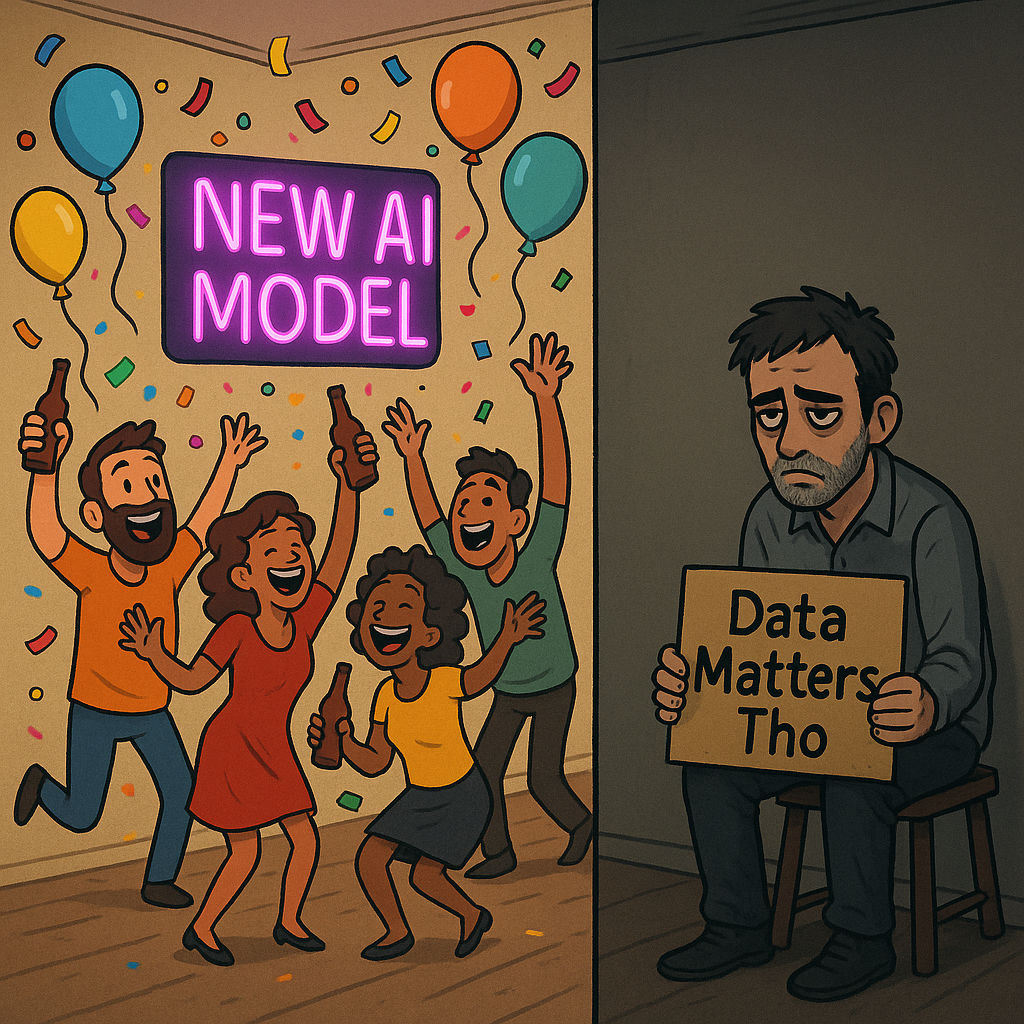
\It’s me over in the corner yo\