A personal reflection about my conversations with my mother and others in my life who don't understand what the big deal is about AI and ChatGPT.
By Nate
Published: 2025-05-12
URL: https://natesnewsletter.substack.com/p/what-i-tell-my-mom-about-ai
I wrote this in hopes that it helps you in your conversations with friends and family in your life who don’t understand AI.
One of the things I reflect on a lot in these situations is that human persuasion happens when the mind is open to possibility. When we get into a space where we’re able to open ourselves to the chance to discover a solution for ourselves.
It doesn’t happen when we say that the other person is wrong, however tempting that might be.
I know most of my writing is for what I’d call the AI-persuaded. Heck, you’re reading this because you care about AI.
But I bet you have people in your life who don’t get it. Honestly, most of the people in my life (if I just count up my circle of ~200 friends and family) probably fall into the slightly-skeptical-to-totally-don’t-get-AI camp.
And I think this technology is worth getting. It’s worth trying to get to a moment of curiosity.
So I wrote this.
Subscribers get all these pieces!
Mom,
I know it was a little weird to you when I was building computers in high school.
I know you asked me to fix the Pentium, and I know how to navigate weird TV menus you can’t seem to find. I can get the Hulu login to work. And I know why your iPhone is doing that thing where it won’t ring properly.
I know my job is a bit of a mystery. No, I don’t just write code.
In fact, that’s one of the things that’s changing. Less and less code is getting written by people I work with. At least by hand.
Yes, I know Uncle George showed you the ChatGPT answer where it didn’t know who the president currently is. (I’m not telling Mom that this is a tools access issue with the early GPT-4 instance that Uncle George had a few months ago.)
I know, how can the tool be that dumb and still write code.
But, it can Mom. It can.
Have you tried it? No? Not on your phone? You don’t want it taking your data.
Ok. And you heard it takes the water.
Ok.
And the children are going to use it for their homework.
Ok.
And they won’t learn anything.
Right. Actually, I’m careful about that one, too.
What if I told you a bit of a story, Mom? Would that be ok? Stories are how humans have connected for 200,000 years, so maybe this one will help us connect, too.
The story begins a long time ago, when we were just figuring out how to get machines to do math. Ada Lovelace. Automatic calculating machines. Machines that could do calculus. I know it wasn’t much of a history you learned, but for the nerds the idea that a machine could automatically, correctly, calculate answers was the beginning of it all.
That automated correctness is the thread we’ve been following ever since, and it’s led us to some surprising places. It’s led to ENIAC, a giant computer that filled a room where you had to fight for time and write your programs incredibly efficiently to make use of every minute on the mainframe. It led to the ENGIMA machine, and to the mathematics that helped crack the ENIGMA code and win the war for the Allies.
It led to a computer that took us to the moon in the 1960’s. By the way, Mom, did you know that the iPhone in your purse has more power than that computer? The one Neil Armstrong landed on the moon with? I found that such a cool stat when I learned about it.
Why am I tell you all this ancient stuff? I know I wasn’t alive for the moon landing and you were, but part of the story here is that we’ve been exploring in silicon while you’ve been following some of the news headlines that silicon made possible. So yes, the moon landing wouldn’t have happened without computers.
And the 401k that’s allowing you to retire this year—that was basically a computer thing, because silicon valley produced so many incredibly valuable companies based on computers during the 1980’s and 1990’s.
Remember how amazed I was when Deep Blue beat Gary Kasparov at chess? That was one of the first publicly consumable news items about artificial intelligence out there, but we in the computing community had been working on AI for a long time.
Not AI you can talk with. That’s more recent. But AI that programs itself, to some extend. That reaches its own conclusions independently. Where we don’t exactly know what will come out.
I worked on that a lot at Amazon, Mom. AI that would help make movie recommendations happen. AI that would help pick the right image for the movie. Or that would predict which item would go in which warehouse at Amazon. Even then I remember you telling me that was all too complicated and you didn’t know about that stuff.
Here’s what’s cool about it: it’s actually really easy to illustrate the concept even if we have to have fancy engineers to build the system. Yes, really.
Imagine for a second that you have a bowling ball. We’ve gone bowling together. You know how bad I am at it. Well, let’s imagine that the bowling ball is going to get rolled, not down a bowling alley that’s nice and straight, but into a mysterious dark room with many valleys and peaks.
The bowling ball’s job is to find the very lowest valley in the room.
That’s it. That’s how AI works Mom! It is a function to find probability across a diverse mathematical landscape. We can visualize that space as a map of peaks and valleys. And it turns out machines are very good at optimizing for a max probability in that space. Here’s what it looks like:
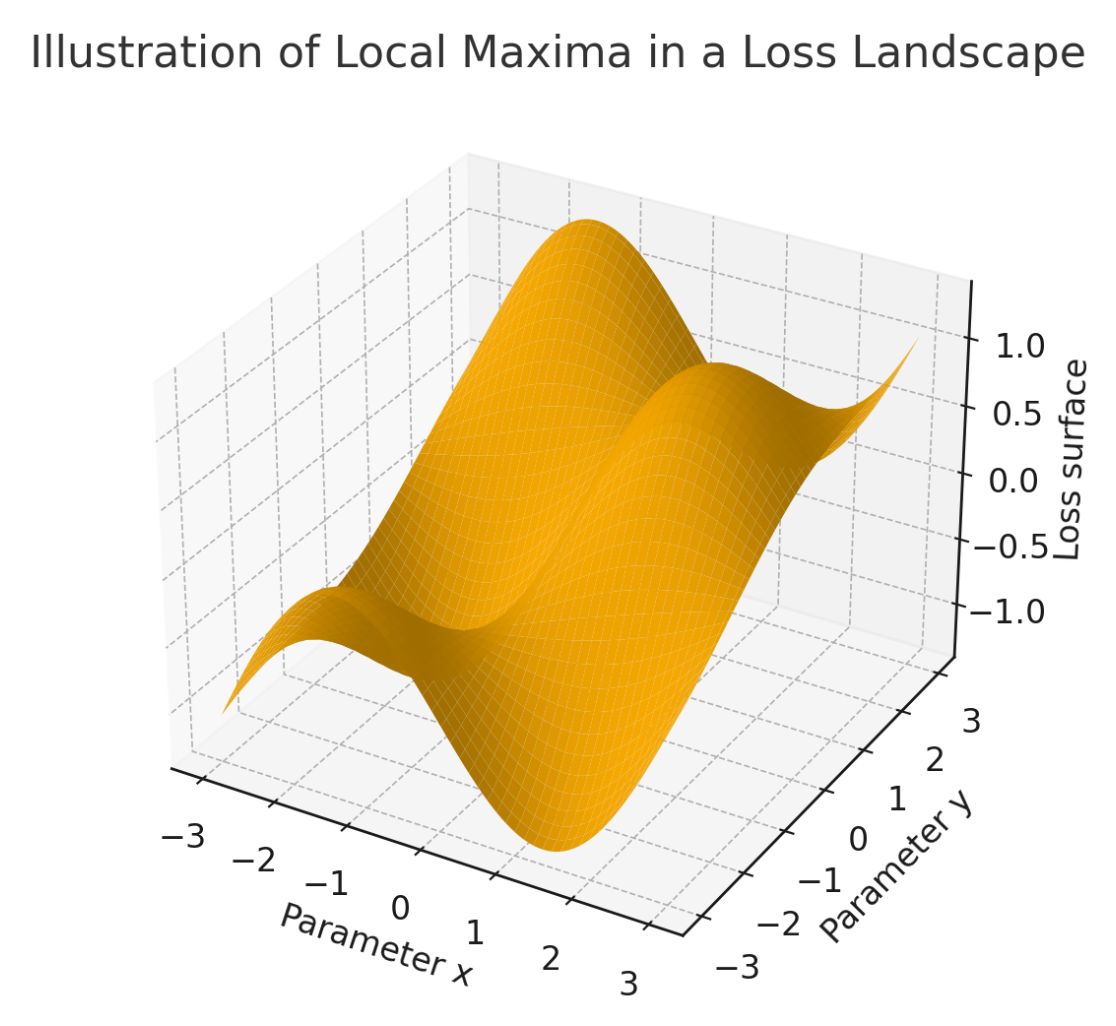
I can see your eyes glazing over, so I’ll remind you this is the bowling ball finding the lowest valley in our imaginary room again. Just let that bowling ball roll around a bit. A lot of our jobs in tech now involve preparing these landscapes, framing these problems, figuring out what kind of problem it is, what metaphorical bowling ball works in this situation. And then how to package up the result we find in a way that’s useful.
And that’s a bit of where the energy piece comes in. As you can imagine, it takes the computer a fair bit of time to sort of roll the bowling ball through the whole landscape and find the optimal point. It takes energy.
And I know it’s tempting to think it’s a waste. Like, why can’t I just have a team that hand-picks those movie images? What about jobs for designers? Isn’t it good enough to just have the items in a warehouse and ship them? Why does it have to be the optimal warehouse?
Well, Mom, you taught me that working hard really matters. And one of the things I’ve discovered by working hard is that correctness really matters at most things in life, and it doesn’t come easy.
In this case, that shows up in a couple ways. First, it turns out getting the answer exactly right (getting the bowling ball to the true maximum in the distribution) yields a way better answer than just a mostly right human guess. And that makes a difference we can measure in human experience. Like, people disproportionately choose to watch movies they prefer when we get the title image exactly right, because it makes the choice easier for them. And sure, that one seems frivolous. But getting that gift for Mother’s Day? That was possible overnight because of these AI algorithms too.
And what’s interesting about correctness is that it’s often so correct we can measure real savings vs. just our guess solution before. So for instance, getting your Mother’s Day closer to you made it possible to ship overnight efficiently, but that also meant fewer carbon emissions. Now multiple that times ten million orders.
Sure, none of this is the AI you can talk with. I’m coming to that part.
It turns out that the same bowling ball thing works for human language, too. We just had to have a computer and data set big enough to do it. And we had to figure out the exact method that would work to help the computer learn language. It’s called the Transformer, and I know it’s not the movie. It’s basically a special method we’ve invented of teaching a computer language space. Any language in the world, as long as we have a lot of it. It works by chopping up a sentence into little bits, and learning extensively about how humans fit those bits together, and then reproducing human-like sentences that match those underlying patterns we use when we talk and write.
And you know how it does that? With that same sort of bowling ball idea. It picks the most probable next token (or word bit) out of a gigantic probability landscape. And does that over and over again. And I wouldn’t think it would work either, but it turns out human language has such recognizable patterns that it really does.
And so when Uncle George asks it about the current president, it is just going through and trying to find the correct word bit to put down, piece by piece, until it gives him a sentence back. And if it’s the wrong sentence, frankly the fact that it’s a sentence is still kind of a miracle. And now these days we’ve given those tools internet access, so they can get the right answer to the president question just about every time.
And you know what’s cool? It turns out most of our civilization was built on language after all. So this one tiny part of AI has become suddenly the most important thing in the world. Because language is the key to just about everything. Language is how we think. Language is how we communicate. Language is how we decide. All that stuff is now accessible to computers, because they speak our language too.
I know, it’s scary. And yes, it does take a lot of energy. But I’ll let you in on a secret: humans are not particularly cheap to run either. Yes, that’s a very nerdy thing to say. But I want you to imagine something with me for a second. This is based on a real story from my office. Let’s say one of my colleagues figured out how to get the AI (Deep Research, for those nerds reading along) to do three months’ worth of work for him on a complicated pricing problem.
Yes, Mom, we have pricing problems that are that complicated. In this case it was a multi-hundred million dollar problem around moving to a multi-cloud computing footprint, and I think it’s probably easiest to leave the details out on that. The point was it was a really really complicated problem, and ChatGPT helped him to save three months of work on a six month problem.
How much energy would three months of work have cost? Like, what if we asked ourselves how much energy all those breakfasts and workouts and lunches and dinners and all the stuff that we consume to be human for three months cost? Because that AI got it done in 30 minutes. Or two hundredths of 1 percent of the time it would have taken the human.
So yes, AI can take energy. But it’s incredibly efficient at what it does. And humans have always consumed energy to be prosperous. A lot of our history as a species is a history of figuring out how to convert energy into prosperity (Mom, I might get you Vaclav Smil for your birthday.)
And yes, Mom, he still has a job. And yes, you could argue his living is a sunk cost. But you could argue the AI getting set up is a sunk cost too, right? These things need to cut both ways.
The point is we’ve come a pretty long way from ENIAC. The computers can now talk to us in our language. Which means they can think like us (although weirdly not, in certain ways). They can help us make decisions. They can help us reason.
And whatever Uncle George says, it’s a really big deal Mom. Your grandkids are going to have their whole lives shaped by how their interact with this AI. It’s my job as Dad to teach them a healthy way to interact with it. But even if you don’t choose to use it or put it on your phone, I wanted you to know about it, because it’s going to shape their whole world.
Yes Mom, it’s probably bigger than the internet. With the internet, we figured out how billions of us could interact in one big messy complicated space. And that idea generated countless new relationships, endless conversation, new modes of language, lots of very bad choices, and most of the world’s most valuable companies. It was one idea that had lots of unforeseen consequences: positive and negative.
Now, let’s imagine it’s 1995 again. That’s where we are with AI.
It’s all still ahead of us, Mom. I’m still the nerdy little kid at heart, listening for that that internet connection ping that meant I was online and could use Netscape Navigator. Except now it’s AI, and I’m learning how to think with a piece of silicon that is (itself) learning to think.
And that’s kind of why this is bigger than the internet. Before it was all of our human brains getting linked by wire. Now it’s that we’ve taught silicon chips how to (more or less) think and speak, and suddenly it’s not just human brains anymore. It’s like all of us have 100x the brains in our pocket, and those brains are getting better all the time.
Yep, there’s a lot of people saying this will end in disaster for us. I know, that Mom. But I gotta say, this feels less risky to me than literally making atomic bombs and hoping we all don’t misuse them as a species. At least with ChatGPT we know there are lots of really positive uses for it right now. And the evidence we have so far suggests that the intelligence of the machine is frankly more consistently ethical than most of us humans.
Is it taking all the jobs? Well, no. That’s a really common misconception though.
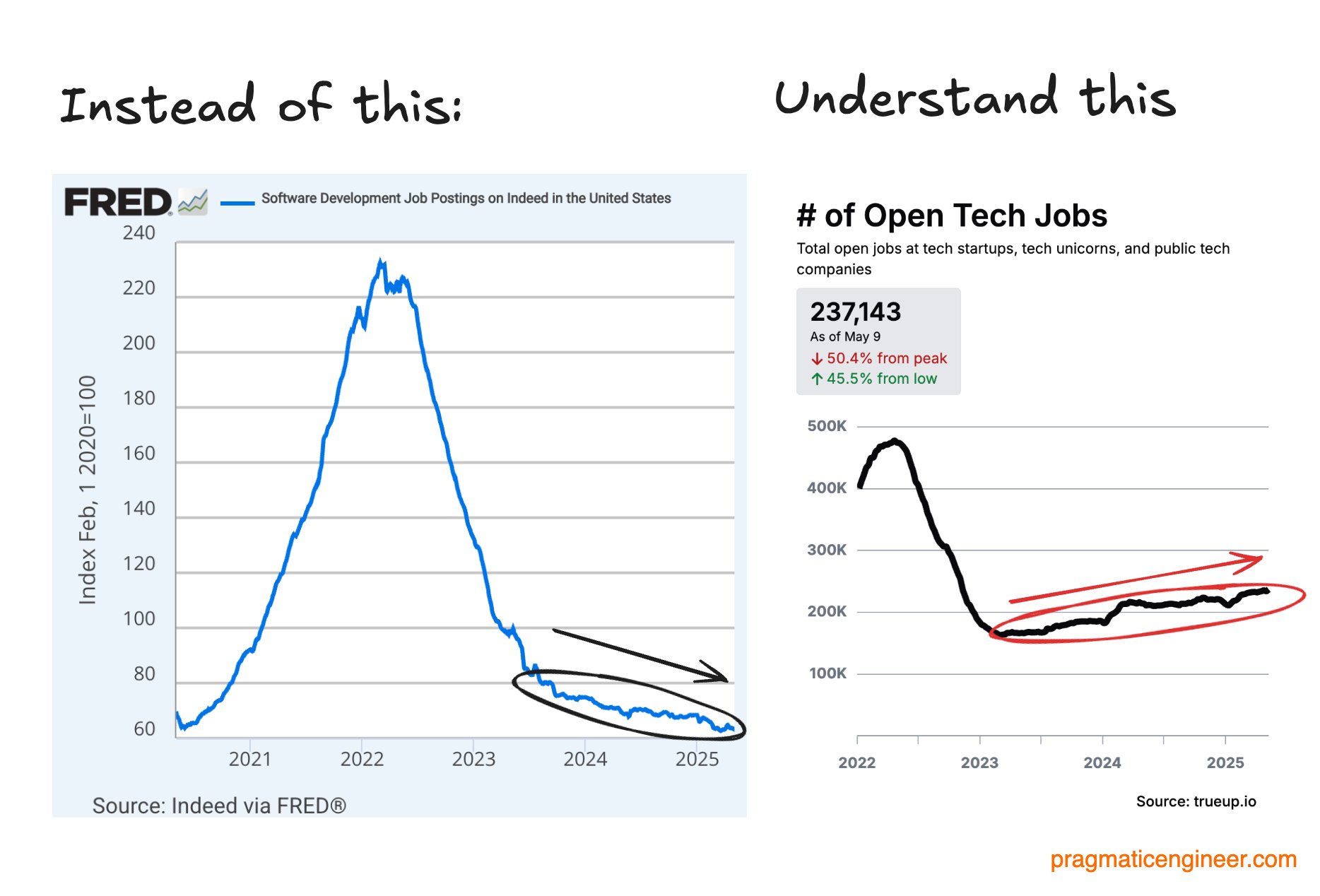
\Work done by Gergely Oroszhere\
We definitely had a bubble burst in my industry when interest raise rose in 2022. You remember I lost my job, Mom. A lot of us did. Well, that had nothing to do with AI, but a lot of people are confused about that.
And it’s certainly true that CEOs are insisting that people in my industry learn and use AI all the time. That’s part of why I mentioned your grandkids will be expected to just know this stuff. And people who don’t use AI are probably going to regret that choice, since they won’t be as competitive. That’s a study by the St. Louis branch of the Federal Reserve I linked there, and it calls out that workers who use AI tend to be ~33% more productive.
As someone who uses AI all the time, Mom, I’d say that under-estimates the impact. I’m probably 2-3x more effective now than I was before ChatGPT. And the thing is, that multiple keeps growing. Adding this new o3 model by itself probably gave me another multiple.
So that’s why I yak on and on about AI, Mom! We’ve taught the rocks to think, they’re getting smarter faster, and it is changing absolutely everything. You might think it’s only about tech, but we all need medicine, and this kind of AI is changing medicine really fast. In fact, AI designed synthetic DNA just this week, and scientists are already working out ways to use it for disease prevention and cure. There’s going to be AI-designed drugs on our shelves in the next year or two, and we’ll all be better off for it. AI can drive cars now, and if we let AI drive cars everywhere in America we’d save something like 40k lives a year.
And we’re just getting started. I know Uncle George thinks AI is a mentally defective parrot. But there’s a lot of evidence to show that innovative ideas have a sharp exponential curve tied (roughly) to IQ. Right now, the AI in my pocket is a really smart grad student in a lot of ways, and Einstein in a few ways (like image recognition).
But in the next year or two we’re going to cross over into super human IQ, and the number of novel ideas from AI is likely to skyrocket. This is related to Lotka’s Law, which predicts the publication by author in a given field. Essentially, the really really smart authors in a field publish way way more novel and interesting papers than everyone else. And there’s no reason to suspect AI will work any differently.An
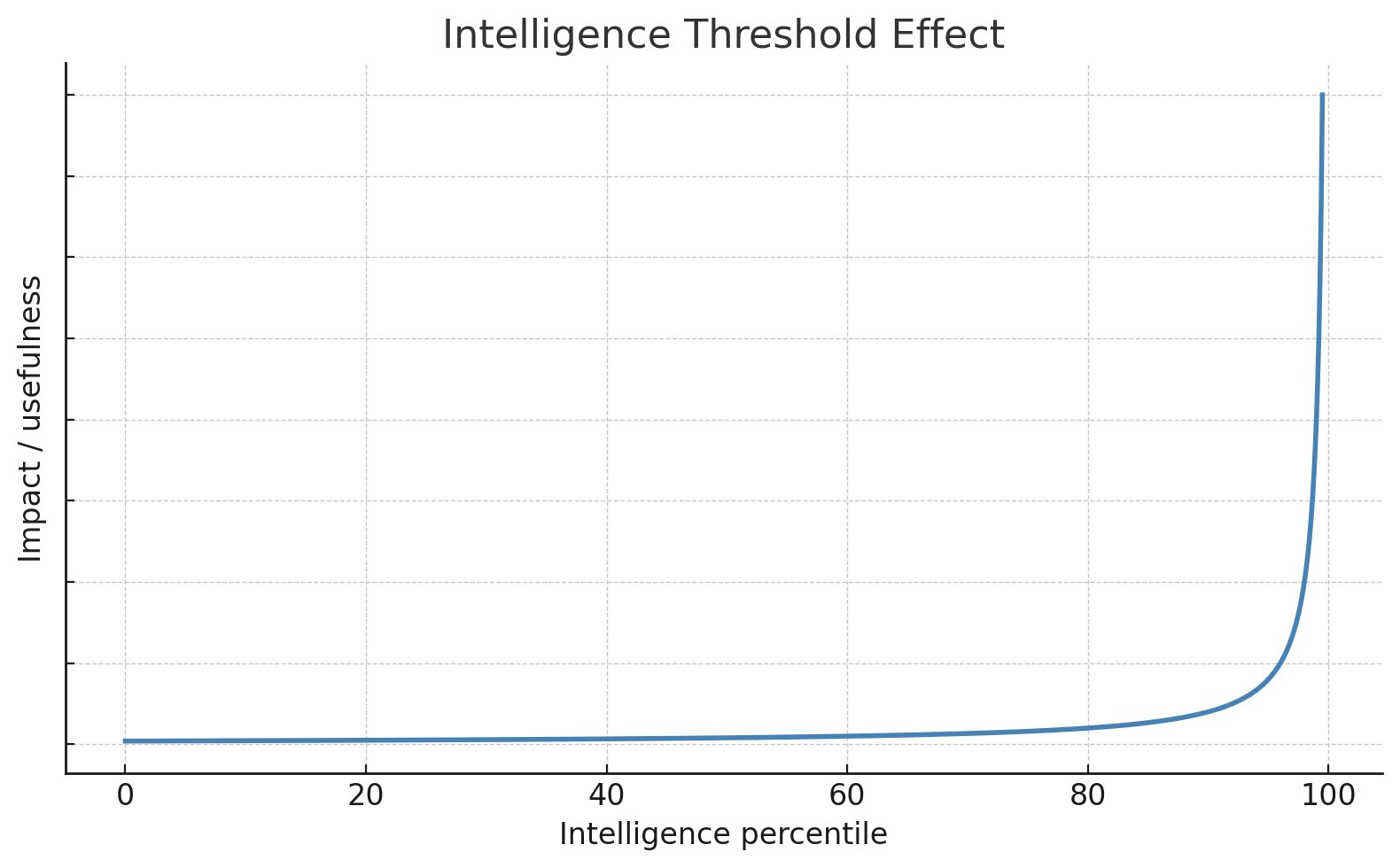
And Mom, we’re going to hit that vertical part of the curve in the next 12-18 months. We’re already at the bendy part. We see novel stuff.
I know. It’s hard to keep track. Uncle George was using an old version of ChatGPT, and most people have a hard time tracking how fast these things are getting smarter. Yes, it can feel a bit scary. I think the unknown is often that way, right? I try and stay brave for the kids. This is really going to be their adventure, and I want them to know that Dad sent them off with bright hearts and clear minds.
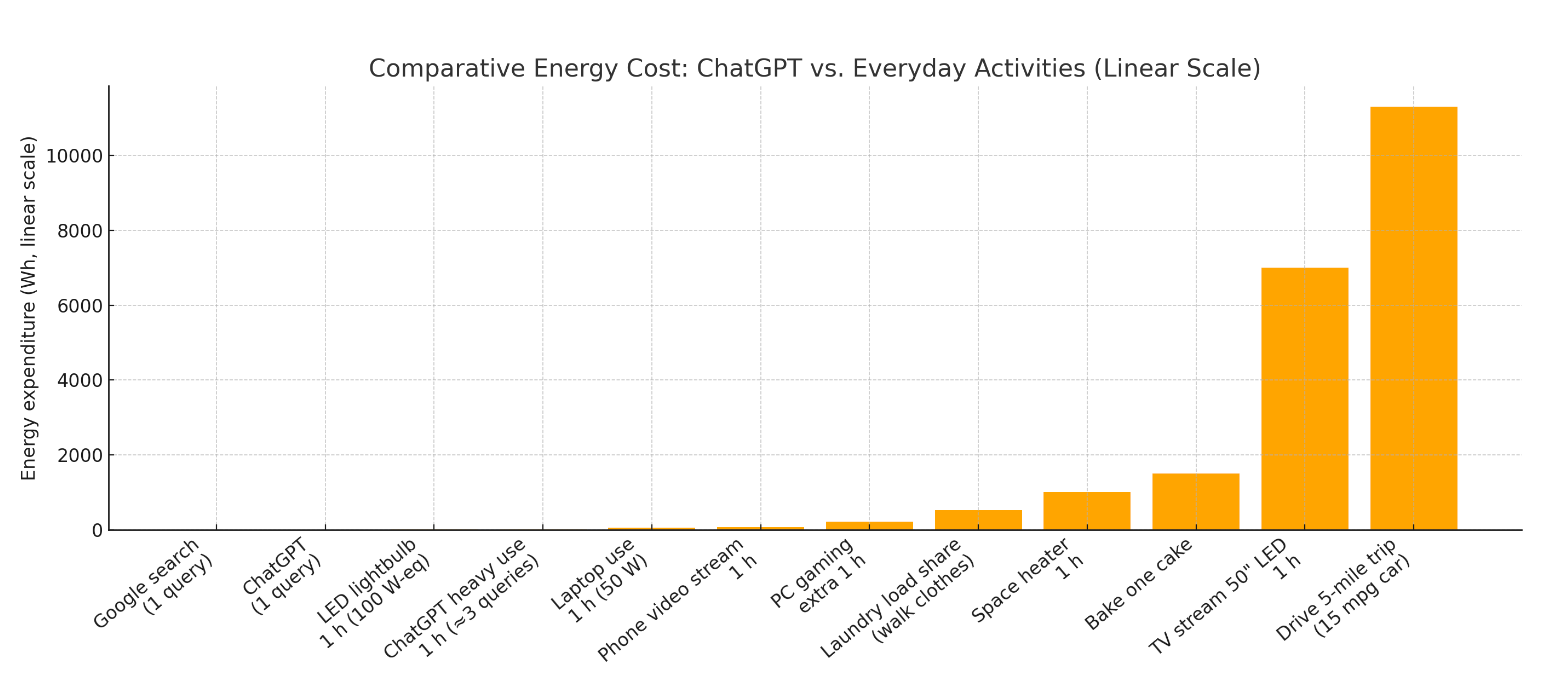
And finally, Mom, about that water thing: most people who think ChatGPT sucks up a lot of energy and water are picking only pieces of the story they want to tell. Did you take a hot shower this morning? That consumes thousands of times more energy than a ChatGPT query. An hour of streaming Netflix is worth hundreds of ChatGPT queries in terms of energy (you can read more on that here). Even “heavy” GPT use (≈3 queries an hour, which is way more than you or Uncle George uses) draws ~4× less power than an hour of video on a phone, ~14× less than a mid-range gaming PC’s extra graphics load, and ~450× less than streaming on a big-screen TV (here).
Look, the ChatGPT energy consumption on this chart is so small you can’t even see it compared to everyday activities.
Yep, it’s so tiny it’s nearly impossible to see, so I made it more visible on this log scale chart. Remember, this is the exact same information, but each scale bar is 10x the previous one so you can see tiny numbers better.
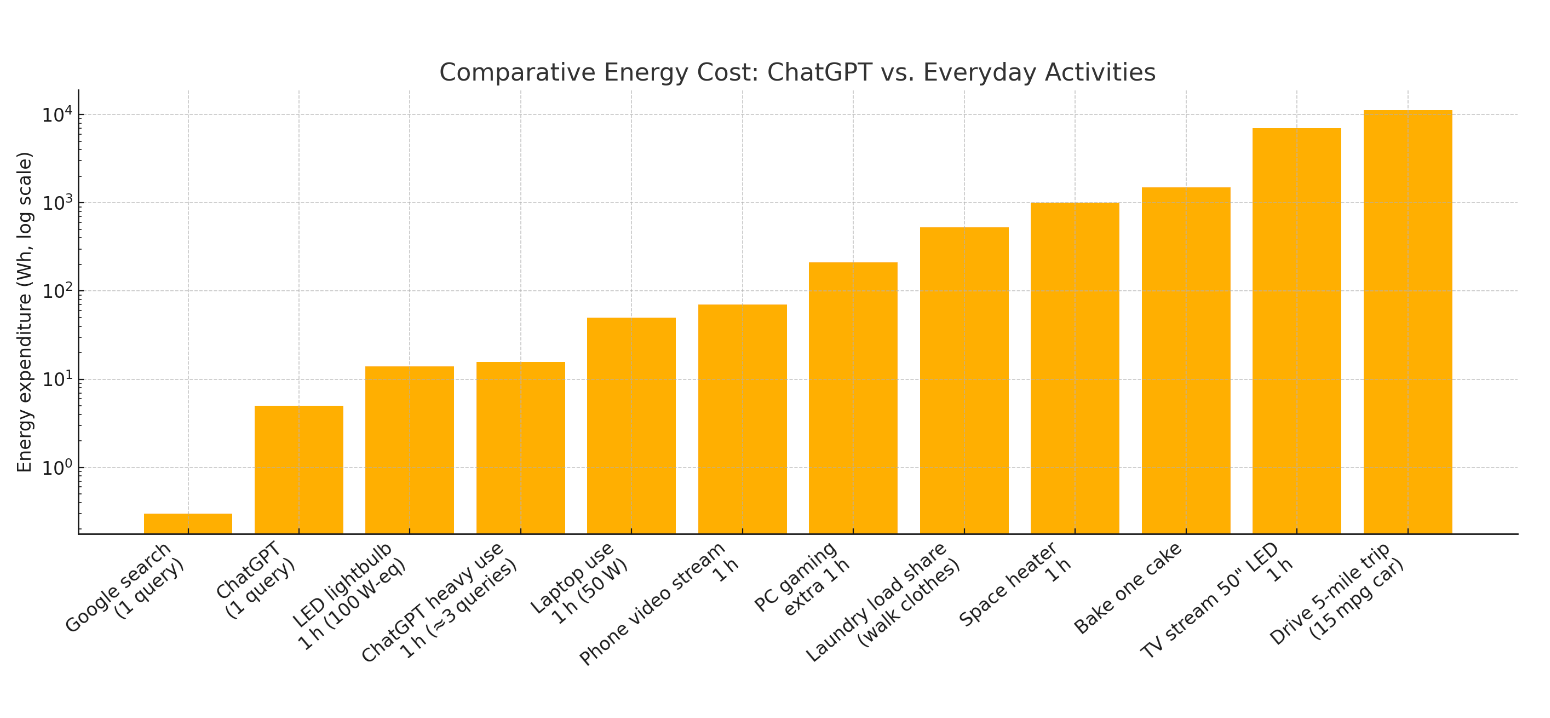
By the way, this is a good reminder to always look at the Y axis on a graph! If you didn’t understand this was a log chart, this one would easily make you think that ChatGPT was comparable to something like the energy needed to bake a cake or to Dad watching an hour of NFL on the big screen. It’s not.
And as for water: the problem is not AI per se. It’s actually that we run a lot of computers now in very large data centers that get very hot. And water is really good at cooling stuff. So we need to cool those data centers and water is an efficient way to do that (more efficient than forced air). And yes, ChatGPT is causing us to build more data centers, so in that sense there’s water use involved. And we have to be really careful with that water, because it has to be really clean to run through the servers (like the diagram below) and not corrode them:
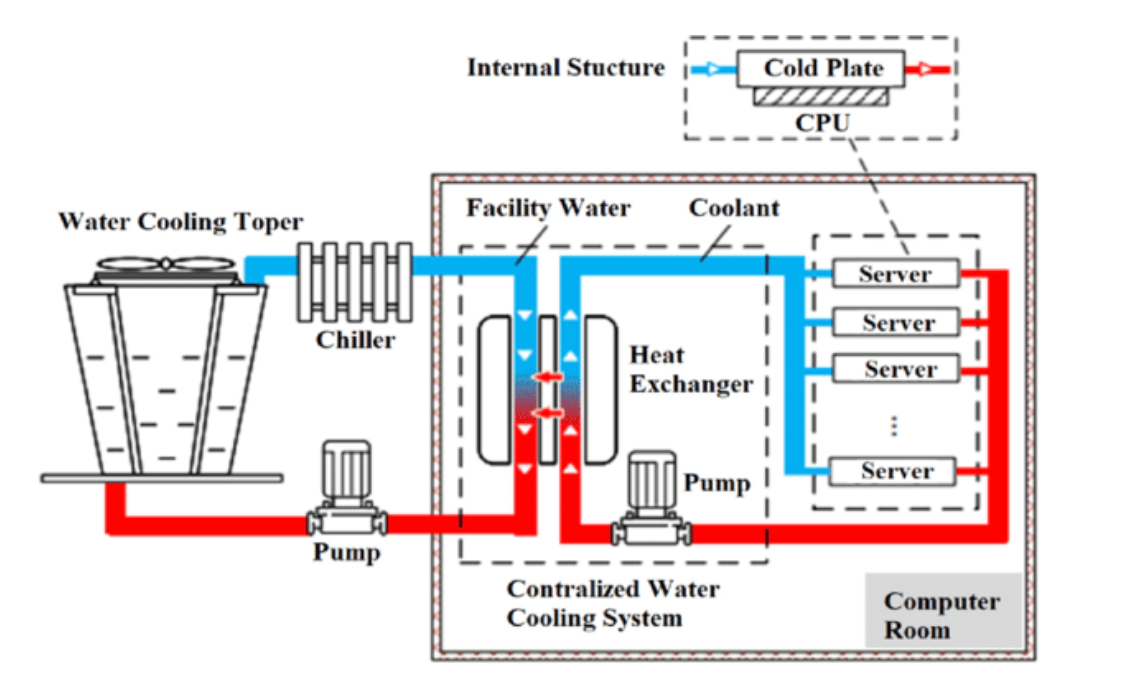
\Diagram fromhere\
So you might think it makes sense to worry! All that clean water has to come from somewhere, right?
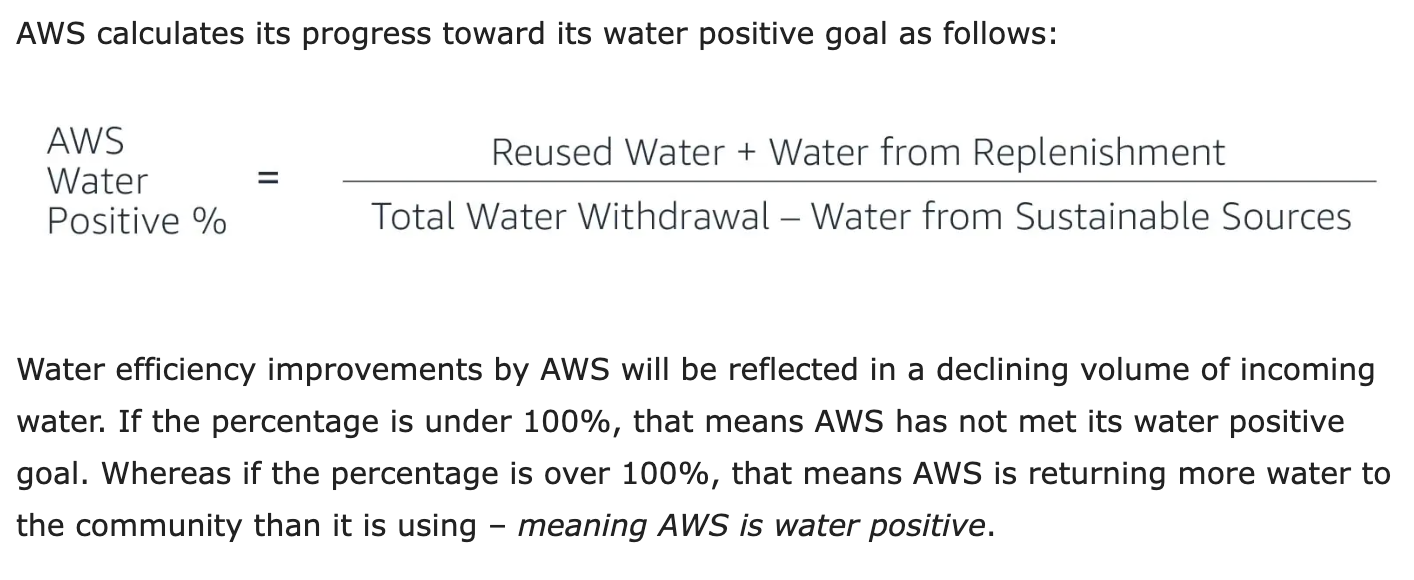
But all of the major players in the space (Google, AWS, Microsoft, Meta) have pledged to be water positive by 2030, which means they will return more water to the community than they consume. And these big players have also launched (or are launching) data centers that dramatically reduce potable water usage by using grey water or recycling the water they use in their data centers to reduce municipal water consumption. So is water being consumed? Yes. But like most technical problems where we turn a lot of focused human attention, we’re figuring it out pretty quickly. You can read more about all the water stuff and how it works in data centers here.
Water positive might be a confusing topic, so I’ve included an explanation from AWS in that article down here:
Ok, Mom, I think I’ve written long enough. Probably time to go out and get you your flowers for Mother’s day and stop yakking on about AI! I hope this letter has helped you get a little bit of a sense of the world I’m working in, and the one in which your grandchildren will live.
I hope you understand a little bit of why I’m excited about AI and I hope you get a sense of what what this kind of AI might mean for our future. I hope you dare to imagine a bit, and if you want to try ChatGPT I’m happy to get it installed on your phone for you. I’m sure we could brainstorm some questions you could ask it, and yes I’ll make sure you get the updated version (not the old one Uncle George uses).
Maybe you could ask it about your garden plan this year! I used it to help me figure out my tomato planting configuration.
And no matter what, I’ll be your loving son…
You get the idea. It’s all about story. I want to tell my Mom (and others in my life) an actual story about AI that helps them get into a space of imagination. That helps them to start to explore the possibility that AI could be a solution for something.
I tried to weave in all the facts that I have trouble communicating directly in a more narrative, story-driven style. Because if I’d started by saying “no, AI energy consumption is an awful myth”—well, no one would listen would they?
So pick and choose, share pieces of this with someone in your life who needs to hear about AI! And even if you don’t, I hope this helps inform your conversations about AI with those in your life who are skeptical or just plain confused…
For more on AI, subscribe and share!