What do you build when the models just keep getting better? I wrote a guide for builders, startup founders, and frankly anyone who is worried these days about their job because they work at a startup!
By Nate
Published: 2025-04-22
URL: https://natesnewsletter.substack.com/p/we-killed-your-startup-lolwhat-to
A couple of days ago I wrote about strategic frameworks guiding AI players in 2025. That post was mostly focused on how to correctly read and build against core strategic dynamics shaping AI, but it didn’t really address the elephant in the room for indie builders and startup teams:
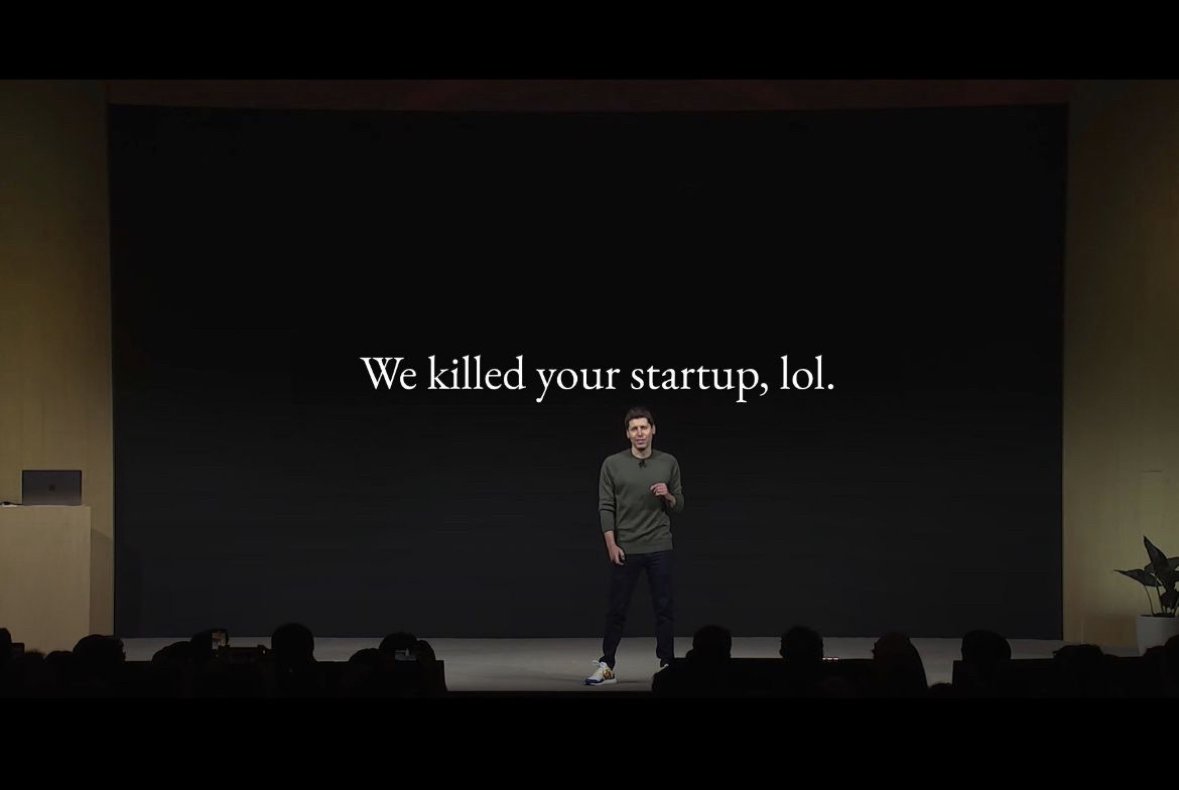
Yes, this is a real slide. Yes that’s Sam Altman in front of it. From way back in 2023. This has been happening for awhile. Read on to find out what we should be doing about it.
Sam’s own advice is just to build with evolving intelligence, which is pretty vague and also correct. My view is that a simple directional statement like that isn’t good enough to really put meat on the bone for anyone concerned about products—which is, like, most employees in tech at this point because we’re all affected when a model drops.
So I wanted to put something together that’s much more useful if you’re interested in how to avoid getting stomped on by OpenAI, or Google’s next Gemini drop, or DeepSeek dropping R2 (maybe this week?), or name-your-model.
I’m interested in how we can think about this deliberately, so we have a frame to fall back on when the next model releases tomorrow or next week and it’s really really good, again. And it changes the game, again.
Basically, we’re all playing a board game in tech where a few people are changing the game unpredictably. But this is an open-world game. We can find our own spaces. So how do you play a game in this world where the most important rules don’t get reset all the time?
That’s why I wrote this. You can call it a guide to product, but you can also read it as a guide to where to work—the best startups to work for are already doing this. Enjoy!
Subscribers get all these posts!
The game has changed
Every sport evolves. Competitors adjust, competitors get better.
Software is going through an incredibly fast evolution right now, and I want to lay out briefly how the game has changed before we get into what you can do to de-risk what you’re building as a founder.
TLDR; we have traded out one set of software risks for another.
In the 2010’s, getting your engineering team to ship something that worked and solved customer pain points was inherently risky because producing code (tokens) was expensive and only humans could do it (and very well-trained humans at that). Competitive risk was an order of magnitude less complex because competitors had to also invest heavily in tokens to beat or undercut you. The core risk was delivery and product market fit risk.
Now in the mid-2020’s code is not risky at all, but competitive risk is an order of magnitude more complex. Specifically, LLM intelligence by major model makers (like OpenAI) is rapidly eating the world and leaving many software companies running for the hills. The risk now has changed to competitive risk from an exponentially growing, world-changing technology. Basically, OpenAI invented raptors and all of us are trying to evolve real fast.

I promise we’re almost done with metaphors. We had dinosaurs. Now we’re gonna go for chariots, because there’s a strategic point here that’s key to the rest of the essay: major model-makers today are effectively controlling the chariots of the ancient world. They can and do quickly overrun the plains of the digital marketplace: broad markets that require large resources to command and that are essentially indefensible without the vertical integration a major model maker brings to the table.
Ok, fine. Where does that leave a builder? In the mountains. What saves startups is figuring out how to exploit niches in the ecosystem that are unworkable at the scale of a major model-maker, for reasons that tie into the D-T-R (Distribution, Tokenization, Reward) framework that I introduced in the AI strategy article. This isn’t just a metaphor, it really works. I’ll show you how, and I’ll lay out some specific niches that meet this criteria so you can get an idea of where the rubber meets the road.
But first, we need to get to a depressing little thought experiment…
King Kong takes the Empire State Building
Yes we’re all in on movies today. Paul Graham likes to say a good startup grows by doing something great for a small number of users before anyone big notices.
The problem now is that the big guys don’t even have to notice you to destroy you, because fundamentally intelligence is a cross-cutting force. Like a good military chariot in 3000 BC, it can be a lot of places on the battlefield in a short amount of time. When Sam kills a startup, he doesn’t even notice. And that makes it even worse, because you can’t game or play the attention card.
So how do you win? Start by testing yourselves. This works for founders or builders.
The King Kong Test is a five‑minute fire drill that turns your fear into a design constraint. You run it before you write a line of code; you run it again every funding round; and you definitely run it the night before Demo Day.
Thought experiment It’s 8 a.m. You open TechCrunch: “OpenAI Launches Exactly Your Product—Free for ChatGPT Plus Users.” You have until close of business to explain to your co‑founders, your investors, and your first customers what you still own at 5 p.m.
Ok well Don’t Panic. There are things we can do here. But before we can do anything, we have to figure out our risk profile as if we are sitting in Sam’s chair (or Satya’s chair, or Dario’s chair—you get the idea).
Before we score anything, quick reminder on the framework:
- D (Distribution) = how many target users can adopt without a new security review or procurement cycle.
- T (Tokenisation) = how close the raw workflow is to model‑ready text or code—no sensors, no OCR.
- R (Reward clarity) = how cheaply you or the customer can auto‑grade success without a human in the loop.
Step 1 – Give yourself a brutally honest D‑T‑R score – Give yourself a brutally honest D‑T‑R score\\
- Distribution – how many of your target users can activate without a new vendor approval? 1 = ten beta testers; 5 = pre‑installed in their daily tool.
- Tokenisation – what fraction of your raw data is instantly model‑readable text or code?
- Reward clarity – can success be auto‑graded (unit tests, binding scores) or does a human have to nod?
Step 2 – Clone the giant’s likely score - Assume OpenAI, Anthropic, or Google can hit T = 5 and R = 5 on day one—they have the weights and the RL infrastructure. Give them their realistic Distribution: GitHub for code, Gmail for docs, iOS for mobile.
Step 3 – Circle the lever where you still outscore them - That lever—maybe it’s regulatory clearance, maybe it’s an obscure sensor network—is your only defensible beachhead. Everything else is borrowed time.
Step 4 – Design a moat‑widening sprint - Ask: What can we ship in the next 90 days that makes this lever twice as hard to copy?
Examples: lock a design‑partner with 40 % of the channel, deploy edge devices no cloud vendor wants to manage, or collect a proprietary reward dataset. Basically, run to the mountains. The mountains (read: painful stuff big model-makers don’t want to deal with) are your only chance.
Step 5 – Schedule a re‑test trigger Quarterly, or whenever a giant files an 8‑K about your vertical. If your advantage shrinks, pivot the roadmap—not the pitch deck. Because the story should stand up if you do this right.
Why bother? Because speed without exclusivity is acceleration into a wall. The King Kong Test turns existential dread into a concrete sprint backlog and keeps your team shipping things a trillion‑dollar company would rather buy than build.
Indie vs VC: How Scale Changes Your Moat Math
Building defensibility isn’t one‑size‑fits‑all. What protects a weekend side‑project is nowhere near enough for a company aiming at IPO scale. Before we dive into moats, decide which game you’re actually playing.
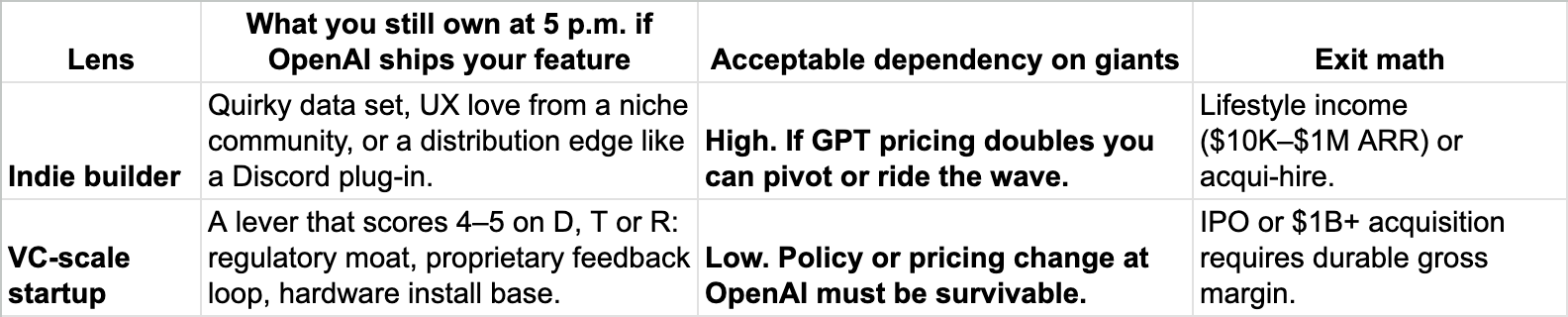
Why scale changes the calculus
- When you’re bootstrapped, survival = ramen and server bills, so you can live on borrowed chariots (APIs).
- Venture money multiplies expectations: investors need a moat the platform can’t bulldoze even if token costs drop by 90%.
Illustration: Same idea, two pathsImagine an AI copilot for construction RFIs. An indie hacker might ship a slick Procore plug‑in, earn $15 K / month, and sleep fine if Autodesk copies the feature. A VC‑backed version needs more: on‑prem data converters for every contractor plus a compliance audit trail that Procore won’t touch. Same workflow, radically different moat requirements.
Investor implicationSeed investors tolerate platform risk if the initial wedge is cheap and the upside is optionality. Growth‑stage investors won’t fund unless you’ve neutralised at least one lever—so prove it early or stay small on purpose.
Quick litmus test (pick one):
- Could a pricing email from OpenAI cut your gross margin > 50%? (You’re indie.)
- Would a GDPR probe shut you down? (Welcome to VC scale; compliance is part of your moat.)
Next we’ll lay out the tactical playbook for widening whichever lever you still own.
Tactical Playbook — Widen the Lever You Still Own
Many founders think defensibility is a feature arms‑race: ship faster than the giants. In reality, speed only matters if it widens at least one of the D‑T‑R gaps the platform can’t close tomorrow. Below are three short field guides—one per lever—explaining why each gap matters, how to enlarge it, and where pitfalls hide.
Fortify Distribution (D)
Your product lives or dies on how many target users can try it without a new vendor review. Copilot wins meetings because it already sits in the Office ribbon. To compete, you need channels giants don’t bother with (local politics, trade‑software partnerships) or paperwork they avoid (jurisdiction‑specific approvals). The table translates those abstractions into concrete moves.
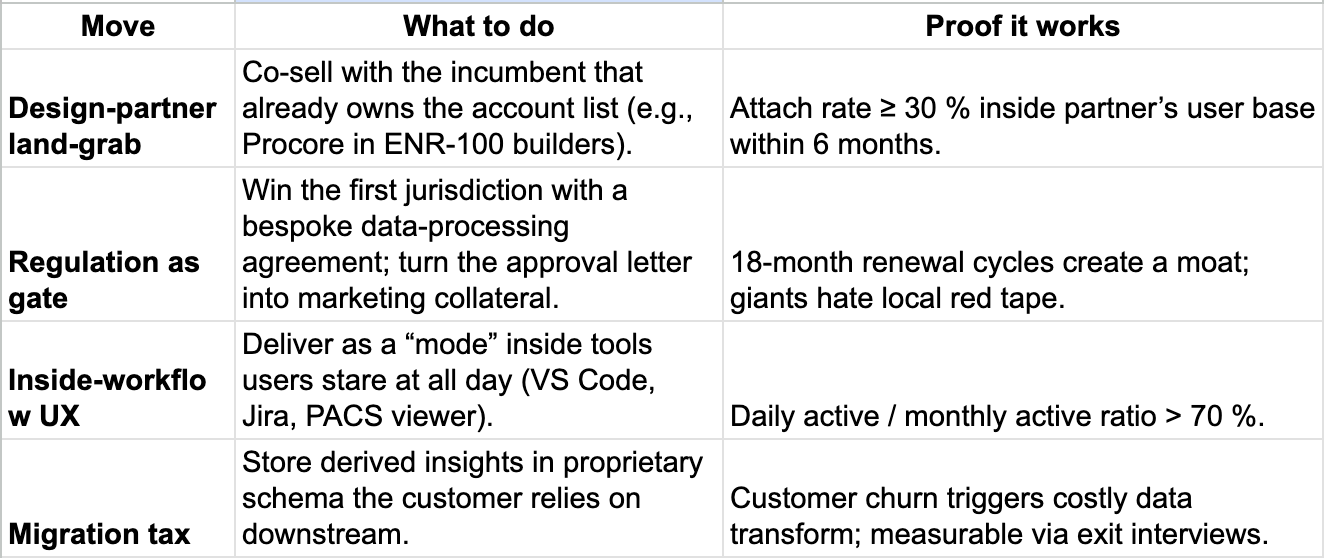
Pitfall watch: APIs can evaporate. If your channel bet relies on a single partner, negotiate a change‑of‑control clause or diversify as quick as you can.
Fortify Tokenisation (T)
Models crave clean text; the world is messy. If raw data can’t flow into a GPU without heroic ETL, you’ve found “rough terrain” chariots avoid. Own the plumbing, and every gigabyte must pass through your tollbooth before it trains any model—open weight or otherwise.
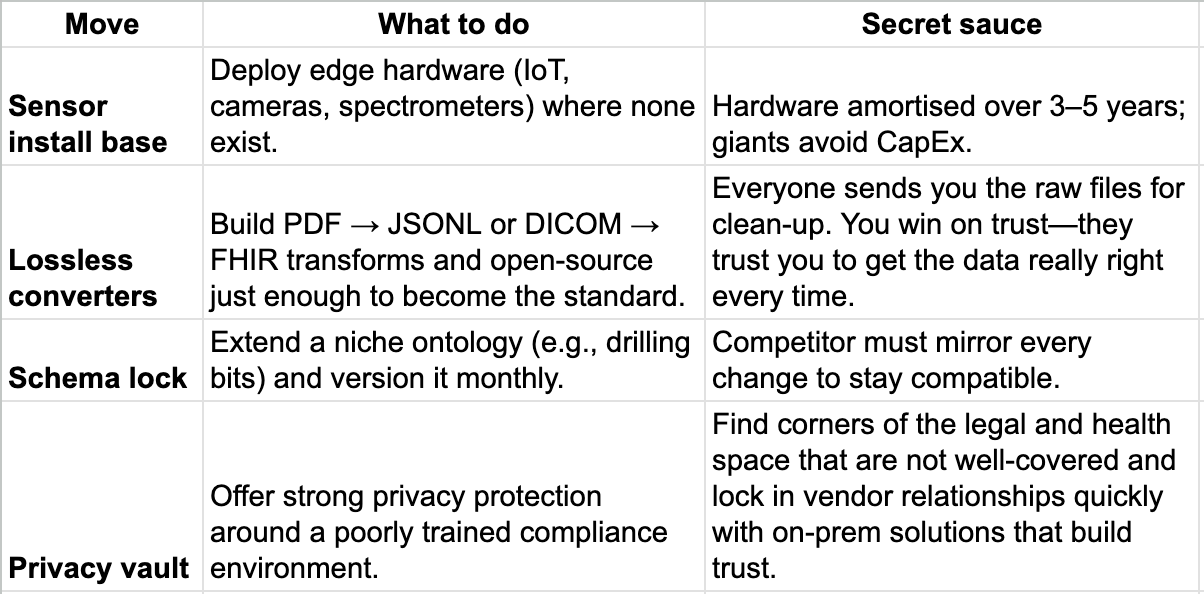
Pitfall watch: If conversion quality is merely “good,” major models will get there as the rising tide lifts all boats. Make it indispensably exact—or legally mandated.
Fortify Reward Clarity (R)
The fastest learner wins. A model that gets an automatic score after every action can improve daily; a model waiting for quarterly human labels stagnates. If you own the feedback loop—or the liability giants won’t touch—you own the compounding advantage.
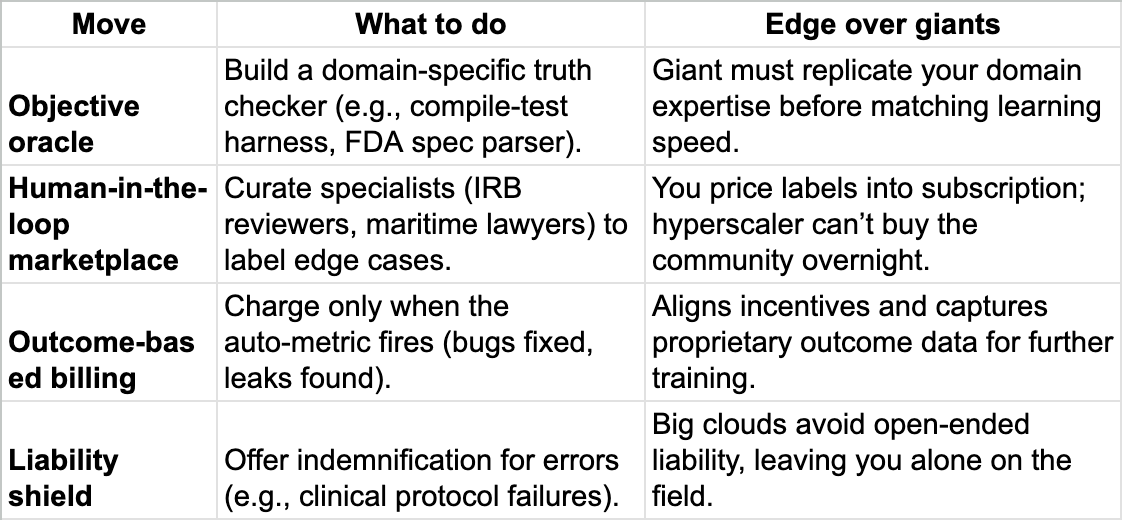
Pitfall watch: Auto‑metrics drift. Audit your oracle monthly or you’ll train the model on bad labels and erode the moat yourself.
Hedge Against Token‑Cost Compression
Even perfect levers crumble if your unit economics implode.
- Multi‑model backend — abstract calls via an orchestrator; swap to the cheapest compliant model monthly.
- Compute‑index clause — write into cloud contracts that your price floats downward if provider token costs drop >30 %.
If Apple or Blackwell GPUs make on‑device inference pennies, you can switch suppliers in a single sprint.
Checklist recap: Maximise one lever to 5 as quick as you can; raise a second to ≥3 within two quarters; hedge the third with portability. Trying to max all three is a burn‑rate trap; triage and intelligence beats brute force. Remember, you are operating in the mountains and you don’t have chariot budgets.
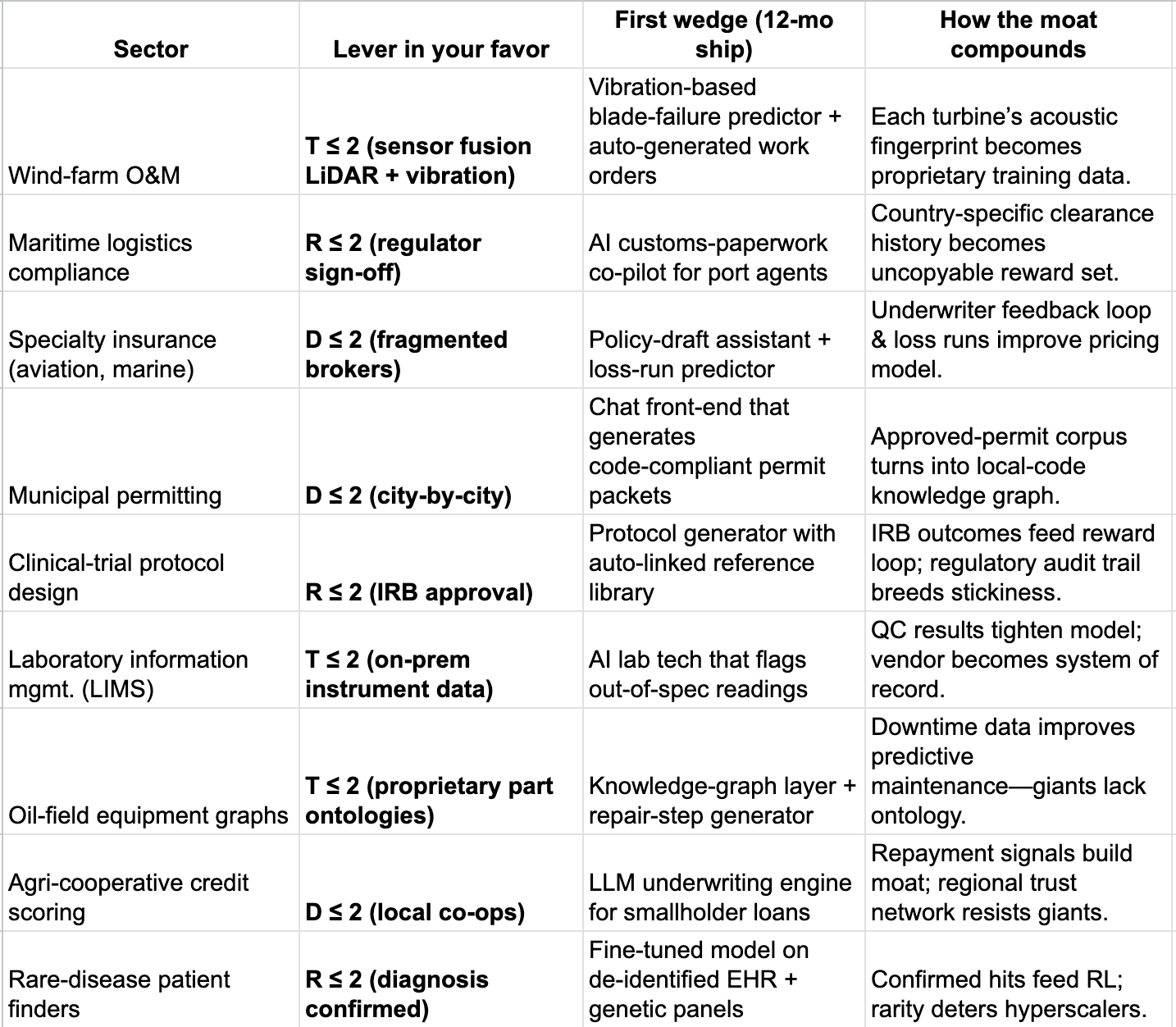
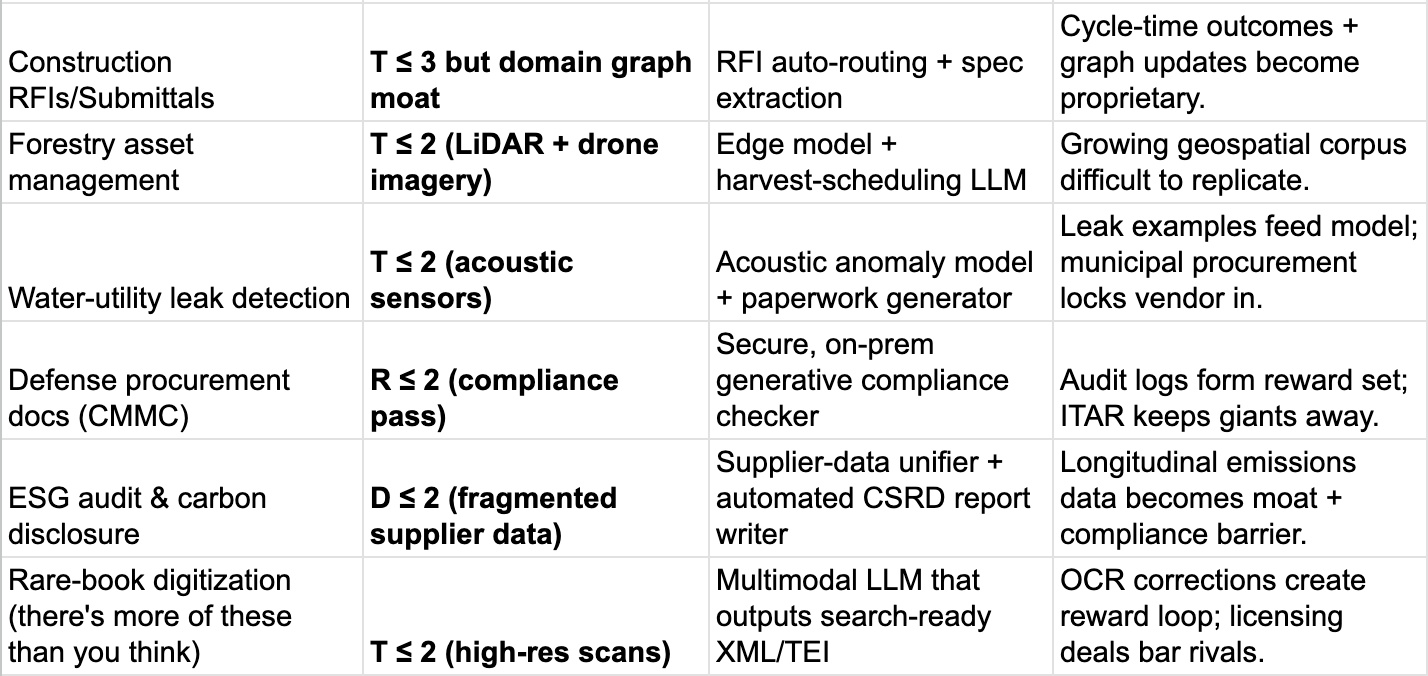
Fifteen Mountains the Giants Won’t Climb—Yet
There’s a pattern to where hyperscalers hesitate: messy data, thorny compliance, or specialist reward loops. Below is a non‑exhaustive map of fifteen “mountain passes.” Each offers a built‑in advantage on one D‑T‑R lever; the other two can be shored up by a focused seed‑stage team.
Why these fifteen? I picked sectors where:
- At least one lever is structurally hard for a hyperscaler (D < 3, T ≤ 2, or R ≤ 2).
- The software TAM can clear $500 M.
- A three‑person team could ship a wedge and widen the gap pretty fast. If you spot a sector with the same lever profile, it likely belongs here too. Full chart here.
Finding the Mountain Pass in Your Sector
Paul Graham’s advice to "live in the future and build what’s missing" needs a 2025 add‑on: build where the giants can’t drive their chariots. Every industry has open plains—clean data, mass channels, obvious metrics—where a hyperscaler’s scale and cheap tokens dominate. Your job is to walk the map until the gradient tilts in your favour.
Three Scouting Questions
- Distribution friction – Where do decision‑makers sit behind fragmented channels, procurement hoops, or political approval? (Think municipal budgets, OEM service contracts, specialty brokers.)
- Data stubbornness – Which critical inputs refuse to turn into UTF‑8? Sensors, proprietary file formats, or photo + thermal blends all raise the Tokenisation barrier.
- Outcome ambiguity – Where does quality still need a licensed human to stamp "approved"? IRB boards, underwriters, compliance officers—their signatures signal low Reward clarity for a generalist model.
When you can answer "yes" to any two of these questions, you’ve likely found terrain steep enough to slow the giants.
Example Walkthrough – Dental Practice Ops
Distribution: 180,000 independent practices in the U.S.; no single channel like Gmail or Office.
Data: intra‑oral scans (3‑D meshes + X‑rays) don’t tokenize cleanly.
Reward: chart audits require a licensed dentist’s sign‑off.
Pass found: an AI platform that autocompletes SOAP notes from scans and suggests CDT codes lives in data the hyperscalers can’t ingest cheaply and needs human approval a giant can’t automate.
Field Checklist: Confirming the Pass
- Channel Test: closing your first ten customers requires domain warm intros, not an App Store submission.
- Converter Test: at least 30 % of raw data fails if you rip out your custom ETL.
- Oracle Test: removing the licensed reviewer drops accuracy below customer tolerance.
- Token‑Shock Test: would a 10× cheaper model halve your COGS but barely dent your price? Good—you’re pricing on decision value.
- Exit‑Clause Test: could a customer swap you for a hyperscaler in <30 days without re‑training staff or re‑filing with regulators? If no, you’ve got terrain.
Treat this checklist like prospecting gear: run it on every workflow idea before you write code. If the map stays flat, keep walking until you feel the slope.
The 90‑Day Validation Checkpoint
Paul Graham will tell you to ship something useful this week and talk to users tomorrow. Keep that tempo. The 90‑day window is not about development pace; it’s the measurement frame that syncs with clocks you can’t move:
- Investor cadence—seed and Series‑A boards meet quarterly. Walk in every three months with evidence you widened at least one lever and the funding narrative tilts in your favour.
- Platform release cycles—OpenAI, Google, Microsoft, Meta: each drops a major model or feature roughly once a quarter. If you don’t strengthen a lever before the next drop, the gap shrinks by default.
Use the quarter as your outer heartbeat: inside it, run YC-type sprints (weekend ship, Monday users, Wednesday iterate). The example (and yes I’m sure there’s lots of exceptions) schedule below shows what proof points you can accumulate by Day 90.
Week 0—Orient
Lock your current D‑T‑R scores and circle the weakest lever. Write down a single "definition of win" for that lever: a design‑partner logo (D), a converter loss‑rate < 2 % (T), or an auto‑metric dashboard with 80 % coverage (R).
Indie builders: pick one metric.
VC‑backed teams: commit to a stretch metric for a second lever as your board OKR.
Weeks 1–4 — Proof‑of‑ConceptShip the smallest slice that touches real data and real users: a Procore plug‑in, an EHR de‑identifier, a customs‑form parser. The goal is signal, not scale. Track two numbers only: time‑to‑activate (D) and percent of raw data that flows in without human correction (T).
Indies can do manual scoring here.
VC teams should wire basic auto‑metrics to get the learning loop started.
Weeks 5–8 — Lever WideningFix whatever blocked activation: build OAuth flows, write missing converters, codify the auto‑metric. If you chose Reward as your lever, this is when you turn a subjective thumbs‑up into a scripted pass/fail test. Ship weekly, demo Friday. Your milestone for the week‑8 update email: “Metric X improved 30 %, customer Y signed, loop is running.”
Weeks 9–12 — External ValidationAdd a second design partner or pilot customer, preferably one the hyperscalers can brag about but haven’t won. Publish a short case study with real numbers: latency cut in half, compliance cycle‑time down 40 %. End the quarter with a lever delta you can cite in fundraising: Distribution now embeds in two systems, Tokenisation covers 95 % of raw artifacts, or Reward auto‑grades 10 × more outputs than at week 0.
Checkpoint: Re‑run the King Kong Test. If OpenAI shipped your feature tonight, do you still keep at least one lever at “4 +” by breakfast? If yes, raise or reinvest; if no, pivot while you still have oxygen.
Pick the product ground you want to fight on
Models will keep getting cheaper and giants will keep dropping features at keynote speed. Your only hedge is to stay in weird use-cases that are too messy for a generalist model maker to deal with and widen a lever they can’t max out before their next release cycle.
Map the terrain with D‑T‑R as a handy guide, pick your mountain pass—messy data, thorny compliance, or a specialist reward loop—and push relentlessly uphill every week. Your startup advantage is that you will suffer pain here no one else will to serve customers. Use the 90‑day checkpoint to prove you’re higher up the slope than last quarter; repeat until the view is yours.
If you want a quick gut‑check, run the “How Safe Is My Startup?” quiz. It’s super light, but it scores the bones of your idea in 60 seconds and spits back the lever you need to fortify next. I made this one a ChatGPT artifact so you can remix it easily.
The giants will keep dropping features and snarky slide decks, but if you’ve done the work, the punchline will fall flat—and your customers, investors, and board will still be there the morning after the keynote.
For more on AI, subscribe and share!
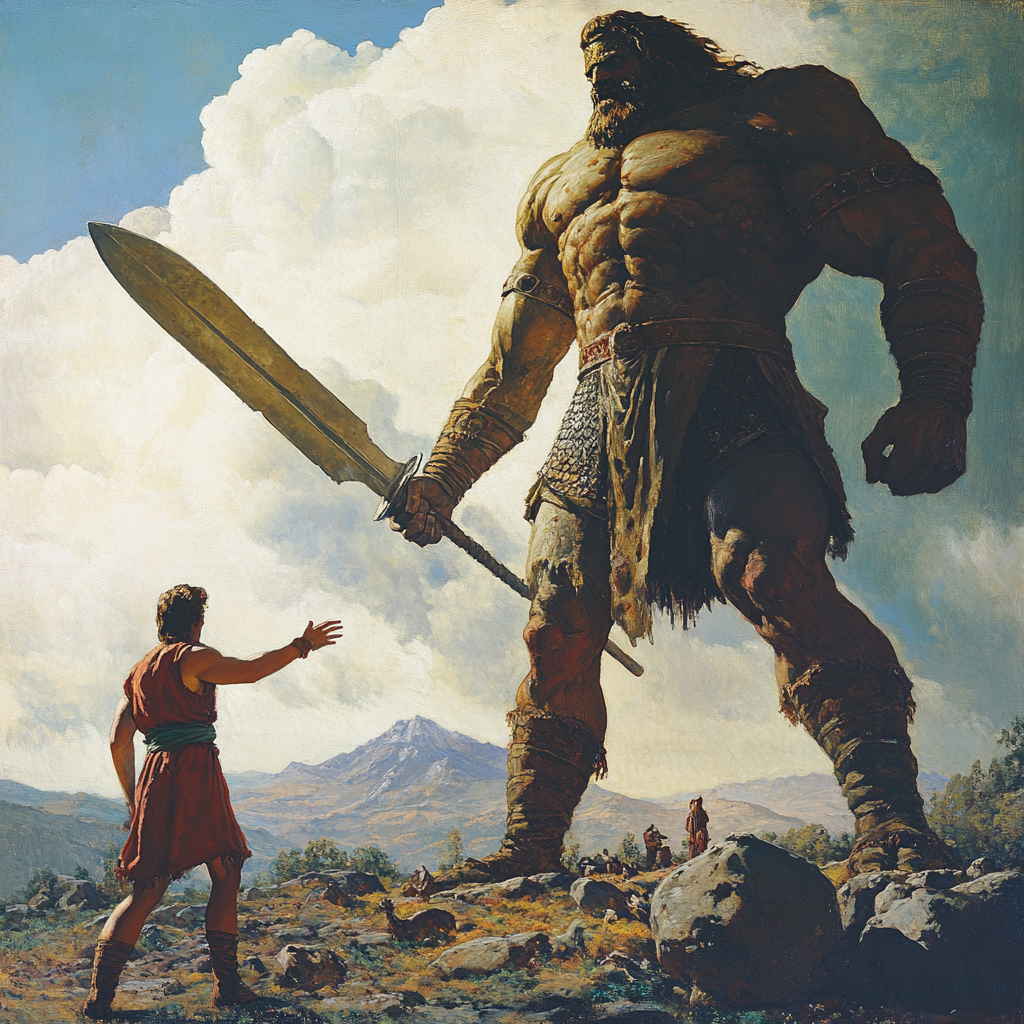
\I think Goliath probably doesn’t miss a day at Barry’s\