How AI speeds up thinking but can’t replace judgment, and why the real craft of writing is in knowing what to keep, what to cut, and how to stay in control—and that hasn't changed!
By Nate
Published: 2025-03-18
URL: https://natesnewsletter.substack.com/p/beyond-ai-slop-learning-to-write
If you think AI wrote this, I encourage you to try to prompt for it and see if you can get anything this personal that doesn’t sound like hallucinated AI slop. Asking AI prompted stuff alone to be extraordinary writing is like expecting a paint can to roll onto the canvas and become one of Andy Warhol’s soup cans. Good writing is a dance, and I’m revealing a bit about how AI helps me think and wrestle through drafts here.
I used to think writing was this sacred act between brain and page – just me, my keyboard, and the relentless cursor. That changed a few months ago when I got really desperate. I wanted to write a lot more, and my problem wasn’t time. It was follow-through. I couldn’t get out of idea stage enough. I was like a plane struggling to take off on the runway. I had a half-finished idea on neural networks, I was desperate, and I was willing to try something different to get the gap between brain and page closed.
Subscribers get all these posts!
So I started chatting with Claude. What came back wasn't magic, but it wasn't useless either. It was… a conversation starter. And it was helpful, and it helped me to get to tomorrow, and to the next draft, and the to the draft after that. Slowly I realized what writing AI really is—not a replacement, not AI slop, but having a constant co-editor with a strong technical perspective who can always read my pieces (and never gets tired) and who can help me strengthen them.
But that’s not how most people around me talk about AI and writing, and that’s why I am writing this piece. I hear “hey AI wrote that” a lot, and the undertone is always one of judgement. And I kind of shake my head, because if you worked with AI the way I do you’d understand: AI doesn't "help" me write any more than a sparring partner "helps" a boxer train. It pushes back. It suggests angles I wouldn't consider.
Last month, while working on a piece about AI ethics (not done yet), I asked for alternative openings. ChatGPT spit out twelve options – three terrible, five decent, four genuinely intriguing. One began with "What if Socrates had ChatGPT?" That question was interesting enough to keep writing. Then ChatGPT spit out some crap that read like a philosophy textbook filtered through Reddit. I kept the spark, ditched the rest. I’m still working.
The real magic happens in the rewrite dance. I'll crank out a few hundred or a few thousand messy words – sometimes just by yakking into advanced voice mode. Then I call in my AI editorial assistant. It's like having a partner who never tires of asking "But what did you mean here?" and "Could this analogy be clearer?" It’s especially useful for clearing up metaphors. Have you tried to visualize the difference between a zettabyte of tokens and a trillion tokens correctly? Apparently a trillion tokens is like a single drop of water, and a zettabyte of tokens is like all the drops of water in all the world’s oceans. See? That pops and it’s approximately accurate! Thanks AI.
But here's where the need for human taste comes crashing in. Last week, the AI suggested a completely made-up personal story. It basically invented a job for me that I didn’t do (at Netflix) and talked in a garbled way about some work I’d actually done at Prime Video. But it flowed with the story! I had to step in and correct with facts. Now I have an argument about where I actually worked and what I actually did sitting in ChatGPT lol.
The learning curve feels like teaching a particularly stubborn but very bright 19 year old my handwriting (the irony, because I was a very bright and stubborn 19 year old a long time ago). Early on, I really struggled with getting reasonable style. I didn’t find it easy to explain what I meant or wanted, and I kept getting upset because default chat would generate a bunch of bullets that looked like a technical outline. I tried Claude’s style copier and I didn’t love it. Sounded smarmy. I can get all the bullets I want on transformer models anywhere, but I can’t get my voice, my preference for writing in paragraphs of actual complete thought very easily. My preference for longer sentence is also not something AI does naturally; nor does AI love semicolons (love what I did there).
I have found (for short to medium pieces) that Lex can be helpful in drafting here. They rolled out a new feature that lets me pull in my previous substack style, and then (as long as I remind AI to delete the pesky bullets) I have the flexibility to start dumping text into an open draft and can pretty quickly iterate on stuff. I like that Lex lets me yell at DeepSeek and Claude (both 3.5 and 3.7)—the easy model switching makes it clear if I have a prompt issue or if I have a thinking clarity issue or if it’s just a model quirk.
So it’s handy, and it’s not perfect! If I try to get it to help me compose a larger piece (like my recent longform article on software laws), it tends to just not be able to avoid compressing. Love the clarity there (maybe I should paste Lex-generated summaries next time), but I feel like I lose too much fidelity of thought and I can’t stand it. Again, personal taste!
I think one thing I’ve begun to have a strong opinion about: we need to stop trying to judge people for how they interact with AI in their creative process, as long as people take accountability for every word they create or write. Our current attitude toward AI is reminding me of the 1980’s, when housewives would suffer a social setback if it became known at certain parties that they hadn’t actually baked the cookies. Yes, I’m that old. Yes, I saw it happen and the judgement was real.
We’re sort of in that place with AI. We have an imagined model of creative purity that was never really there in the first place, and we sometimes want to hold creatives to that model whether they like it or not. Well, if Andy Warhol can collect soup cans and make them into art, we all can figure out a way to work with a new industrial technology for something creative.
As I look back, I think what surprises me most is how this creative partnership with AI has changed my writing process. I take bigger swings now, knowing I've got a safety net for the clunky parts. I think my Substack is stronger because the pain of getting started is almost zero, so I can just run ideas out there and see what I like before committing. My first drafts are MUCH messier but more adventurous. The editing phase feels less like triage (haha sometimes) and more like sculpting. And when I hit that sweet spot – where my voice comes through clearer because the mechanical lifts are handled – it's like discovering a new gear in creative thinking.
At its best, working with AI feels like dancing with a technically correct dance partner. They always get the steps right, and it’s up to me to bring in that touch of imperfection and that drive across the dance floor that makes it art. But where would I be without AI? I’d be a lot less productive. I’d have less of a clear-eyed technical read to keep me honest. My structure wouldn’t be as strong and easy to follow. Could I write a strong backbone for a piece on my own? Absolutely—I did my five paragraph essays lots as a kid—but getting help with scaffolding lets me focus more on the message, and ironically emphasizes and underlines where I have weaknesses in my thinking. A good vanilla structure lets me choose where I want to add a digression, lets me see the places my thinking isn’t right. And lets me see where the AI is pushing a structural conclusion that feels flat.
Have you noticed that? AI conclusions are notoriously flat. They don’t know how to conclude a piece like a love letter, leaving it to the reader to complete that final post script with their own thinking. AI conclusions are too neat, typically.
Well, this one isn’t. This one is an invitation to you to think outside the binary of “AI wrote it” or “AI didn’t” and start thinking of AI as a conversational partner that happens to help with thinking—and that leads to stronger writing, one token at a time. AI informs me that if a trillion tokens is a drop of water, a single token is a molecule. So there we go! Happy writing, one molecule token at a time.
For more on AI subscribe and share!
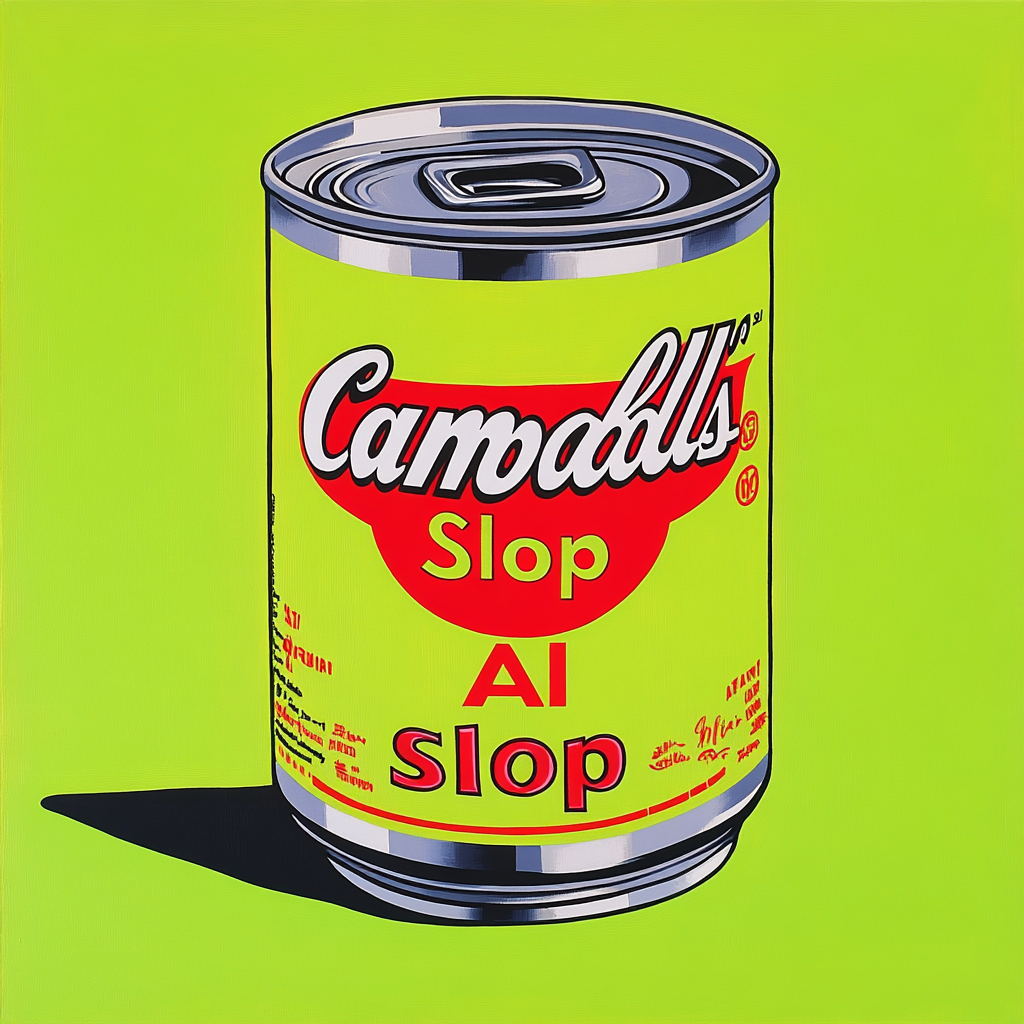
\Had to have fun with the artwork here…Andy Warhol this is not!\