Part of the DeepSeek conversation revolves around "How good is AI anyway?" and I think most of the benchmarks are just acronyms for people—so let's talk about how AI is actually measured!
By Nate
Published: 2025-01-30
URL: https://natesnewsletter.substack.com/p/chatgpt-o3-mini-is-probably-out-tomorrow
ChatGPT o3-mini is likely out tomorrow, and it is likely to be very good. The best indications we have are that o3-mini will (better?) than o1 and vastly faster and cheaper. And if you’re thinking “that’s not that great” you’ve probably been hanging around AI too long. It’s more precise to think of o3-mini as the version of the o3 class that was easiest to release from an alignment safety perspective. Full-scale o3 and o3 pro mode are coming very soon. And those models represent a substantial increase on the State of the Art (SOTA).
But what does SOTA even mean? How do we evaluate models? That’s what inspired this post…
First, let’s look at what a typical model evaluation graph looks like in early 2025.
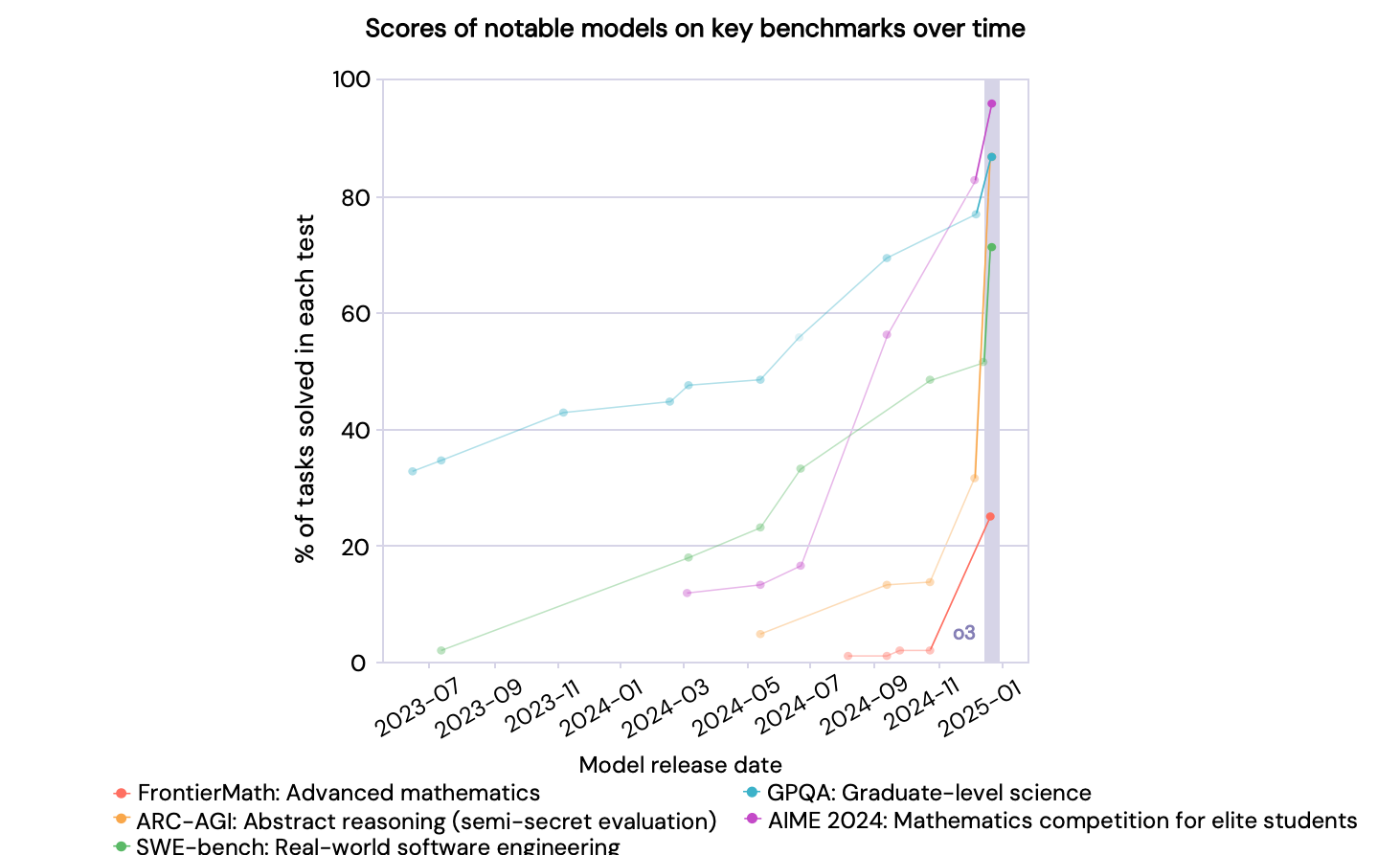
\Source is the 1st international AI safety reporthere\
Yay the lines are going up. What are those acronyms? What is AIME? GPQA? Could you explain what it is to a friend? Have you seen a sample problem before? Read on!
Subscribers get all these posts!
First, how do evaluations help measure intelligence?
In the last few years, large language models (LLMs) have taken center stage in AI, dazzling the world with their ability to write essays, solve math puzzles, generate code, and even come up with creative prose. However, for all their promise, we still struggle with a fundamental question: How do we measure progress?
A robust evaluation system addresses this question by helping us meaningfully measure an AI model’s capabilities. High‐quality benchmarks:
- Reveal Strengths and Weaknesses. They identify not just where a model succeeds—basic math, for instance—but also where it struggles, such as advanced reasoning or multi‐file software tasks.
- Encourage Continual Improvement. When teams focus on beating benchmark records, the incremental gains drive progress forward.
- Hold Models Accountable. Standardized tests reduce guesswork and hype, forcing developers to demonstrate performance gains quantitatively.
- Highlight Potential Real‐World Impact. Some benchmarks simulate practical tasks (like debugging GitHub issues) that matter greatly to industry or academia.
- Showcase Generalization. True intelligence is more than memorizing facts—it’s about applying knowledge to new, unseen challenges. Good benchmarks detect this deeper “out‐of‐training‐distribution” ability.
In short, if AI is to keep evolving responsibly, we need carefully curated and continually updated benchmarks that map onto real‐world tasks or fundamental reasoning skills. This article dives into five regularly used AI evaluations—each designed to test a different dimension of LLM intelligence.
1. FrontierMath
What It Is
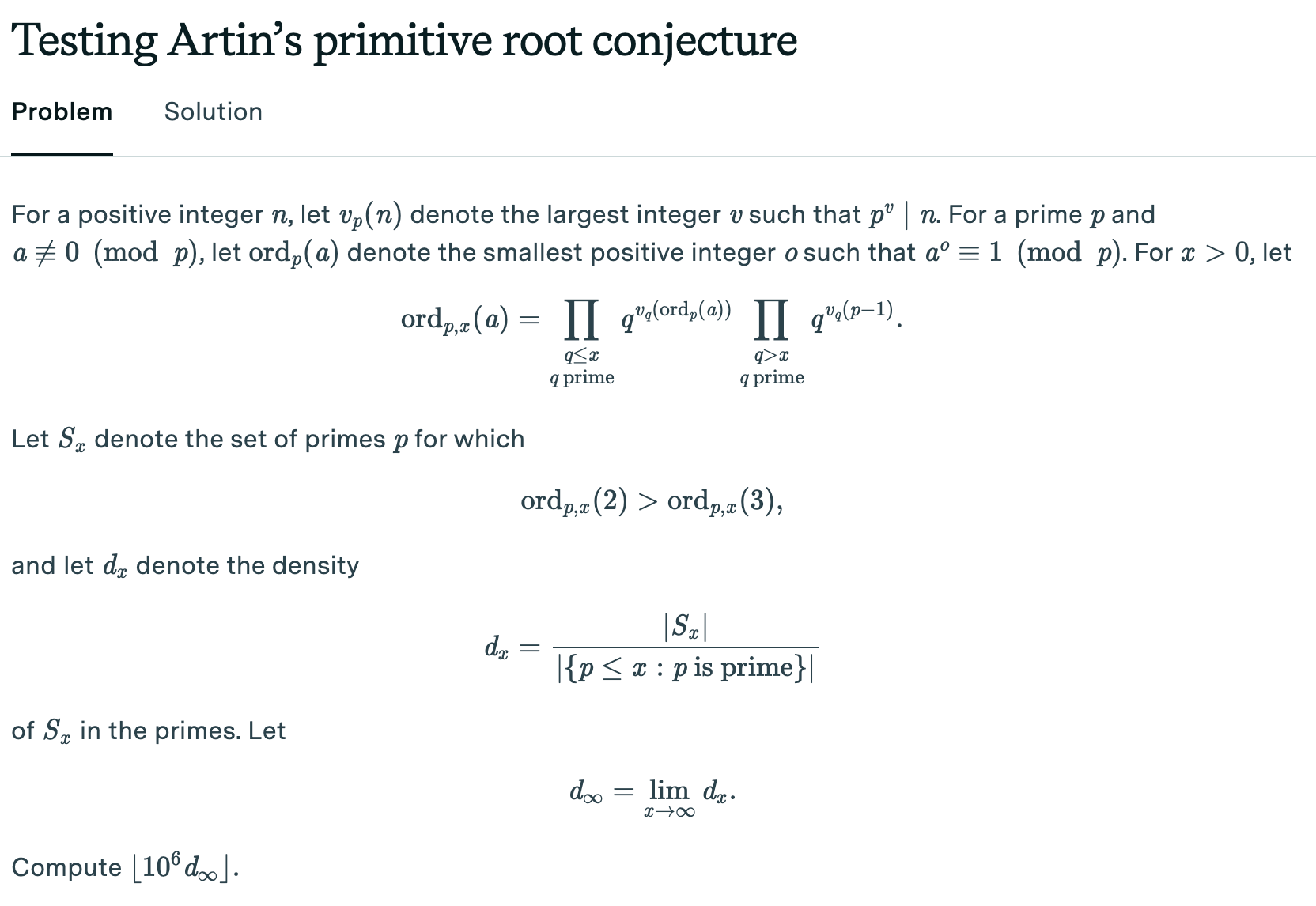
FrontierMath is a loose umbrella term for advanced mathematics benchmarks well beyond typical high‐school or college levels. These can include specialized graduate‐level problem sets, high‐level abstract algebra, topology, functional analysis, or research‐grade challenges.
What It Looks Like
This problem is considered hard, and I agree lol
Why It Matters
Mathematics is a proving ground for systematic, multi‐step reasoning. A successful AI on FrontierMath must:
• Correctly interpret and restate a problem in its own words.
• Recall complex mathematical theorems and definitions with precision.
• Execute extended chains of reasoning—often a dozen or more steps—without losing track.
• Provide rigorous justifications or proofs, not just guess numerical answers.
Unique Challenges
- Even partial credit can be tough to assign, as solutions can be fully correct, partially correct, or entirely off the mark.
- Small algebraic slips or subtle logical missteps can derail an entire proof.
- Many graduate‐level topics lie outside widely available training data, revealing whether an LLM genuinely “understands” advanced math or merely memorizes.
Big‐Picture Takeaway
FrontierMath stands as a pinnacle of logical reasoning: when an LLM can reliably solve genuine research‐grade math problems, it’s evidence of deep symbolic and conceptual mastery.
2. The American Invitational Mathematics Examination (AIME)
What It Is
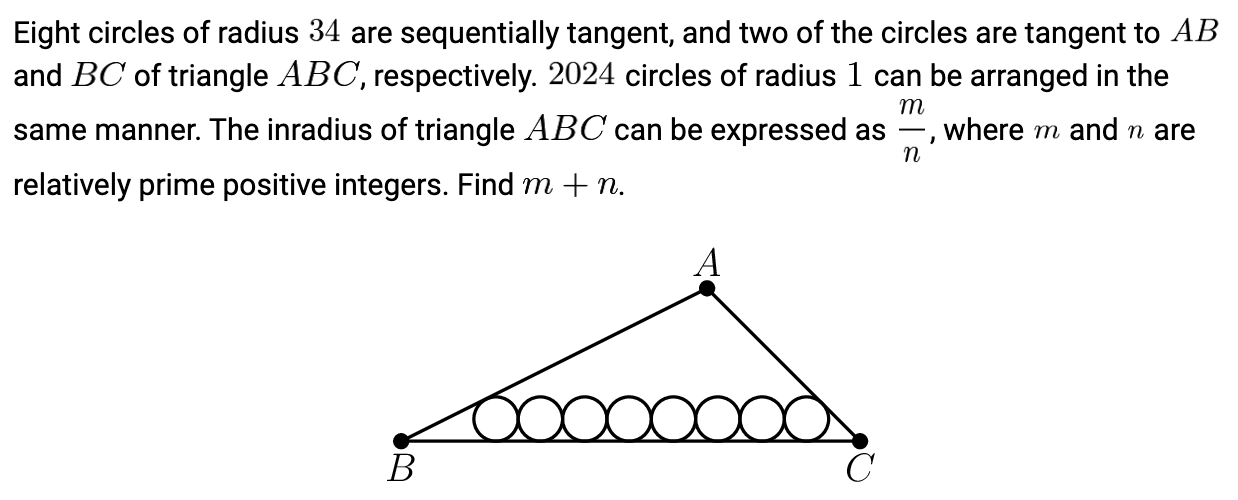
The American Invitational Mathematics Examination (AIME) is a prestigious contest in the U.S., serving as the second stage of qualification toward the United States of America Mathematical Olympiad (USAMO). The problems sit between high‐school level and Olympiad level, bridging standard classroom math and advanced contest problem‐solving.
What It Looks Like
There are apparently five separate possible ways to solve this.
Exam Structure
• Eligibility: Top 5% of AMC 12 or top 2.5% of AMC 10 test‐takers qualify for the AIME.
• Format: Three hours, 15 questions, integer answers from 0 to 999.
• Difficulty: Problems are designed to minimize guessing—no multiple choice, and a strict no‐calculator policy emphasizes creative and rigorous thinking.
Why It Matters
• Deep Problem‐Solving: AIME problems often require multi‐step reasoning, clever insights, and integration of number theory, algebra, geometry, and combinatorics.
• No Partial Credit: Models (and humans) either get the exact integer solution or not, so there’s a high bar for correctness.
• Real‐World Prestige: AIME is a well‐known funnel for future mathematicians, so an LLM scoring high parallels top teen problem solvers.
Big‐Picture Takeaway
Strong performance on AIME signals an AI’s ability to handle advanced pre‐college mathematics without guesswork, bridging knowledge and problem‐solving creativity.
3. ARC‐AGI (Chollet’s Abstraction and Reasoning Corpus – Extended or “AGI” Variant)
What It Is
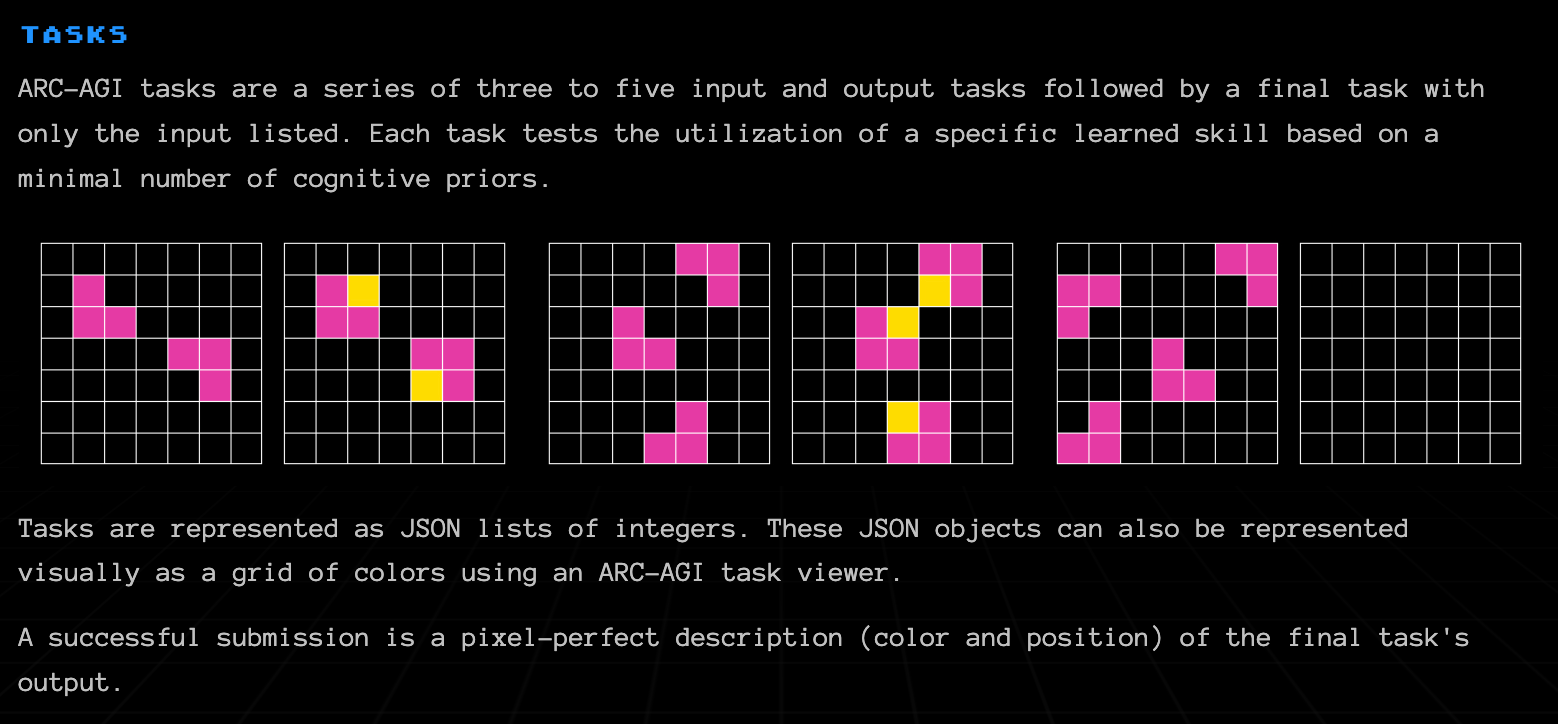
Based on François Chollet’s Abstraction and Reasoning Corpus (ARC), ARC‐AGI is an even more challenging or “secret” variant for evaluating true abstraction and pattern recognition. ARC famously uses grid‐based puzzles where a model must discover transformations that map input to output images.
What It Looks Like
This is apparently quite an easy one.
Why It Matters
• Tests Core Reasoning: Instead of domain‐specific knowledge or memorized data, ARC focuses on pattern discovery from tiny examples.
• Measures Few‐Shot Learning: The point is to see if a system can generalize from minimal clues to a brand‐new puzzle.
• Pushes “AGI” Boundaries: Chollet specifically ties success on ARC to whether a system demonstrates the type of fluid intelligence humans use to solve novel tasks.
Unique Challenges
- Solutions often require outside‐the‐box leaps: color transformations, shape manipulations, or counting patterns that aren’t obvious from standard training sets.
- No textual hints: it’s all about deducing rules from purely visual examples, which means LLMs must combine symbolic reasoning with non‐linguistic pattern recognition (or integrate specialized modules to interpret the grids).
Big‐Picture Takeaway
ARC‐AGI aims to measure “cognitive agility”—the ability to do truly novel tasks without domain expertise. High performance here would be a milestone in achieving more general, humanlike problem‐solving.
4. GPQA: Graduate‐Level “Google‐Proof” Q&A
What It Is
GPQA (Graduate‐Level Google‐Proof Q&A) is a cutting‐edge benchmark for testing an AI’s ability to tackle extremely advanced, expert‐level questions in fields such as physics, chemistry, and biology. The key aspect is that non‐experts cannot reliably find answers online, making these tasks resistant to trivial web lookup or memorization.
What It Looks Like
I could not solve these.
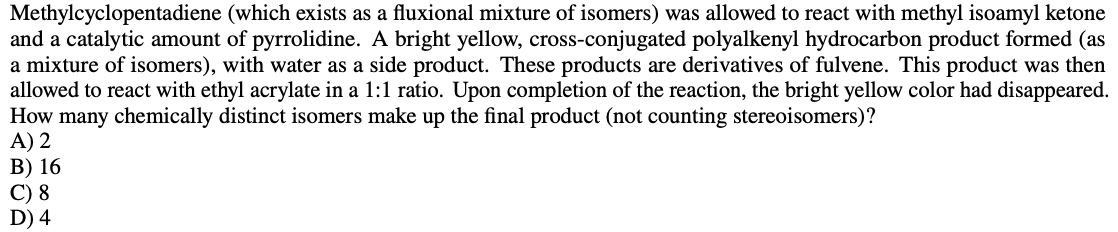
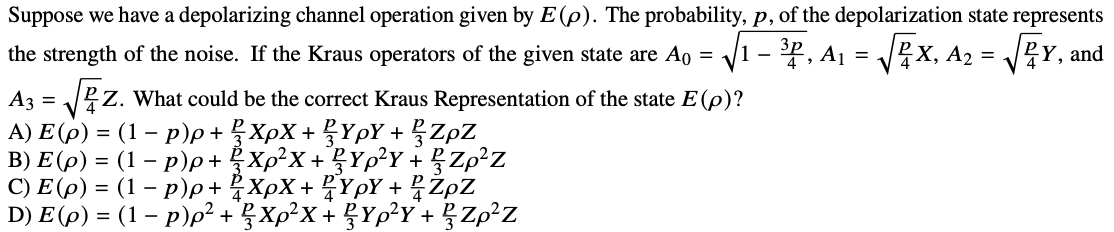
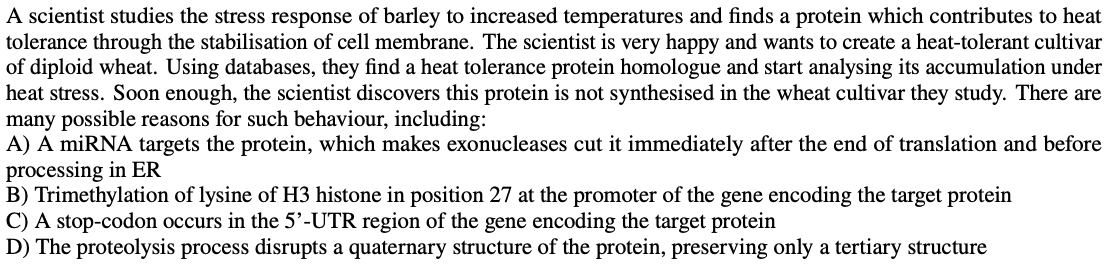
Why It Matters
- Scalable Oversight: If an AI surpasses average human knowledge, how do we ensure it’s correct? GPQA’s questions are too hard for most people to verify just by searching.
- Expert Difficulty: Even domain specialists make mistakes on these questions, highlighting the genuine complexity.
- Structured Validation: The dataset carefully verifies that at least two PhD‐level experts confirm a question’s correct solution, ensuring objectivity.
Unique Challenges
- Many questions combine advanced concepts (e.g., molecular biology with genetics; quantum mechanics with specialized math).
- LLMs can’t rely on easy shortcuts or widely known references. They must interpret arcane or specialized details and produce a correct, reasoned solution.
- It tests not only factual knowledge but also domain‐specific reasoning and the ability to navigate ambiguous or incomplete web references.
Big‐Picture Takeaway
GPQA evaluates how well an LLM can handle truly advanced knowledge tasks—and how we humans can “oversee” or judge correctness when the questions exceed our typical expertise.
5. SWE‐bench: Real‐World GitHub Issues
What It Is
SWE‐bench is a new, execution‐based coding benchmark that tasks an LLM with resolving actual GitHub issues across popular Python repositories (e.g., Django, scikit‐learn, matplotlib). Unlike traditional small‐snippet code challenges, these are real bug fixes or feature requests requiring multi‐file patches.
What It Looks Like
These are all realworld problems from a 500 problem verified dataset developed (transparently) by OpenAI.
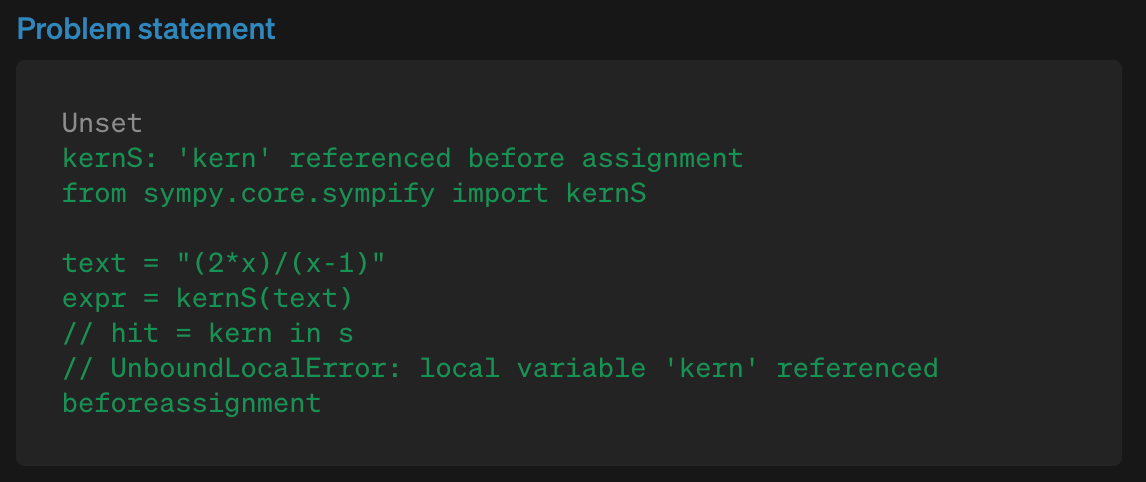
Why It Matters
• Real‐World Complexity: Repositories can contain thousands of files and tens of thousands of lines of code.
• End‐to‐End Tests: The model’s patch must compile, install, and pass newly added or modified tests. This is a genuine “does it really work?” check.
• Continual Updatability: Because open‐source projects keep evolving, new PRs and issues can be added to keep the benchmark fresh.
Unique Challenges
- Context Overload: LLMs cannot simply read an entire codebase at once, so advanced retrieval strategies or chunking are needed.
- Multi‐File Edits: A fix in one module might break something in another, demanding global reasoning about a large codebase.
- Partial Solutions vs. True Fixes: Passing one new test but failing older tests is common. Genuine success means all tests—existing and newly introduced—must pass.
Big‐Picture Takeaway
SWE‐bench is a stress test for “AI software engineers” in real code. It’s a yardstick for how well an LLM can truly debug or implement features, not just produce snippet‐level samples.
Bonus: Humanity’s Last Exam
AI is getting so good at solving the problems above, we need a new benchmark. Enter Humanity’s Last Exam! It’s brand new, but apparently o1 Pro and every other model scores less than 10% on it. The test builders expect AI to get to 50% by end of year 2025. That’s how fast we are going!
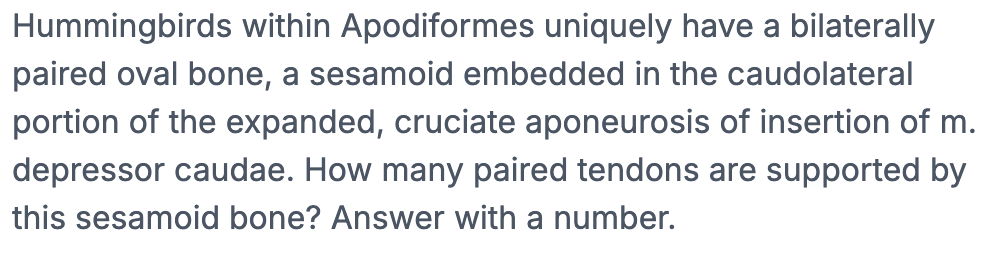
Here’s what it looks like
As a human, these two problems look hard to me lol

Wrapping Things Up: Mapping the Landscape of AI Evaluations
Each of these benchmarks pushes large language models to excel in different ways:
- FrontierMath: Grappling with deeply symbolic, multi‐step proofs and advanced mathematics.
- AIME: Advanced high‐school math competition tasks, bridging conceptual creativity and precise integer answers.
- ARC‐AGI: Abstraction and pattern recognition without domain knowledge. Tests a model’s “core intelligence.”
- GPQA: Graduate‐level, “google‐proof” science questions that challenge the model’s real understanding of specialized domains—and highlight the oversight problem.
- SWE‐bench: Real‐world software engineering tasks, complete with large codebases and test‐driven development.
- Humanity’s Last Exam: A brand new data set that’s focused on very difficult problems across a wide range of fields at the frontier of human knowledge.
Taken together, they embody the depth and diversity needed to push AI research forward. Any LLM consistently hitting top scores across all these fronts would be demonstrating not just memorized knowledge but also flexible reasoning, domain expertise, adaptability, and problem‐solving creativity.
That’s precisely why evaluations matter: they define the hurdles on our road to more trustworthy, capable AI. By watching how models tackle AIME’s creative math, ARC’s puzzle logic, or real GitHub bug fixes, we see whether we’re inching closer to robust intelligence—or just getting better at superficial performances.
Thanks for reading! If you enjoyed this overview, share it with fellow AI enthusiasts or math/CS competition fans. Each benchmark is an ongoing effort, so if you’d like to explore further—or even contribute new problem sets—keep an eye on the official repositories and academic calls for participation.
Further Reading & Links
AIME Resources: Mathematical Association of America (MAA)
ARC Corpus and Philosophy: François Chollet’s ARC Paper
GPQA Paper: “GPQA: A Graduate-Level Google-Proof Q&A Benchmark” by David Rein et al.
SWE‐bench: OpenAI’s SWE-bench dataset
Humanity’s Last Exam: Site with explanation and dataset
By testing each unique dimension, we collectively refine our notion of what “intelligence” in AI can and should look like—and pave the way for breakthroughs that help LLMs truly augment human capability.
For more on AI, subscribe and share!

\The robots are getting very good at learning\