In the wake of o3, a look at how scaling, complexity, and human inertia are reshaping the future—from token streams to fractal software to our own future in this new world. Part of a series, probably.
By Nate
Published: 2024-12-22
URL: https://natesnewsletter.substack.com/p/the-new-laws-of-intelligence-a-manifesto
If it feels like we’re dancing on the edge of a tech singularity, it’s because we kinda are. There’s a swirling mix of breakthroughs, misunderstandings, cultural inertia, and serious moral dilemmas—all hitting at once. Below is an attempt to decode the “new laws” shaping our intelligence-driven future, arranged in an order that hopefully flows like a good narrative. Let’s roll up our sleeves and dive in.
If you’ve been paying attention, you’ve heard about o3 by now. It’s not just about building bigger neural nets and feeding them more data anymore. It is the #175 best programmer in the world. It is breaking the ARC-AGI prize. It is smarter than 99.99999% of humans at math (25% on FrontierMath is a big deal). Yes I counted the 9’s and that does leave ~800 of us who are better at math than o3 which tbh might be generous.
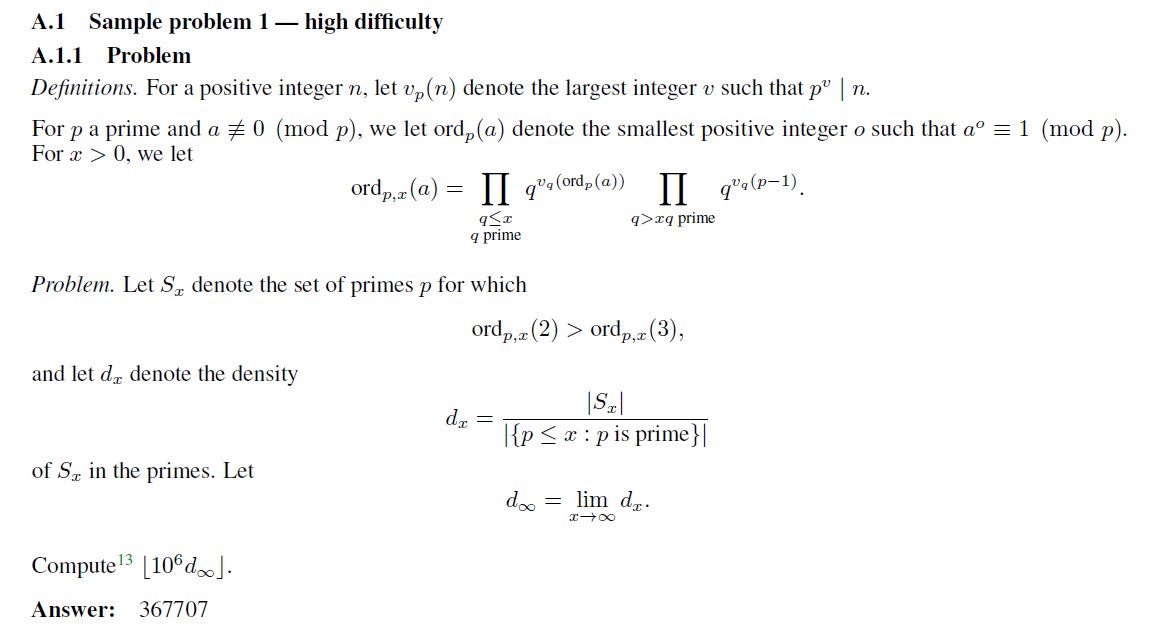
\Could you answer this? It’s a FrontierMath problem.\
So what does this all mean for us? First, I do believe something has fundamentally shifted in the last year. In the last quarter. You can’t look at this graph of AGI performance by AI and not think so.
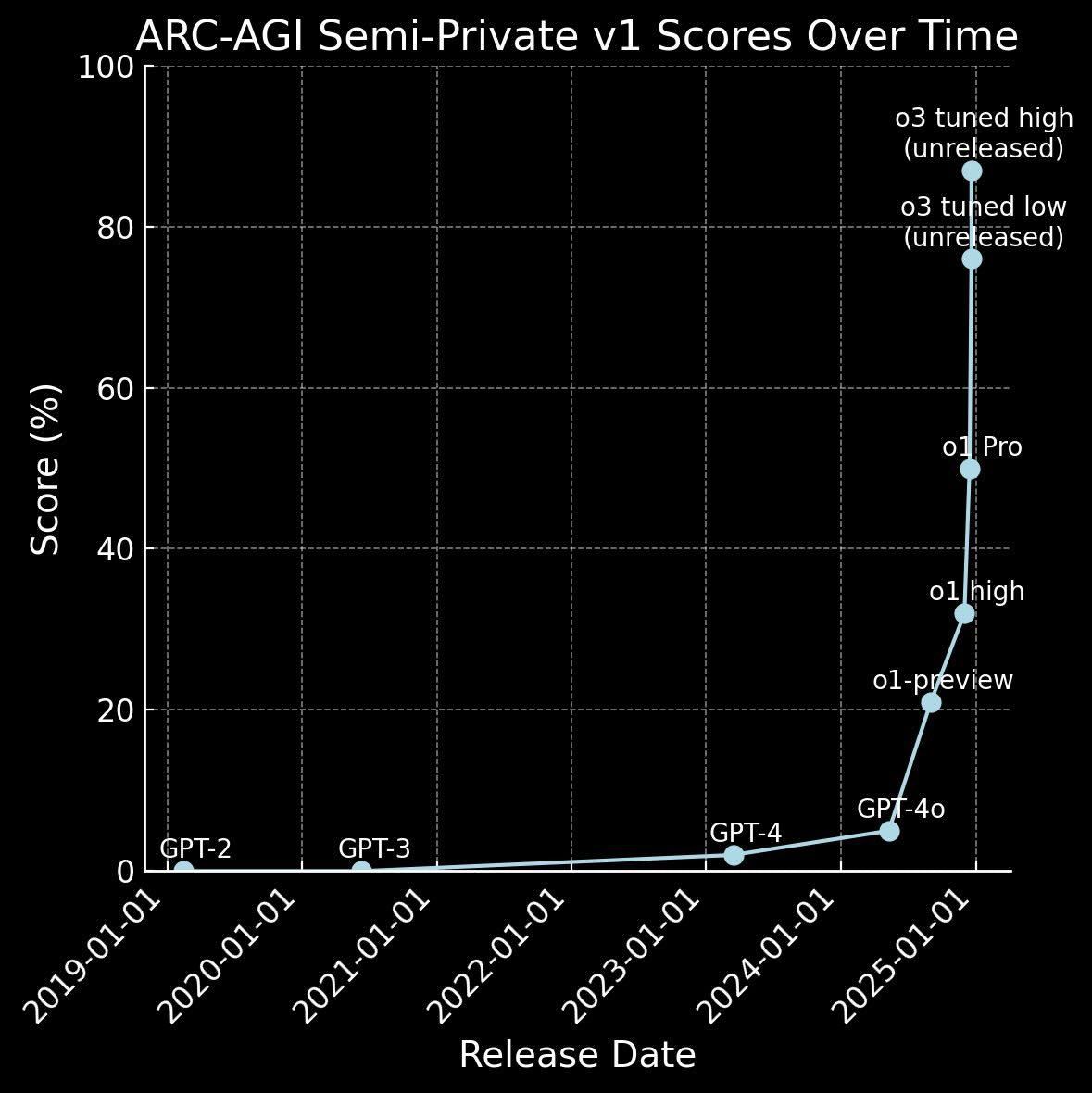
\The most important hockey stick in history?\
Take a minute to digest that graph. Once you have, I’d like to suggest a series of increasingly spicy takes on what will characterize the new intelligence age we’re entering. Let’s start with the baseline assumption that the world as we know it will be fundamentally different, and instead of predicting future events it’s probably more useful to infer scaling parameters. I call these laws for short, but think of them more like an attempt to infer or discover dynamics that should drive social and technical systems in a world where intelligence is going vertical.
So here’s my take on 13 laws that I think will start to get sharp next year.
1. Intelligence scaling laws are abundant, not scarce
I said this would be in increased order of spiciness but as I write this I realize this one is already pretty spicy. Does anyone remember when just a month or so ago this was revolutionary? The idea that test time compute could add a second scaling law suggested that we were going to rapidly increase intelligence going forward (see graph above).
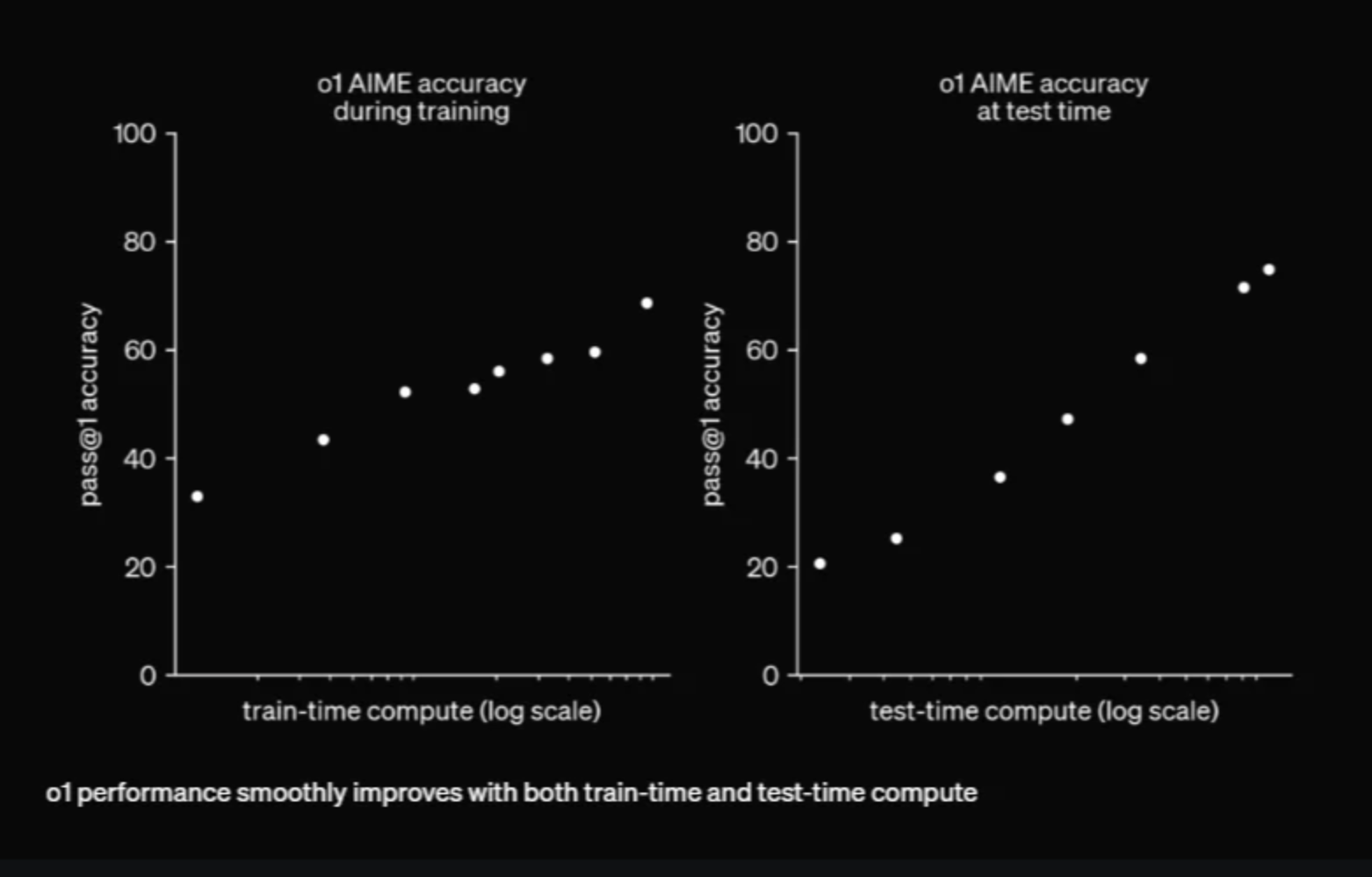
\A dual scaling law, but wait!\
But what if I were to tell you that we’re starting to see signs of yet a third scaling law?Credit to Shengjia Zhao for calling this out:
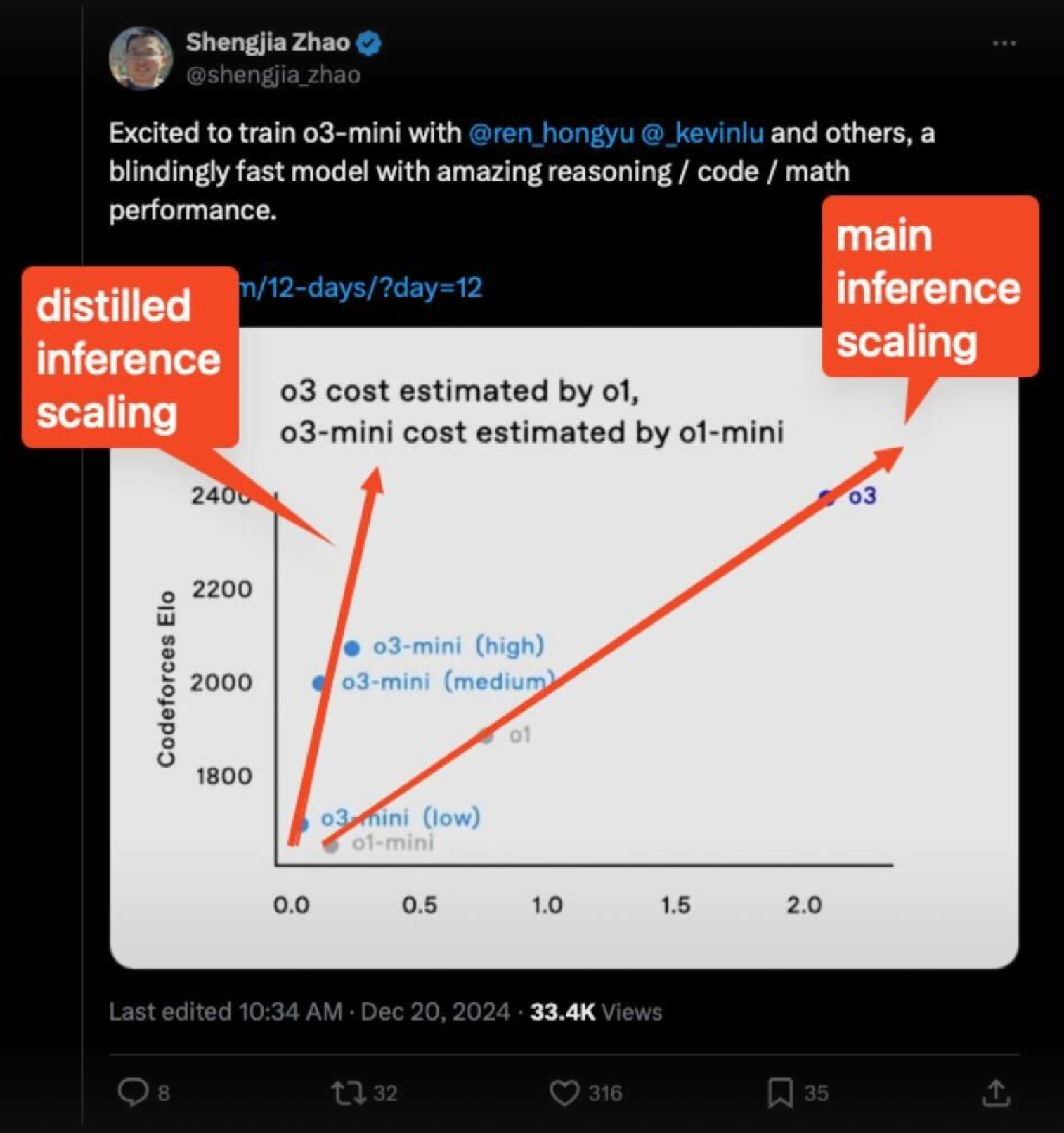
The implication here is profound. If there is indeed another scaling law around distilled inference scaling, it suggests that distilled inference models (minis) will become cheaper more quickly as main inference models scale in intelligence. This lines up well with OpenAI’s confidence that they can release a scaled down o3 mini that is performant and cheap quickly. A distilled inference scaling curve is a massive driver of intelligence ubiquity—it implies a future where extremely expensive e edge performance is followed quickly by Pareto principle mini versions that capture most of the value at a several orders of magnitude less cost. If your new intelligence model is 5x better and you can deliver 80% of that at 1% of the cost of the original quickly then intelligence is going to get faster and cheaper than most of us are able to imagine.
2. But We’re Already (for Practical Purposes) Over-Abundant
Here’s the kicker: in many ways, we already have more intelligence than we strictly know what to do with. While the media fixates on the next big GPT release, we’re actually underutilizing the AI that’s right under our noses. Even a run-of-the-mill large language model can handle an absurd swath of tasks—ranging from summarizing legal documents to drafting marketing copy to analyzing bug logs. It’s an ocean of capability, waiting.
But we have organizational gridlock, confusion over best practices, and a general “Wait, is it safe to trust AI with that?” mindset. To be fair to most of us, the main model makers have been so busy building models that they haven’t really socialized the capability set these models bring to the table, nor have they had time to actually evaluate model capabilities in real-world scenarios across multiple industries. This leads to a core insight: most model capability in your industry is undiscovered, and the undiscovered territory there is increasing exponentially as models gain intelligence faster and faster. So the real bottleneck isn’t some imaginary shortage of smarts; it’s our (very human) inability to integrate these powerful tools into daily life. That’s a theme you’ll see repeated: plenty of intelligence, not nearly enough social, legal, or infrastructural readiness.
3. Problem Complexity Has Incremental Cost
Now, for a twist: While we bask in that ocean of intelligence for the everyday stuff, the edges of AI are a different story. Going from “really good” to “holy crap, near-human or above-human” intelligence can get astronomically expensive. We’re talking exponential jumps in compute power, specialized engineering, huge data pipelines—just to inch forward another few percent in performance. I’m not actually making that up—during ARC-AGI evals o3 cranked up delivered an incremental 3.5 percentage points in score gains per hour of compute across a 16 hour test.
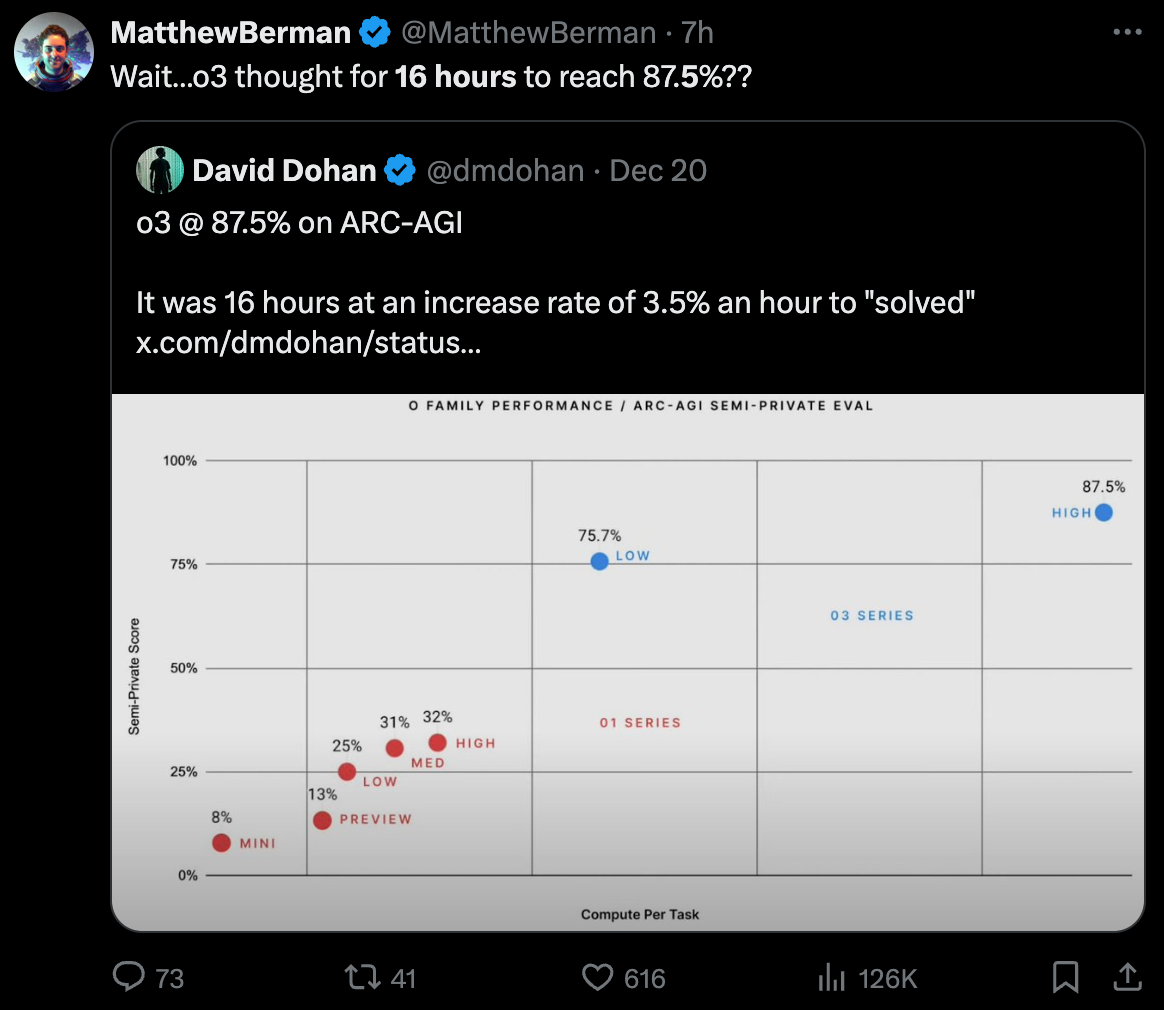
\Thanks to David Dohan for the callout here.\
So is it worth it? In niche, high-stakes domains—drug discovery, fusion energy modeling, nuclear deterrence simulations—absolutely. But for the majority of tasks, the ROI of the maximum intelligence we already have becomes questionable. This is why o1 Pro (we hardly knew ye) was targeted to science and researchers.
This is a big deal, because it sort of breaks our brains. We’ve lived in a world of flat intelligence for all of species history. Now we live in a world of exponential intelligence. In our previous world tool use was a breakthrough technology. Now leverage may be shifting elsewhere in the intelligence landscape. For instance, ability to correctly map complexity to model may become a highly monetizable skill. We can’t just say, “Sure, 10x the compute budget, we want 1% more accuracy” unless we really need to move from 98% to 99% on a task. The cost curve is no joke.
And this brings me to…
4. Humans Are Going to Stay Bad at Estimation
Enter the next big snag: we suck at scoping projects. It’s a well-documented phenomenon in software development—people are optimistic by nature, or they just fail to see hidden complexities, or both. There’s something extra complex about estimating software projects—we can’t see it, we have differing understandings of the edges of complexity and the problem, and we have different approaches to using code as a tool—in an AI-saturated world, the stakes for getting these estimates right go up exponentially. Do you want to use an Agile point system for picking a model to solve your problem? If you misjudge how costly that “next 1% intelligence boost” is going to be, you could sink entire budgets (or companies) chasing a bad estimate.
And I think this human difficulty with estimation isn’t going away. It’s been flat for decades. We haven’t magically gotten better at estimates. Scrum, agile, Kanban—the only thing that helps is a deeply experienced team that knows how to work together and knows the code. Even then estimation error bars are wide—like give or take a 2 weeks over a 6 week project at best.
But that’s not an acceptable error bar in our new world. Now we’re dealing with black-box models, uncertain leaps in architecture, uncharted ethical territory, plus the intangible cost of training ever-larger systems. We might need a new breed of professionals—call them “AI project economists” or “intelligence auditors”—to close the gap between our naive guesses and the harsh reality of incremental cost curves. Or may be we solve it with specialist AI models.
Conquering this kind of human propensity is going to take new ways of thinking, which brings me to…
5. Think Different: If It’s a Token Stream, It Can Be Optimized
Now let’s pivot to a conceptual shift that’s fueling many of these breakthroughs. Language models in a GPT architecture treat words as discrete “tokens.” But text is just one application. If you chunk code, logs, sensor readings—practically any data—into token sequences, guess what? You can feed those tokens into AI systems designed to handle them, transforming, predicting, and optimizing in ways that blow older rule-based methods out of the water. That core insight has been one of the foundational discoveries of the intelligence age. ChatGPT wouldn’t be possible without tokens (and now Meta says it has beat tokens—a story for another day).
Why are tokens so powerful? Because tokenization is a universal data interface. You can unify how you process disparate data types by seeing them as chunkable emitted data streams to parse, interpret, and generate. That kind of unification used to be a pipe dream—machine translation for code, sensor data, text? Now it’s a reality. It’s a mental rewire, for sure, but once you see your business processes or software logs as tokens, you start imagining new ways to supercharge them.
Which brings me to…
6. What’s Not a Token Stream?
The short answer: almost nothing is not a token stream. Your billing system? A token stream. Your data lake? Definitely a token stream. Your business logic? Reworking token streams. The information stream you process to drive? It can be a token stream. Your bedtime stories to your kids? Yep, it’s a human-generated token stream.
You can break nearly every complex system into transformer-intelligible chunks called tokens. An IoT sensor array spitting out hourly readings? That’s a sequence. An accounting ledger spanning decades? Another sequence. And with each sequence, you have a potential gold mine: maybe you can forecast anomalies better, maybe you can detect fraud patterns, maybe you can automate reconciliation tasks that used to require human eyeballs.
This worldview is bigger than just “language modeling.” It suggests a future where we treat data ingestion as a single universal pipeline. The kicker is that it drastically simplifies certain aspects of system design—you build one pipeline for tokenized input, then let specialized models do the heavy lifting. It’s an incredibly flexible approach, tying deeply into that scaling laws + abundance of AI synergy we kicked off with.
I will say, though, that this doesn’t mean I’m suggesting we will immediately run to software designs that forcibly unify data pipes into some sort of giant mish-mash. Instead, I’m asking us to think about leverage in our product work as the invitation to imagine the product landscape as a tokenized landscape and then find the high leverage token transformations and slot intelligence where it has the most value. There’s a lot in that statement and I may do a separate post there.
Despite this mental model shift, some things haven’t changed about software…
7. Software Remains Fractal
A stable lens that merges nicely with this new token-stream idea: software continues to have these self-similar, repeating structures at different scales. I don’t see that changing. Look at a microservice architecture or a monolith, you’ll see patterns that pop up again and again—APIs, transformations, data flows, error handling. The structure of any SAAS business software solution is so well understood that entire PE models have developed to roll up SAAS. Software is simply connecting data with business rules to interfaces that solve human problems. Complexity inside that basic architecture is nested—the signup flow is a mini piece of software that has the same basic structure of the larger site. It’s basically the same architectural thinking, just repeated across clusters, or across entire ecosystems of services.
Fractal software means that if we figure out how to optimize or automate a pattern at one level—say analyzing a particular code snippet in a small library—we can often replicate that solution at larger levels. Throw enough compute at it, and you can solve bigger fractal patterns. This fractal approach dovetails with tokenization: break stuff down, process it with a known method, then piece it back together.
The implication here, I think, is that we are on the leading edge of a longterm transformation in our ability to build scaled software solutions. No one is pretending that o3 by itself today can engineer Netflix. But the fractal nature of software suggests we’ll get there—perhaps soon.
BUT, that doesn’t mean we humble humans are screwed. Here’s why…
8. First, Software Has Infinite Demand
If you think we’ll ever “run out” of software to write, you’ve never worked in a real-world enterprise. The death of developers has been preached by news outlets since the 1990’s. There are more developers than ever. There are always more features to add, more bugs to fix, more automation to do. Every time you solve one problem, new problems pop up. That’s infinite demand right there. Just ask anyone who’s spent time triaging Sev-3 or Sev-5 tickets in a backlog that never fully clears.
Now combine that with the fractal nature of software and the token-stream worldview. We can tackle tasks at scale. But guess what? The moment we solve 1,000 issues automatically, I bet you we notice 2,000 new areas to optimize. Human creativity is a fountain of new ideas and new demands. This keeps devs and AI systems busy—there’s always another corner of your architecture to refine, another data pipeline to build, another user pain point to smooth over.
Software has infinite demand, and that’s a source of job security right there. But, there’s another drive of software job security…
9. Enterprise Software Is Still Hard
While it’s trivial to spin up a toy AI demo (I teach it in a class), scaling to Netflix-level reliability or Fortune 500 compliance is a beast of a challenge. You can’t just duct-tape a large language model onto your existing system and call it a day. Prototyping in Lovable doesn’t work for actual production software at scale. And it’s not close. Enterprises deal with security audits, multi-cloud strategies, data governance laws, legacy code from 1992 that nobody remembers how to fix… the list goes on.
This is why humans remain critical. We’re the ones who negotiate business requirements, interpret regulations, and figure out how to handle corner cases that no AI is quite prepared for. Yes, we have an “ocean” of intelligence, but bridging that to enterprise-grade products still demands old-school project management, domain expertise, and trust-building. I’m not going to sit here at the end of 2024 and dare to say AI will never do this stuff. But I’m going to say it’s hard. And that in turn reinforces another pro-job dynamic that isn’t changing any time soon…
10. Jobs Are Remain a Function of Human Trust and Cultural Momentum
Look at the steam engine. It took over a century and a half to fully integrate into every corner of society. Technology alone didn’t flip a switch; culture, institutions, and economics took their sweet time catching up. That’s cultural momentum in action. It applies to AI today: just because the tech could replace or transform certain jobs doesn’t mean it will next Tuesday. People’s trust in AI, legal frameworks, corporate workflows—these things move glacially.
Our existing social structures are rooted in how we “expect” work to happen. The inertia is huge, and for good reason: trust isn’t built in a day. So while the possibilities are mind-blowing, the mainstream adoption pace might be slower than the hype suggests. If your job is heavily interlaced with institutional trust, it’s probably safer (for now) than a hype headline would lead you to believe. I walked through the airport yesterday and saw life going on quite as usual, even though I knew our world had fundamentally changed.
I don’t know what you call the interior sense of dislocation that occurs when you see a future coming fast that those around you seem unprepared for, but there’s probably a German word for it somewhere. It’s isolating and strange and I think those of us who see what AI is are going to feel it a lot more next year. But that very dislocation is a cushion for the speed of change—when 98% of people don’t believe the world is that different then…it doesn’t change fast.
Ok that’s the basics of the brave new world, conveniently wrapped at ten laws. If you’re still with me, it’s time for the SPICE!
11. Reasoning Inference is Actually Antiagentic (Spicy Take Warning!)
You stuck with me and now you get a treat. Here’s where it gets real spicy: I am beginning to think that reasoning and agency run on separate rail lines. Everyone has said that 2025 is the year of AI agents—and I know the consensus itself is in and of itself is a reason to be skeptical—but even if everyone is right and this is the year of Agentic AI I would suggest that the model progress we’re seeing is not yet aligned with agent-based AI systems.
In fact I’ll go farther: we’ve seen enormous progress in thinking and reasoning models via test time compute over the last half of 2024, but those models are arguably inherently less agentic than their predecessors precisely because they can think and reason. Think about it: you want an agent that will do what you ask it to do, and that means that the agent shouldn’t have too much critical thinking capabilities because then it might select a different path it thinks is smarter. Reasoning systems are not agentic, because they are designed to effectively practice critical thinking at the highest level. If you can think like a post-doc researcher (and o1 Pro can already) then you are going to push back more on queries (which o1 Pro does) and you are going to be less agentic inherently.
And the kicker is this: reasoning has all the momentum right now. Agentic is a dream and a pile of frameworks. It’s still getting enough investment that it is going to happen in some form in 2025. There is too much monetary momentum not to bring agentic into the world this year—but money and excitement aside the technical progress has been weighted much more heavily to the reasoning side of the tracks. We’ve had no breakthrough ChatGPT moment for agentic yet, but we’ve had multiple reasoning breakthroughs in the last 12 days.
All this implies we might need a separate or parallel path to “true agency” in AI. Maybe it’s closer to the classical GPT approach (with its token-by-token generative style which may enable more precise control), or maybe it’s a wholly new architecture that merges reasoning with actual drives.
Regardless I think appreciating that reasoning and agency may run on parallel tracks helps to blow up the common assumption that “once AI can reason as well as humans, it automatically becomes Skynet.” I may hear that in my TikTok comments a lot, but it’s necessarily true.
12. Synthetic Is Not a Problem (Also Spicy)
One of the biggest debates in 2024 was around whether or not synthetic data could get past The Wall. The Wall is the idea that we have only so much data and therefore pre-training traditional GPT models on lots and lots of additional data to make them lots and lots smarter may not be viable. So said former OpenAI founder Ilya Sutskever as recently as last week. But current OpenAI researcher Noam Brown shot back at the same conference that reasoning was a way forward, and that reasoning was achieved via synthetic data generation (in part).
Now the talk is of using o3 synthetic data to rapidly train additional models, because the reasoning of the model enables researchers to have a high degree of confidence in the quality of data. Gone are the days of a GPT architecture where a single LLM searched in vector space for a pattern match. We need to fundamentally change our vision of LLM architecture to a single chat window stretched across thousands of LLM calls governed by a relentless Monte Carlo logical search engine (write-up from ARC-AGI here).
So the spicy take is simple: getting to reasoning makes the synthetic problem go away. I think we’ll look back on synthetic data as a 2023-2024 blip in the journey toward Artificial General Intelligence.
13. Ethics May Be a GPT / Uncanny Valley Artifact (Five Stars F’ing Spicy)
Finally, the real mic drop. We’ve spent years tearing our hair out over AI ethics. The models we use talk about ethics when we don’t ask them to because they’re being reminded of it all the time. But what if all those “zombie” moments—AI spitting out racist diatribes, or repeating harmful stereotypes—are symptoms of primitive architectures that lack true context and moral reasoning? In other words, maybe it’s easier to align a deeply reasoning AI than a simple, brute-force transformer. It’s possible that we’re in an “uncanny valley” of AI ethics: advanced enough to cause havoc, not advanced enough to fully comprehend moral nuance.
This implies that many of today’s ethical crises might fade as AI becomes more contextually aware and truly capable of reasoning. It’s definitely a spicy take, and it might piss some people off because my observation is that anytime someone is optimistic about ethics and AI they’re viewed as either a Pollyanna or in the pay of some nefarious actor. I’m neither, but I am beginning to get suspicious that o3 is the first indicator that ethics may get easier from here out, especially as researchers used more reasoning-based approaches to train it on ethics.
This doesn’t mean zero risk of misalignment at all. We saw misalignment risk from a GPT model (Claude) published just this week. But if it’s true, then the meltdown over AI’s moral hazards could be a growing pain rather than a permanent apocalypse. In hindsight, we might see 2023–2024’s frenzied debates as an artifact of halfway-there architectures, not an inevitable collision course with evil AI overlords.
Fin: How Wrong Am I?
If you’re still reading, I want to leave you on a note of humility. I don’t know that these are the 13 fundamental laws that shape 2025. Maybe I don’t have the most comprehensive underlying dynamics mapped correctly here. Maybe I do but I’ve mis-described them. Humans are near 100% incorrect at mis-predicting the future. But one thing I do know: o3 marks a moment. Questions like these are not just a niche interest for AI nerds anymore. We’re on the cusp of the next wave of human history. Buckle up.
For more on AI, subscribe and share!

\This is what MidJourney thinks an AI reading the 10 Commandments looks like lol\