So much for AI winter. It's been 11 hours and I can already tell this is one of those days we're going to mark in the history books.
By Nate
Published: 2024-12-06
URL: https://natesnewsletter.substack.com/p/the-day-the-rocks-began-to-think
December 5, 2024, may go down as the day the rocks began to think. OpenAI launched o1, ushering in a new era for large language models. Yes, it’s a big deal. Eleven hours in, and o1 already feels indispensable to me. I can imagine dozens of uses for it that would not be well-suited to 4o—like coding simplification for starters.
This day has been a long time coming. OpenAI has been hinting guardedly for months that o1 was on the horizon, but no one knew when exactly we’d get the next big leap in intelligence. Well, it’s here.
And as OpenAI is teasing 12 Days of OpenAI there’s a lot more to come! But for today, o1 is plenty to digest. I’ve spent time today chatting with it and already the difference is clear: If its predecessor, GPT-4o (“4o”), felt like an overly wordy intern, then o1 feels a truly senior partner. Someone who knows how to be thoughtful, concise, who can walk you through a complex problem with calm mastery.
It’s been a few hours, and I’m still just scratching the surface with o1. While I’m still exploring, I have strong early opinions: o1 is faster at zeroing in on the heart of a problem and better at explaining each step. It’s like having a 10 or 15 year veteran sitting beside you, thinking through the whole problem and answering correctly the first time. It’s a world apart from what we understood about LLMs just yesterday.
From Intern to Partner
Thousands of hours of YouTube and millions have words have been created to debate what intelligence means in AI. For two years now, language models have mimicked knowledge and reasoning. They can write essays, answer questions, code, and summarize complex texts. But they always felt slightly junior—eager, bright, but prone to confusion when pushed too far. Complexity and nuance tripped them up. To keep them on track, you had to nudge, rephrase, and sometimes simplify your questions, much like guiding (or leaning on) a junior analyst still learning the ropes.
We have to have that whole debate over again now with o1. With full chain-of-thought reasoning, o1 approaches problems the way a thoughtful human might: it breaks down puzzles into manageable steps. It doesn’t just give an answer; it shows a careful internal process that leads to a more reliable, well-reasoned conclusion. And it does it faster than o1 Preview! It’s as if we’ve finally given AI the ability to think to itself before answering. This capability underpins more accurate responses in coding, data science, and even specialized domains like math or case law analysis.
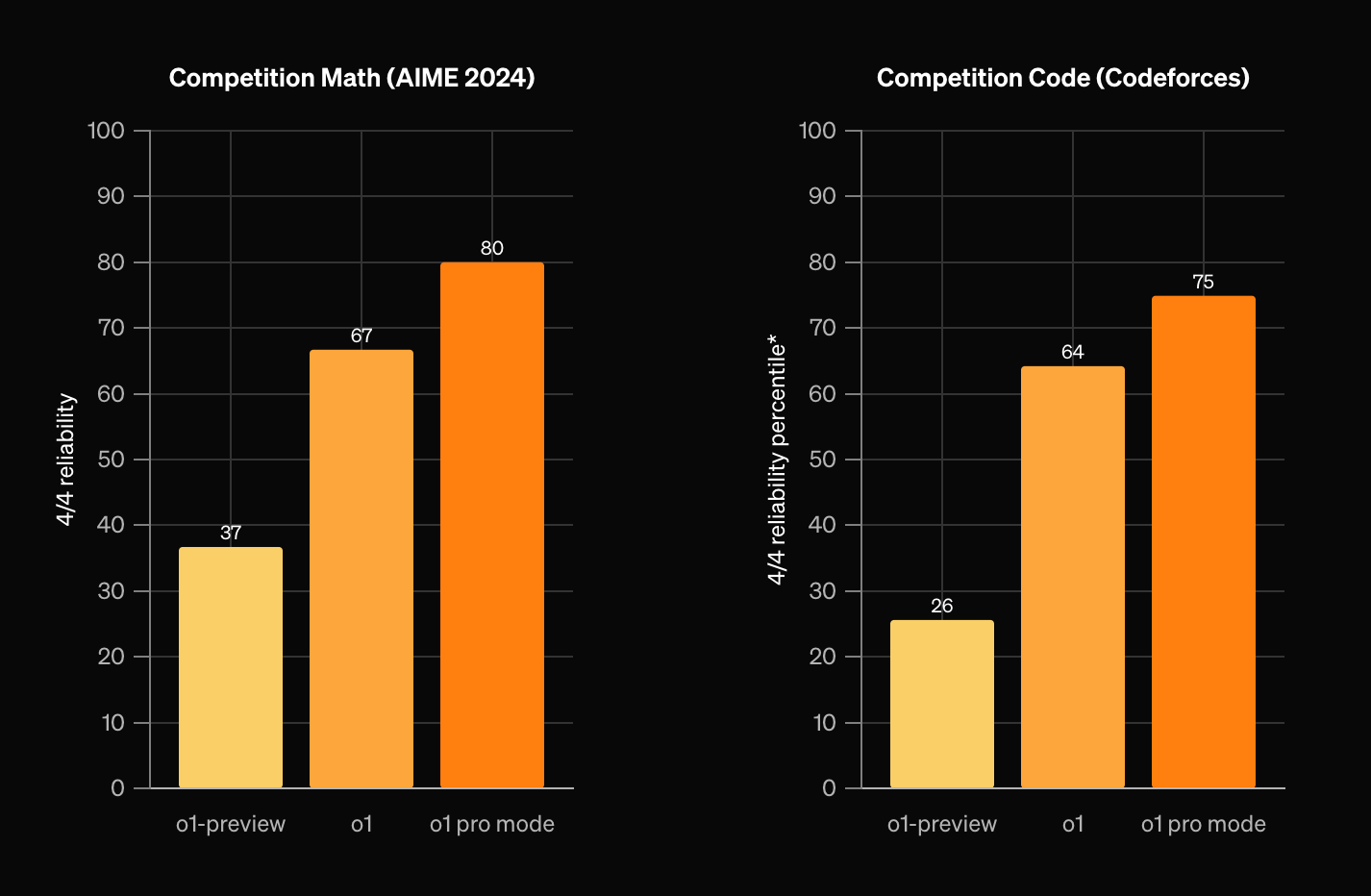
In fact, o1’s reasoning skills are so developed that OpenAI tested it on benchmarks that the vast majority of humans couldn’t solve—competition-level math and code problems once considered out of reach. On the AIME (a notoriously difficult American math competition), o1 preview models soared to performance levels rivaling top students. On Codeforces problems (a platform for competitive programming), o1’s skill beats older models by a wide margin. The graph below tells the story.
\Source: OpenAI\
It’s a vibe shift, but I’m going to put a stake in the ground: we’re going to look back and say today is the day the rocks began to really think. We may not be at Artificial General Intelligence (AGI) quite yet, but I can see why Sam Altman thinks AGI is coming in 2025. This does not mean all jobs will go away (post here).
My guess is we will hit AGI sooner than most people in the world think and it will matter much less. - Sam Altman (reported in the Verge)
What does the difference between 4o and o1 feel like?
You’ve got the TLDR, but if you want to dive in, here are the dirty details!
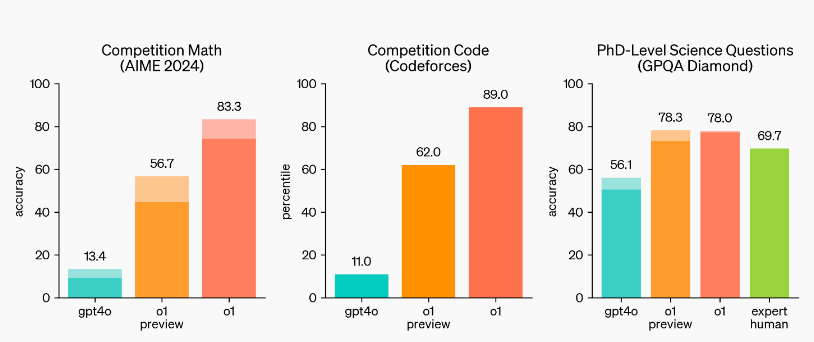
GPT-4o was already impressive, but o1 is in a new league. With more advanced reinforcement learning techniques, o1 thinks before it answers, generating a private chain of thought before producing a final response. This approach, refined through careful training, leads to fewer dead ends and more consistent accuracy. Its only day one, but so far its handling of technical subjects and complex questions feels natural and methodical. Where 4o might have given a correct but sometimes wordy and tangential answer, o1 laser-focuses on the logic and heads for the correct answer faster.
\Source:Vellum\
Where might this apply in practice? In coding tasks, o1 now ranks in the top tier of human competitors under tight constraints. And when allowed more time and submissions, it can surpass human experts on challenging tasks. In math, o1 doesn’t simply recite formulas—it solves real problems. If 4o was a capable undergraduate, o1 is the seasoned researcher who can guide you through proofs or debugging sessions with equal finesse. That’s not just me saying that! In fact, o1 Pro is packaged precisely to appeal to PhD researchers looking for an LLM research partner.
Introducing o1 Pro: The Science and Math Whiz
Today’s launch would have been big enough with just o1. But in addition to o1 arriving on Plus and Teams plans, we also got a big new surprise: o1 Pro, available through the new $200/month (yes!) ChatGPT Pro plan. O1 Pro mode uses more computational resources at test time, allowing the model to think longer and reason even more deeply about the toughest problems. The model uses a special progress bar to measure and display progress on tasks that can take minutes. Early evaluations show o1 pro mode producing more accurate answers in areas like advanced math, code, and legal reasoning benchmarks. So it’s slower, but thinks better.
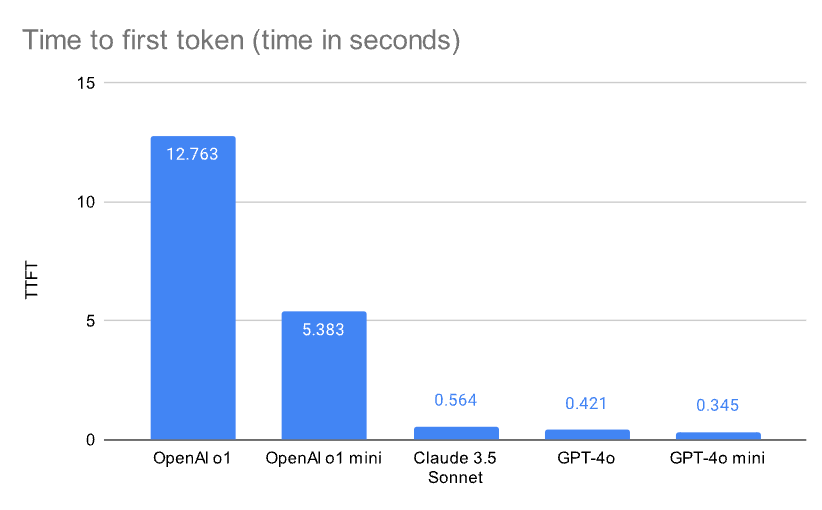
\Source:Vellum(note that I believe they are incorrectly labeling this as o1 when it was actually o1 preview out at the time of authorship in September—o1 seems much faster than o1 Preview so far)\
For those who push models to their limits—researchers, engineers, data scientists—o1 Pro offers a powerful ally. And I will double down on this: o1 is cheap at the price for the kinds of tasks it can do. I mean it. Imagine this: you’re a solopreneur and your choice to scale is either hire a developer or use o1: o1 Pro looks like a screaming deal. Or you are needing to choose between not finishing your grant research or getting it done on time: o1 Pro looks like a screaming deal. I’ll be honest here—I don’t know how many of us actually need o1 Pro level intelligence. I’m actually not sure how many of us need o1 level intelligence! I find it an extraordinary upgrade, but it certainly feels over-powered for entry level roles at this point.
If you take one thing away from o1 Pro, take this: the rocks can think better than most of us need them to already, and we’re still worried about AGI (which by all accounts is going to be yet another massive gain in intelligence in 2025).
So why does continued improvement matter? Why not stop? Because extraordinary innovations that power the lives of billions of people have always been made at the margins, and powering up intelligence so it can impact the margins of our knowledge is the highest leverage use I can think of for AI. That core insight is precisely why o1 Pro is aimed at science and mathematics.
Back to o1: the TLDR is Better Writing, Better Reasoning, Better Results
Even if you’re not coding complex algorithms, o1’s improvements shine in everyday uses. Ask it to write a detailed report, and the prose is tighter, more precise, and better organized. Summarize a complicated scientific paper, and you’ll get a well-structured explanation that doesn’t lose itself in jargon. I already find the model’s clarity startling, as if it has learned to coach itself internally, ensuring it never strays too far from your request. This means I stay clearer and I find that for the first time talking with an LLM is less about multi-step conversations and more about a very thoughtful initial prompt followed by a very thoughtful response. It’s almost like old-fashioned snail mail in that way.
The combination of deeper chain-of-thought reasoning and improved training means that even tasks once considered “soft” benefit. O1’s writing feels more polished, its analogies more apt, and its grasp of context more reliable. It doesn’t just draft emails. It writes them cold, in your style, first go round. I still have to think through my ask carefully, and I still have some opinions, but increasingly I find that o1’s response is so tightly constructed that my opinions end up being about the defects in my own prompt, not really about o1’s quality of response. This indicates to me that o1 is going to look like not much of an upgrade unless you have complex work and know how to prompt at a high level—but if you do o1 feels like going from a Toyota to a BMW.
What’s next?
Today we’ve been handed a tool that might redefine how we think about intelligence itself. The old arguments—“Can AI think, or is it just mimicking thought?”—start to feel academic when faced with a system that reasons, refines, and improves its output. I’m honestly just not that interested anymore. I’d rather spend the time figuring out how to solve problems with o1. Time will tell, but my view is that on December 5, 2024, we crossed an invisible line: today was the day when models began to feel less like tools and more like collaborators.

\I asked o1 to give me a prompt for a self-portrait. This is the result.\
And we’re not done yet! The 12 Days of OpenAI hint that more is coming. We might see new application programming interfaces (APIs), more compute options, maybe Sora will finally drop, maybe we’ll get o1 that can browse or better handle file uploads. We probably need better handling for spreadsheets. I can’t wait for the next 11 days.
The line between a sophisticated tool and a genuine thinking partner has blurred. We’re not just telling these models what to do; we’re working with them, exploring problems together. December 5, 2024, is the day the rocks began to think. I think you’re going to want to remember to tell your kids where you were today, because they’re gonna read about this in the history books (or ask ChatGPT about it).
If you want to hear more about the 12 Days of OpenAI, subscribe and share!

\o1’s prompt for the abstract idea of teaching rocks to think\