A meditation on the fragility of our materials supply chain in the wake of the hurricane
By Nate
Published: 2024-10-01
URL: https://natesnewsletter.substack.com/p/helene-hits-tech-supply-chains
Hurricane Helene has left a trail of devastation across North Carolina, parts of Georgia, and Florida. Links to donate are here and here. While the immediate human and environmental toll is evident, there’s another less obvious casualty: the global tech supply chain. Specifically, the hurricane has impacted Spruce Pine, North Carolina—a seemingly obscure town that plays a pivotal role in the production of silicon chips, the backbone of our digital world.
Spruce Pine is home to the world’s purest quartz sand deposits (more here), a critical ingredient in the Czolchralski process. This process is essential for transforming polysilicon into monocrystalline silicon ingots, which are then sliced into wafers for chip production. The purity required for these silicon wafers is astounding—11 nines of purity or 99.999999999%. To put it into perspective, that’s about one impurity atom per 10 billion silicon atoms. Put another way: if you had 10,000 copies of War and Peace, 11 nines of accuracy would mean tolerating one typo in that entire mountain of books. Achieving this level of purity isn’t just challenging; it’s a craft honed by a guild of experts over decades, relying on both natural resources and specialized human expertise.
The disruption in Spruce Pine highlights a larger issue: the fragility of our global tech supply chain. Companies like Taiwan Semiconductor Manufacturing Company (TSMC) depend on these ultra-pure silicon wafers to produce advanced chips. TSMC, in turn, relies on photolithography machines from ASML in the Netherlands, the only company capable of producing the extreme ultraviolet (EUV) lithography equipment necessary for cutting-edge chip fabrication. These are not easily replaceable components; they represent the pinnacle of technological advancement in their respective fields.
The demand for these advanced chips is skyrocketing. Tech giants like Nvidia are designing new GPUs to power the next generation of artificial intelligence and large language models. Data centers are scaling up, with companies investing billions of dollars and requiring enormous amounts of energy to run these facilities. Oracle, for instance, is building a $100 billion data center powered by three nuclear reactors. The competition for these limited resources is so intense that top executives are personally negotiating deals to secure their supply (see Larry’s Nobu dinner).
This brings us to a stark realization: our software-driven world is precariously balanced on a foundation of physical materials and specialized processes that are surprisingly fragile. Natural disasters like Hurricane Helene expose the vulnerabilities in a supply chain that relies heavily on a few key locations and companies. When a single town like Spruce Pine goes underwater, the ripple effects can impact technology sectors globally, from consumer electronics to critical AI research.
Today’s sharp thought: Helene is a wake-up call. It underscores the interconnectedness of our silicon supply chain, the delicacy of the relationship between our digital ambitions and the stormy realities of the physical world. Our software ecosystems, cloud services, and AI innovations are only as resilient as the material supply chains they depend on. It’s easy to walk away here with a simple truism about fixing bottlenecks, but the hard realities of materials limitations wash away easy answers and leave me more inclined to simply recognize the fragility of the system and (frankly) stand in awe that we have silicon at all.
If you enjoyed this post, give me a subscribe!
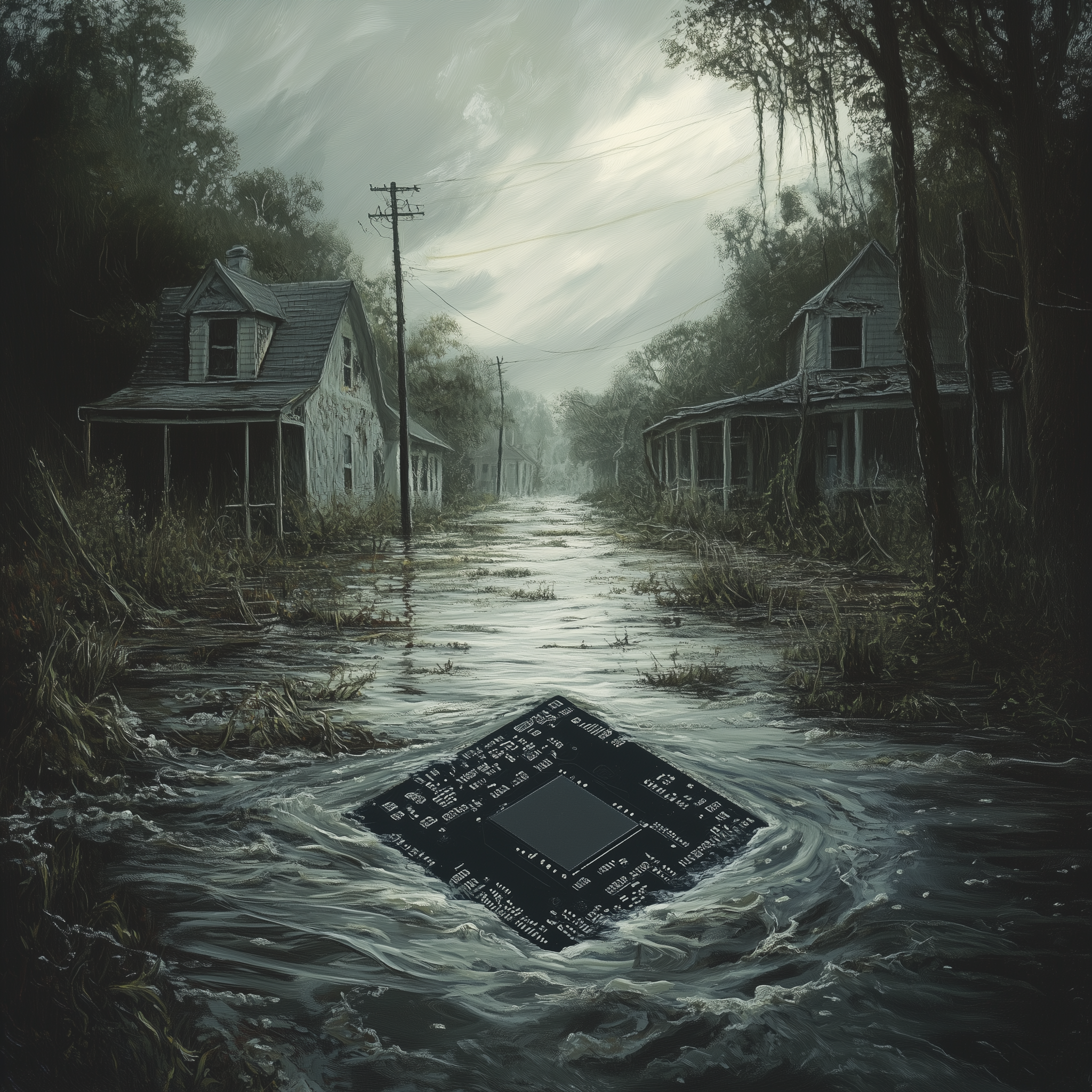
\A chip floats on the floodwaters, fragile and swirling.\