A short post on OpenAI, what kills momentum, and why we don't notice when it dies
By Nate
Published: 2023-11-21
URL: https://natesnewsletter.substack.com/p/momentum-is-the-rarest-thing
I hear it a lot. One of those inside baseball product things.
When we got together over coffee or dinner for the first 10 months of the year, it was common for my product (and engineering) buddies and I to remark on how fast the team at OpenAI ships. They had (for lack of a better term) it. They had it. Whatever the thing was that led to shipping round after round of meaningful updates on pace and at a reasonably high quality bar, they had that thing.
Nate’s Substack is a reader-supported publication. To receive new posts and support my work, consider becoming a free or paid subscriber.
And they partnered with people and companies who drove that acceleration loop, or fed it, or both. Microsoft has been on an insane shipping pace this year for a big company, and have pushed ship after ship out the door in the AI space, with more to come shortly.
I’m going to stop you right there if you think the answer is: they work extra hours Nate. Because I get it. They care about their work (their goal is to invent super-intelligence!) So what. A lot of us care about our work. There are plenty of founders and teams burning late night oil. Bias for action isn’t in short supply across tech either, so it’s not like they are the only ones with the instinct to ship either.
I’d suggest if you peel the onion what the OpenAI team had (has?) to an extraordinary degree is esprit de corps. We can call it ‘team spirit’ in English but that translation falls flat. The OpenAI team is one of the more extraordinary examples in recent memory of what a team of people can do when they are all profoundly united around a very difficult common objective. Hard objectives motivate teams, and people self-select against the difficulty and challenge.
I’ve seen some comparisons recently between the AGI project (Artificial General Intelligence, or what the tech community calls the goal of building silicon consciousness) and the NASA moon missions. The point being we are on pace this year or next to spend more money on AGI than on any other single organized goal in human history. More than the moon missions, the previous record holder. More than the Manhattan Project. More than we’ve spent on the recent spate of private space exploration.
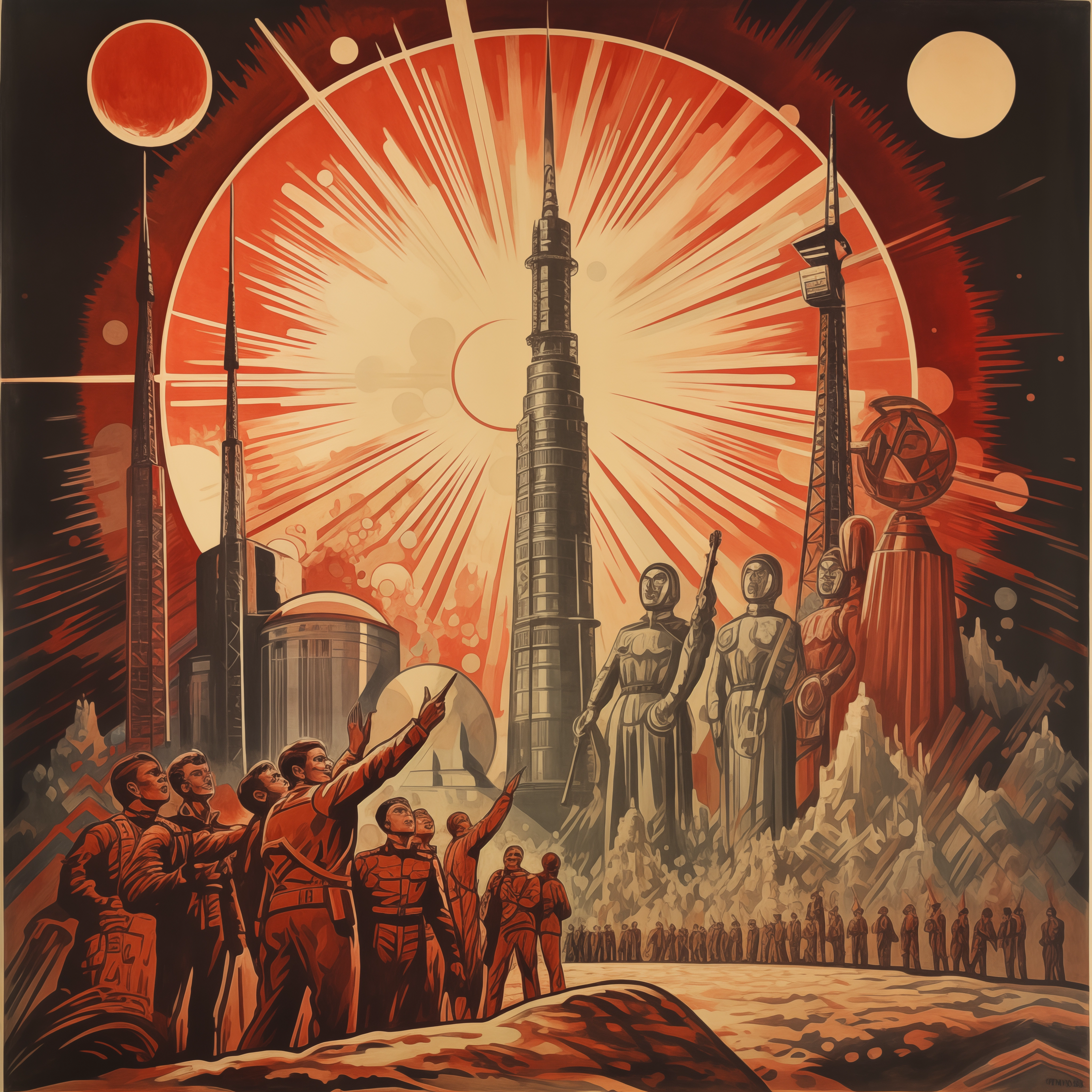
\Yes this is not in the style of NASA posters, but I messed around in Midjourney and thought the 1930’s soviet aesthetic was a nice illustration of the power of teams, even if NASA definitely won that race at the end of the day!\
And OpenAI was set to capture a disproportionate share of that cash burn until last week (with presumably a disproportionate chance of success).
But the team at OpenAI had an asset worth more than the purality of cash in the space, and that was the same sense of unity that motivated the moon mission team to get Apollo 11 to the moon in 1969, that motivated the team to get the astronauts of Apollo 13 home safely just a few years later. Esprit de corps.
If your company has it, you can feel it. If you don’t, it’s really hard to replicate.
And this weekend we saw that it might be the most powerful asset in tech.
Because of esprit de corps the interim CEO (for a day) of OpenAI asked the board to bring Sam back. Because of esprit de corps Ilya (who started all this) publicly apologized for breaking up OpenAI on Sunday. Because of esprit de corps something like 90% of OpenAI employees signed an open letter demanding the board resign and threatening to join Sam.
And the kicker is that the unity tested this weekend is what fostered the high trust, high velocity environment that enabled the OpenAI team to ship so fast. And although we can all see that now, under pressure, we are probably seeing the death throws of that momentum. And because we are drawn to the human side of the drama, or the AGI risk, or the politics, or the investor story, or the governance story, none of us are thinking about how momentum has just died at OpenAI.
The team is not going to be the same after this, wherever they end up. Shipment velocity has been interrupted and history shows once you interrupt the magic of a united team, you can’t just put the same people back together and expect it to magically work right away.
There is no one left who knows how to build a Saturn V. There is no one left who knows how to build a space shuttle.
That knowledge was distributed across expert craftspeople and engineers who all solved individual problems that together resulted in astoundingly complex technical solutions. It’s gone now, because the teams have been broken up. The shared memory of the teams is shattered.
It’s not all doom and gloom. If the board can make this a days-long interruption rather than weeks or months, then it’s possible the interruption will be minimal and shipping delays will happen but not be a long-term impact on the team’s momentum.
But given the board’s behavior this weekend I think we saw the death of shipment velocity at one of the most interesting companies in the world, and I grieve that. Uniting around a common challenge is a uniquely human endeavor (for all the fact that the current goal is about building something non-human!) Our team unity is what makes us capable of great things, and I’m sad to see a great team under pressure like this.
Momentum dies unnoticed because by the time we notice it, other things have broken our esprit de corps and usually it’s already gone.
Good luck finding your team and your mission,
Nate
Share with folks who want to read occasional, interesting product takes!