Or how change management works from seed to scale
By Nate
Published: 2023-02-08
URL: https://natesnewsletter.substack.com/p/how-to-change-a-lightbulb-with-15000
I’m not kidding about the 15,000 people, by the way. That is more or less how many people it took to launch a new marketplace in a new country at Amazon when I joined in 2016. 300 teams, each with ~50 people. All working toward a massive change that would affect millions of customers in a new country.
It was taking roughly 3 years to launch a new marketplace when I started at Amazon, and I was involved (very tangentially) in a couple of those launches. I’ve also seen the other side of the table: I launched a new country (Germany) as part of a team of 2 in less than a week when I was selling my own product. I recall we followed up with FRITES (France, Italy, and Spain for those who haven’t sold on Amazon) just a week or two later.
Thanks for reading Nate’s Substack! Subscribe for free to receive new posts and support my work.
And those scales interlock, don’t they? One gargantuan effort by 15,000 people enabled (among thousands of other features) an individual seller like me to launch in a new country with a couple of button clicks.
I’ve worked at launching new countries at other scales too. Seed, Series C, and even in the nonprofit world. I think geography is a useful proxy for change management difficulty because the unit of measure is fairly consistent, and companies of all size tackle it.
All that experience has left me with a core thesis for how change management works at different scales. Most change management textbooks will emphasize a particular set of artifacts, a particular sequence of steps to go through when bringing any kind of change to your business. They’ll talk about involved stakeholders, or about the importance of executive champions. And none of that advice is bad.
What interests me, though, is (for lack of a better term) the mathematics of change. I promise I will explain this with minimal math, and I promise it will tie right back into product management by the end! After all, what are product managers if not change agents?
So here’s my mathematical thesis: the difficulty of change management at various scales is primarily a function of network density. If you’ve ever worked with graph algorithms, this one is going to be very intuitive for you, and if you haven’t, I have some visuals to make it easier.
First, this is what change looks like at small scale. Like when I launched a new country in a couple of weeks, or pivoted our product strategy after a 4 hour walk with my co-founder.
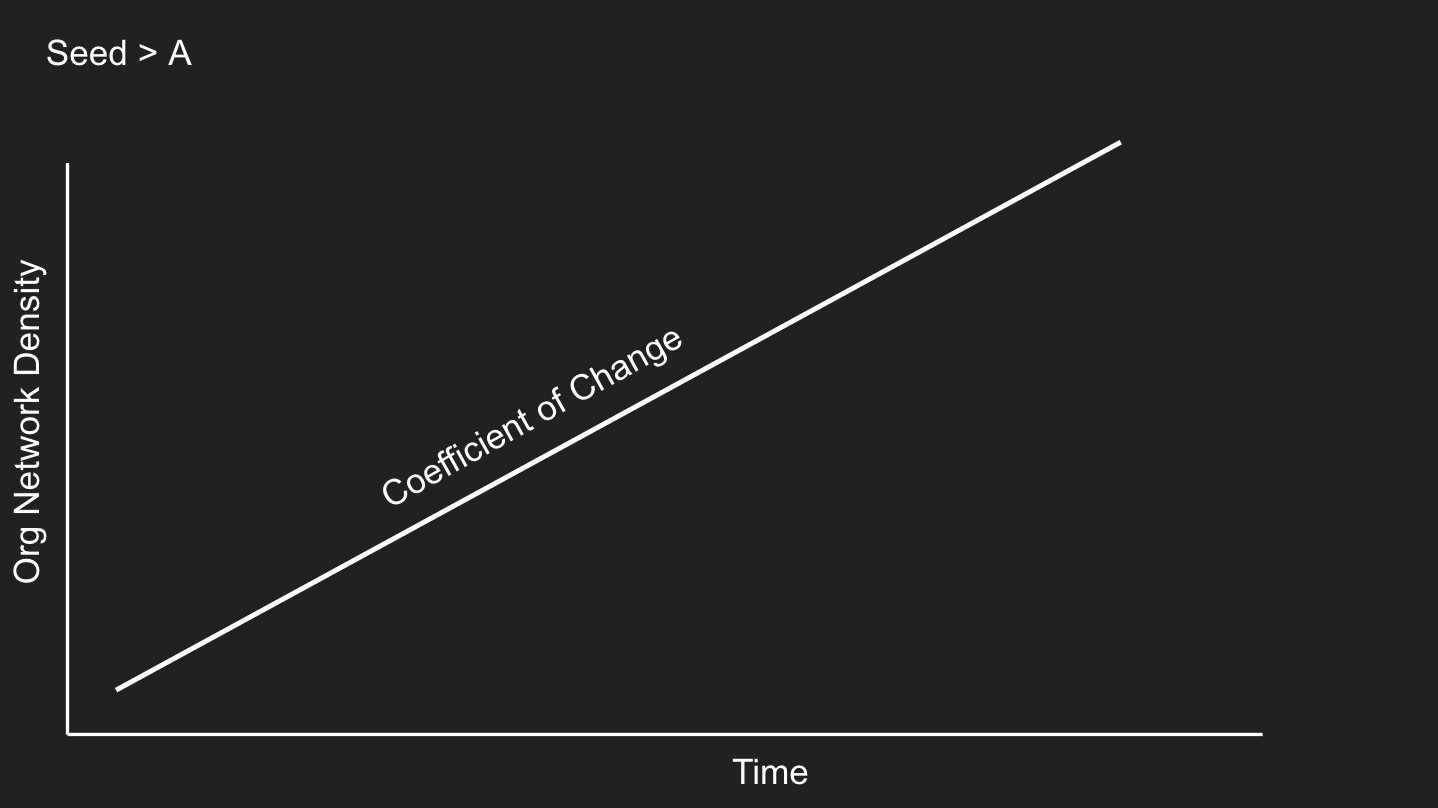
Linear. There are so few total employees or team members that you can decide and roll out scale changes fast. Each change only affects a small set of relationships for each person involved, because there are very few total people. Mathematically, a 5 person startup has [ N x (N-1) / 2 ] = 10 relationships. If that sounds like a lot, look how quickly we’ve scaled from just 1 relationship in a 2 person company.
Most companies would consider a 5 person startup extremely agile, and I would agree, but you can see that the pace of change still does slow down as you grow from 2 to 5 to 10 or 20 at at a Series A. At 20, there are 190 relationships to work with, and the company is probably big enough that each person has a subset network they actually leverage to get work done.
Now, let’s go bigger. Beyond Series A in my experience, change becomes change management, because it takes focused work to make any kind of change happen.
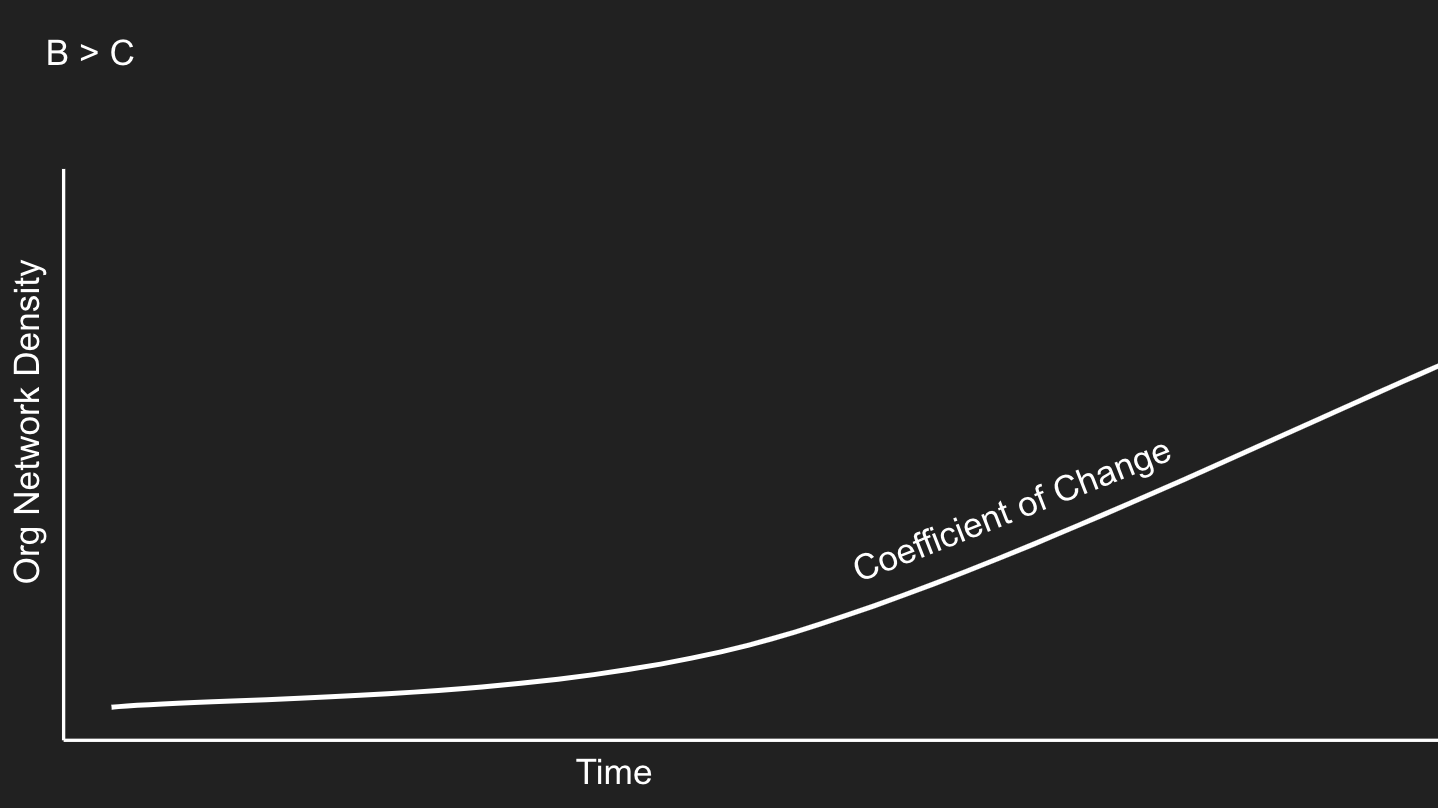
You can see that curve starting to tip up. The difference between a 50 person Series B and a 400 person Series C is significant: 1,225 relationships at B vs. 79,800 at C. Change gets harder. At this point, CEO’s will sometimes bring in change management experts, or they will hire in a new C-Suite specifically to drive change home across an org (above Series B change is usually focused around particular orgs, and full company change efforts are rare in my experience.)
Now, let’s go one step further. How hard does Amazon scale get?
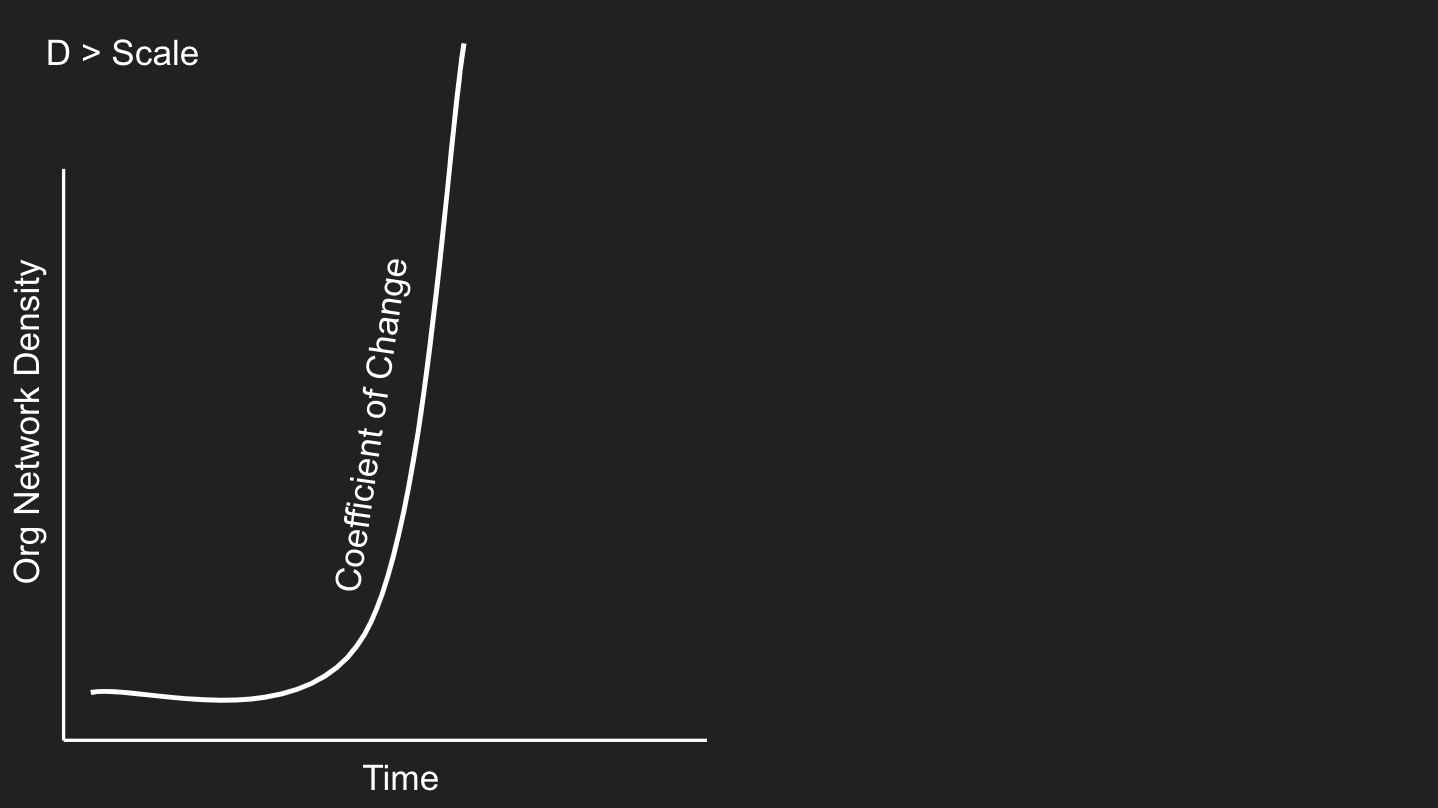
Let’s avoid giving ourselves a headache, and take just one example. Let’s use the 15,000 people example from the top of this newsletter to look at just a subset of Amazon’s scale: 112M+ possible relationships. Now, we all know that no one employee is connected perfect to the other 15,000 at that scale, and the fact that we are looking at networks of networks only makes the change management harder. One stakeholder mis-aligned can cut off hundreds or thousands of employees from the change.
We’re toward the end of this newsletter, and I’m done with the mathematics. What’s the takeaway for product managers? Change is still possible. That’s it. Amazon decided they wanted to move from 3 years to something like 90 days to launch a new country. They had buy-in at the highest levels. They had a scalable set of artifacts they could use to drive change management like a first-class product, and they had the fiat to identify key stakeholders, get them onboard, and ruthlessly build around teams that weren’t strictly necessary.
And they did it. Did it take all the usual suspects of change management? Artifacts, leadership, clarity in messaging? Definitely. Did it also take an understanding of networks, and of which teams and individuals were truly integral to launching a new country? Yes. Did it take a re-imagining of the process with a willingness to break glass with teams that weren’t essential? Yes, that too.
The takeaway here is two-fold:
- Change management delay is not necessarily the fault of any one person. Mathematics make any kind of change prohibitively hard at scale. Blame less. Listen more. Be kind. This will take you a long way in product too!
- Work the graphs, and intentionally scale ruthlessness with org scale. You can have conversations with everyone at a Series A about a pivot if you choose. It’s just not possible at enterprise scale. And in my experience, clarity of messaging substitutes significantly for individual listening sessions when you get to scale. People get that one person can’t sit down with everyone, and they will usually take clear expectations and messaging instead. (Yes, this is also a cheat code for product at various scales—told you we’d get back to product!)
So it takes 15,000 people to change a light bulb, but if that’s not good enough, you can also cut that number by ~90% with some deep imagination and willingness to build simpler. None of this, by the way, implies that a bunch of people were let go as a result of this change—Amazon kept them all and as far as I could tell they often played similar roles at different points in the process after country launch. The point was unblocking customer value, so adding incremental functionality later was fine.
I’ll close with this invitation: What changes are you stuck with? How might those look different from a graph or mathematical lens? How densely are teams in your org connected? What is the right balance of compassion, clarity, and ruthlessness for your scale?
Best of luck,
Nate
Thanks for reading Nate’s Substack! Subscribe for free to receive new posts and support my work.