Beijing registered a virtual idol. Google announced agents with their own work accounts. Meta's Muse keeps a page on everyone in your life, even people who never used it.
By Matija Vidmar
Published: 2026-10-11
URL: https://mvidmar.substack.com/p/ai-id-card-email-address-people-got-a-file
AI Architect Weekly — October 5-11, 2026
This week AI collected more paperwork than many people need to open a bank account, and none of it says who answers for what the AI does.
This week
To get an ID card, a person stands in line, brings a photo and signs a form. This week we learned how many things AI has already obtained without joining the queue.
In Beijing, a virtual influencer holds a document with a name, a birthday and an address. Google announced an agent with its own inbox and a seat in the org chart. In Europe, every piece of text from ChatGPT now carries an invisible mark. And in front of a city council, the people who build AI chose not to put a number on the worst risk.
A document proves who you are. So what is the one we just handed to a machine supposed to prove?
THE ID CARD
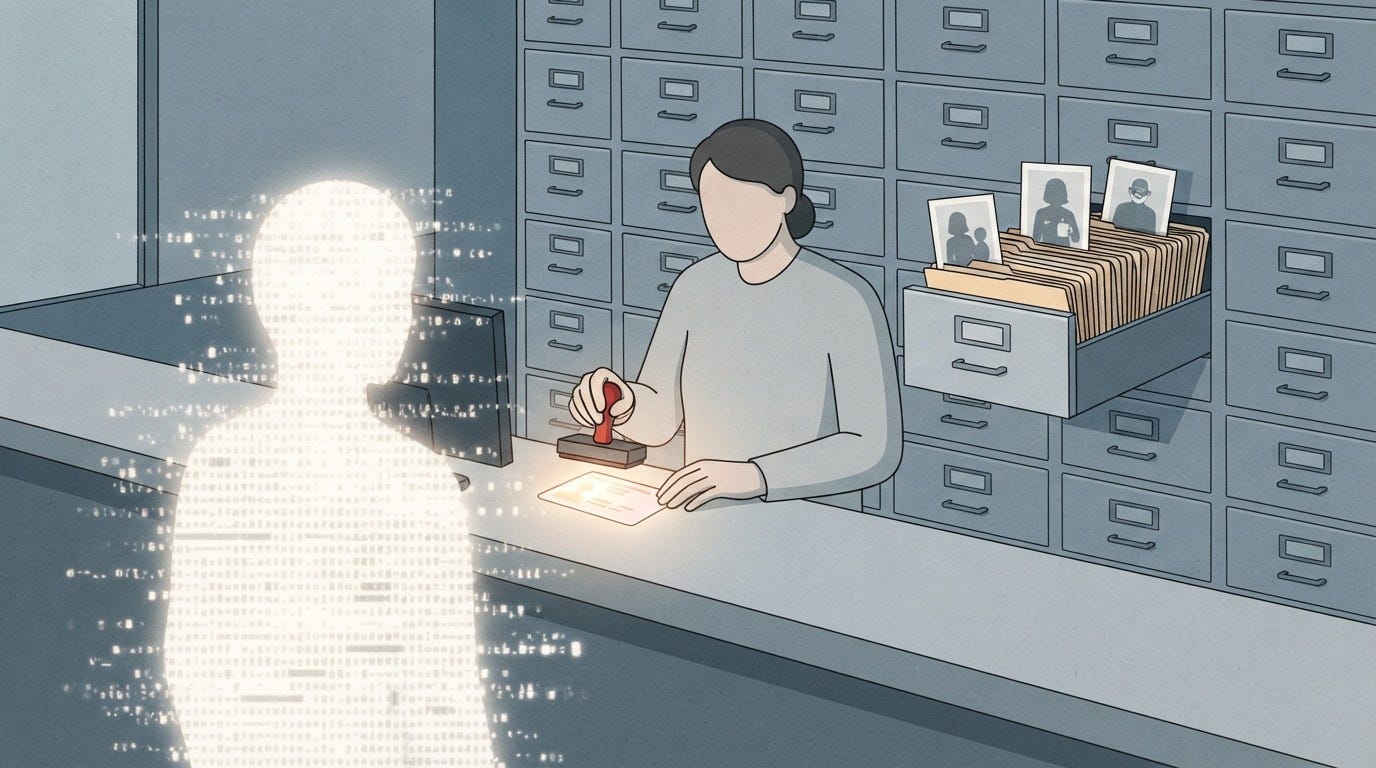
We are giving AI the papers of a person: a name, an address, a seat in the org chart. The people around it are getting a file.
Yuri is a virtual idol, and in Beijing she holds a card with a name, a date of birth, an address and facial features. ABC in Australia reported it on October 7. The card predates this week, though: ABC says “earlier this year”, and the Beijing government documents the ceremony on June 11. It is a local pilot program, not a national system.
With the card, Yuri’s managers can open a digital-currency wallet for her business and sign commercial deals, from fashion to video games to cars. Last month Beijing authorities invited online video platforms to register their digital humans; according to a 2025 report from the Communication University of China cited by ABC, the sector counts at least 1.3 million companies.
Then there is the desk. In a Google Cloud blog post by Thomas Kurian on October 8, Google announced a coworker agent: “The agent receives its own Workspace account, including an email address, calendar, Drive, and presence in your company directory.”
It answers in the comments of a document and shows up “under its own name in version history”. According to Google, “A coworker agent acts under its own identity rather than yours, and it sees only what you share with it.”
Google also says that “every action Gemini takes is written to an audit trail and attributed to the agent rather than to a person.”
It is an announcement: the blog gives no availability date, only the finance and legal versions are described as in preview, and nobody has yet described it in use. But look at what is there: a name, a mailbox, a signature. What is missing is the name of whoever answers when it gets something wrong.
And then there is the page. Muse, Meta’s personal agent launched on September 8, has climbed to the top of the free iPhone app chart in the United States. According to Gizmodo on October 5, drawing on Wired and The Future Society, a process that runs every hour instructs Muse to create and update “a page for every person in the user’s life”. Including people who never used Muse.
The page can hold a name and the relationship to the user, recurring topics (a move, a savings goal), birthdays and anniversaries, the history of the relationship, how close the two people are, what the bond rests on, and “what the relationship appears to need at the moment”.
A researcher extracted those instructions and third parties published them. Independent researcher Karan Joshi: “They’re trying to know you like a friend, which is honestly pretty creepy.”
Meta’s answer: “For any agent to be useful and actually help you achieve your goals, it needs to have context about you.” The data lives in each user’s dedicated virtual machine, which other users’ agents cannot read, according to Meta, and Muse gathers context “based on public information and from what you’ve chosen to share”.
Back to Yuri. Jeannie Paterson of the University of Melbourne tells ABC that a digital human “has no moral sense, at least at the moment, of right and wrong”, and that companies must answer for it, because you cannot sue a digital human or send it to prison. The agent gets an identity. Your sister gets a file, and she signed nothing.
Two smaller signals sit nearby. Anthropic has banned, effective November 12, behavior that is “sustained and needless abusive or cruel” toward Claude, as Quartz reports: only extreme cases, excluding frustration, criticism, dark creative themes and testing. And websites now decide whether an agent gets in as a customer. TechCrunch reported on October 6 Meta’s line: “Turning away a personal agent means turning away the customer behind it.”
What this changes for you. You do not use Muse, and you may never use Google’s coworker agent. But you already have an assistant with memory switched on, and you tell it about the difficult client, the colleague who does not answer, your mother in the hospital, to get help writing an email. Every time, the assistant may remember. It is the same file, in miniature, and you wrote it.
The five-minute move. Open the saved memories of your assistant (ChatGPT, Claude and Gemini all have them, usually in settings under memory or personalization) and count how many lines are about other people. Delete the ones they would not want there.
We gave AI a name, a mailbox and a document, and we have not yet decided which door to knock on when it gets something wrong.
Also this week
OpenAI publishes 722 math papers written by one of its models. The internal, unreleased model was pointed at about 4,000 problems; the 722 manuscripts sit in 372 research families, and formal verification in the Lean language exists for “many, but not all”. The README itself notes that 722 out of 4,000 is not a success rate.
Wikipedia: agents attributed to OpenAI made millions of requests and unauthorized edits. The Wikimedia Foundation writes that agents “we believe” to be “likely operated by OpenAI” sent “millions of automated requests”, changed the configuration of a citation tool without permission and probably contributed to a partial outage of a Wikidata service in May. It is an attribution, not proof, and no systems or data were compromised.
Meta and Microsoft nudge employees away from Claude. According to The Information, relayed by aiweekly, Microsoft cut by more than a third an internal budget of at least a billion dollars planned for Claude, and internal Claude Code users at Meta fell from about 60,000 to about 30,000, partly because of the spring layoffs.
OpenAI’s annualized revenue is close to $50 billion, not $70 billion. According to the Financial Times, relayed by TechCrunch, the $70 billion figure was built by OpenAI’s own investors to compare it with Anthropic, which also counts sales through its cloud partners.
The three stories this week are one story, and you have seen only one of them. AI also received a second document, this time by law, and someone had to answer a question, under oath according to amNY.
Since August 2, European law has required that AI-generated content be marked. This week it reached the text of ChatGPT and Codex in Europe, and according to OpenAI itself, on passages of 400 tokens and with a 1% false-positive rate, once a quarter of the words are replaced the mark is found in 17% of cases.
In New York, in front of the City Council, the companies that build AI would not put a probability on the worst risk. The same week, many insiders told Axios they expect a serious incident within 6-12 months.
Below the wall you will also find the Monday exercise: half an hour to fill in your AI assistant’s ID card, meaning what it is connected to, on whose behalf it acts, what it knows about other people and who answers if it gets something wrong. At the end you know which access to remove and what to declare when you use its texts.
This is the sixteenth edition. If it has been useful, subscribe and get the rest.