The agents you launch never see each other. What comes back looks like consensus, and it is a disagreement nobody caught. The two questions to ask whoever is selling them to you
By Matija Vidmar
Published: 2026-08-21
URL: https://mvidmar.substack.com/p/ai-team-cost-no-referee
TL;DR
-
On August 17, 2026, two agents launched in parallel on the same question contradicted each other on a verifiable fact, and neither could have known.
-
Multi-agent setups typically burn three to ten times more tokens than a single-agent approach on the same task: Anthropic says so on its own blog.
-
In claude.ai chat, secondary agents stay off by design, the documentation says so in plain words: they run in Cowork, in Claude Code, over the API.
On August 17 I launched two agents in parallel, in the same session, on the same task: one had to check one piece of documentation, the other a different one, and report back what they found. They came back with two answers that contradicted each other on a verifiable fact. One reported that Anthropic never published an engineering post about its own multi-agent research system. The other brought back the address. Neither knew what the other had said.
If there hadn’t been a person there to put the two answers side by side, only one would have come back. And it would have looked final.
This needs to be said plainly: it’s a first-hand observation, on a single case, dated August 17, 2026. It’s not a measurement, and it’s not proof that agents get things wrong often.
It’s not that agents get things wrong often. It’s that when two disagree, that disagreement never reaches anyone. What comes back is one answer, coherent, and it reads like consensus. That’s apparent agreement: divergence nobody caught. The problem isn’t the reliability of a single agent, it’s what happens once you put more than one to work without giving anyone the job of comparing them.
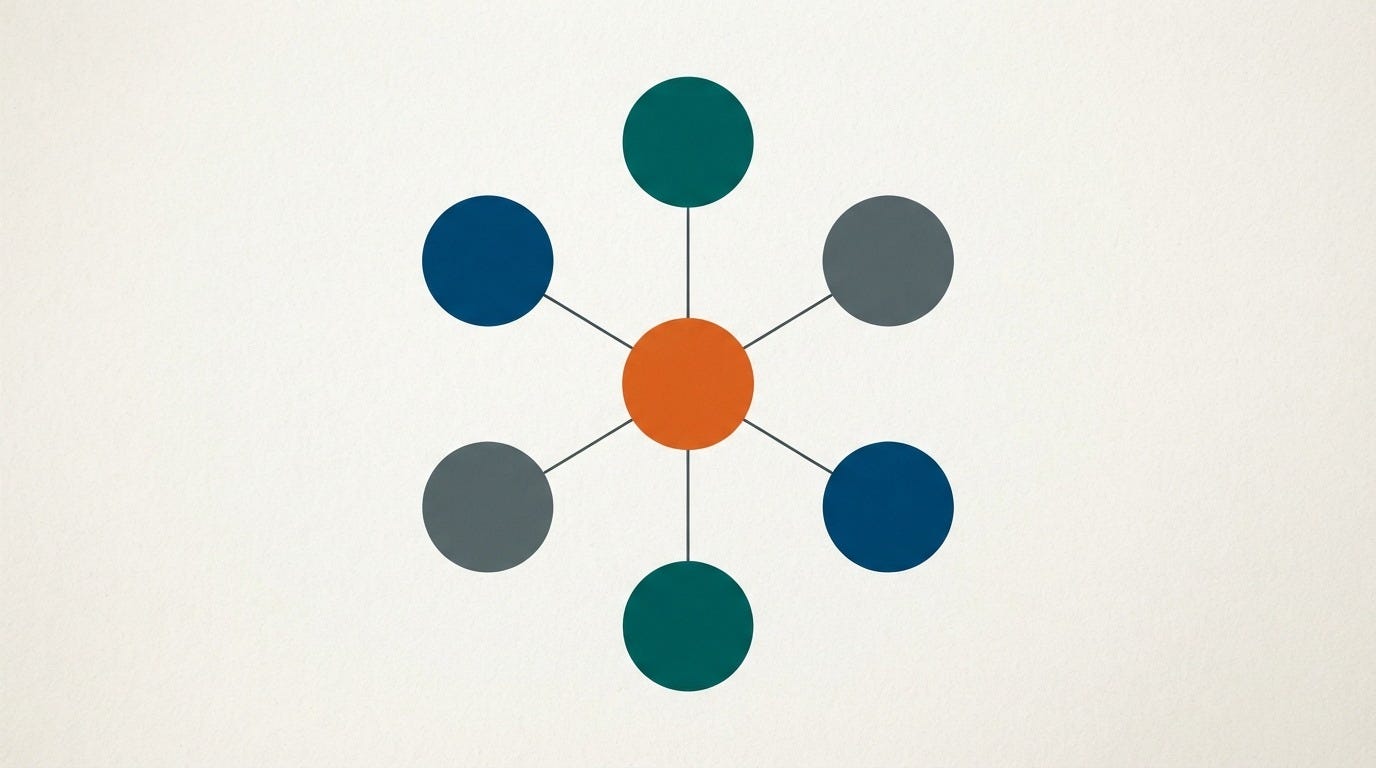
Here’s how it actually works, no jargon. When you launch several agents on different parts of the same task, each one reports only to you, the one who launched it, never to the other agents working at the same time. In Anthropic’s own naming these are subagents, a second assistant the first one launches on its own. Each works with its own memory, isolated from the others, and all that comes back from that work is the final message, as text. This isn’t a limitation waiting for the next update, it’s how the system is designed. The more agents you launch, the more pairs there are that could contradict each other without anyone noticing: with two agents you have one pair to watch, with five you have ten. The one documented exception is Claude Code’s agent teams, declared experimental and off by default, where team members actually message each other.
It’s a star, not a team: five people sending five reports to the same boss, who have never talked to each other.
Adding agents doesn’t add intelligence, it adds agreement. And when two of them disagree, neither one can tell.
There’s also a price, and Anthropic publishes it on its own blog. Multi-agent implementations typically consume three to ten times more tokens than a single-agent approach for the same task. For Claude Code’s agent teams the stated cost runs around seven times. The causes Anthropic lists: duplicated context across agents, coordination messages, final synthesis of results. A vendor that publishes the cost of its own feature is a strong source, not a weak one. Keep this in mind: you’re paying three to ten times for a group that doesn’t talk to itself. Do the math on any task: if a single agent costs you a given amount, the multi-agent version can run you up to ten times that, before you even know whether the answers it produced hold up.
The role that’s missing here isn’t one more agent. It’s someone who compares the answers and decides who’s right, with the power to discard the wrong one, exactly the role that Anthropic’s research on multi-agent systems describes as necessary to validate the work. It doesn’t take a fancy title or a new tool, just someone with the time and the authority to say no to an answer. In the opening scene, I did that job by accident, in three minutes. I’d already written about a related decision Anthropic made on the same point: who checks the work, and what not checking it costs.
Where does this actually exist, verified on August 18, 2026: in claude.ai chat, no, and the documentation says it in plain words, “hooks and sub-agents run only in Cowork, so they appear grayed out in chat”; in Cowork, yes, handled automatically; in Claude Code, yes; over the API and Managed Agents, yes, with a coordinator that delegates. It’s worth it, Anthropic says, to protect context from noisy tasks, for parallelism on genuinely independent work, for specialization with a few targeted tools. It’s not worth it for sequential tasks, for work that doesn’t split along context boundaries, for simple tasks where it only adds weight.
Buying “a team of AI” means buying two things at once: a cost multiplier, three to ten times, and an agreement between agents that nobody has ever verified. What actually changes the outcome isn’t how many agents you have, it’s whether someone compares their work and has the power to throw it out when it’s wrong. That role, today, is either something you put there yourself, or it isn’t there. A vendor who’s never thought about it isn’t hiding anything from you: nobody ever asked them.
Being the referee is a skill, not a role you improvise once the vendor stops answering. In the From User to Orchestrator course it’s the first module, because without someone comparing and discarding, the rest of your AI team is dead weight.
Here are the two questions, in full. Copy them into an email, as they are.
Two questions for anyone selling you “multiple AI working together”.
- Which of your agents checks the others’ work, and what happens when it
disagrees with them? If the answer is “they compare notes”, ask to see
where it says they can.
- How much does this setup consume compared to doing it with a single agent?
If the answer is not a number, it was never measured.
The first question asks for a role and a power, not reassurance, which is why an adjective can’t answer it. The second asks for a number, and whoever doesn’t have one hasn’t measured anything, which means they’re selling a setup they never compared to the simpler alternative. Notice what these questions don’t ask: they don’t ask how many agents the vendor runs, because that number alone says nothing about who’s checking what.
If the vendor is internal, a team inside your own company, the second question becomes: how much did last month cost compared to the month we did this with a single agent.
Those are yours, whether you pay me anything or not.
Those two questions get you an answer. They don’t tell you whether that answer is worth anything or just well written. Try writing, in one line, who has the final word when two pieces of work contradict each other in your own setup: if you can’t in thirty seconds, what follows is more for you than for anyone else.