People are coming back. The math isn't. And the real bottleneck was never the price of the model
By Matija Vidmar
Published: 2026-07-20
URL: https://mvidmar.substack.com/p/jpmorgan-dimon-ai-costs-orchestration-2026
TL;DR
-
Cause: JPMorgan cuts headcount by 30-40% in certain areas thanks to AI. Effect: the bank’s 2026 costs still climb to nearly $106 billion, not down.
-
Cause: only one employee in 100 knows how to give an AI agent genuinely useful context. Effect: the exact same code migration task costs $4 or $310, depending on who’s steering it.
-
Cause: 4,500 Google employees sign a petition against AI-linked layoffs. Effect: analysts and academics start calling it the “forever layoff,” a cycle that never quite closes.
You’ve probably already read this story. Ford recalled roughly 350 veteran engineers it had replaced with AI, people carrying decades of tacit technical knowledge no model could replicate (read it here). Commonwealth Bank reversed 45 roles after its voice bot increased call volume instead of cutting it. Klarna admitted cost had weighed too heavily in its decisions. IBM is hiring triple the entry-level headcount for roles redesigned around human judgment, not to fix a mistake, but as a bet. These are different mechanisms: tacit knowledge for Ford, operational failure for Commonwealth Bank, a quality-cost trade-off for Klarna, a proactive wager for IBM. No need to unpack each one again. Robert Half says 32% of US hiring managers have already rehired for roles previously replaced by AI.
Meanwhile, Sam Altman admitted he was wrong about his own employment apocalypse, and junior programmer roles are still down 19% anyway (we covered that here).
The real question, though, isn’t whether the people came back. It’s whether the ledger did.
In the same news cycle, three independent facts say it didn’t. No one has put them together yet.
The Dimon paradox.
In the Q2 2026 earnings call, Jamie Dimon said something that should rattle a few CFOs around the world: AI has already cut jobs by 30-40% in circumscribed areas of the bank. Not all of JPMorgan, just certain departments. Most of the people affected weren’t laid off outright, they were redeployed elsewhere in the company. So far, the story you already know.
Then Dimon added the part nobody wanted to hear: don’t expect AI to lower the cost ratio or dramatically widen margins. JPMorgan’s 2026 costs are expected to land near $106 billion. Prior guidance had pointed to $105 billion. A billion more, not less, in the same quarter the bank is touting its most aggressive AI cuts.
CFO Jeremy Barnum added a detail worth watching: generative AI token spend is still “trivial” today, but it’s headed for “a significant acceleration” in the second half of 2026. Right now it’s background noise. In two quarters it could be a line item with its own name.
Dimon’s framing is almost more interesting than the number itself. In a competitive market, he argues, every bank adopts the same technologies. No single one retains a structural cost advantage, because they’re all racing in the same direction. He compares AI to two decades of banking computerization, which didn’t produce extreme margins for anyone. Translation: if everyone cuts the same way, nobody wins, and the costs simply find somewhere else to hide.
Cutting for AI, in other words, doesn’t lower costs the way it was promised to. It relocates them.
Are you about to cut headcount betting on AI, or did you already cut and the promised savings never showed up? I help companies run the real numbers before deciding, not after an embarrassing earnings call. Explore my AI Consulting services or reach out directly.
The orchestration flip.
George Sivulka, CEO of Hebbia, an a16z portfolio company that sells enterprise AI orchestration tools, wrote an essay titled “The Next AI Gold Rush: Tokens & Loops.” Let’s say it upfront, no hedging: this isn’t neutral a16z research. It’s the opinion of a founder with a direct commercial stake in the exact problem he’s describing. That said, the number he brings is too concrete to wave away.
The same task, a code migration job, costs $4 when guided with well-written instructions. It costs $310 when left running in an unsupervised AI “loop,” without clear context. $310 is close to the cost of a full working day for an average US employee. Same task. Likely the same model. Result: seventy-five times more expensive.
The cause, per Sivulka: only about 1 employee in 100 knows how to give an AI agent effective context. Everyone else lets the agent guess, correct, loop, and guess wrong again. Every extra cycle is another charge.
Sivulka puts it this way: “for the first time in history, humans are cheaper than software.” A good line, worth taking with a grain of salt: it’s not a macroeconomic study, it’s one example, however vivid. Agents, he writes, are like “a million bad employees”: you still need people telling both humans and AI what to do, in what order, under what constraints.
And here’s the counterexample no one had placed next to Sivulka’s yet. Cognition, the company behind the coding assistant Devin, replaced Opus 4.8 with Fable 5 in its own product. Fable 5 costs twice as much per token as Opus 4.8. And yet Devin’s overall bill went down. Why? Fewer cycles, fewer corrections, fewer retries to reach the same result. A more expensive model per token, a lower final bill. Same logic as Sivulka’s, opposite direction.
The real cost of an AI task doesn’t depend on the model’s per-token price. It depends on who knows how to orchestrate it. The bottleneck isn’t execution anymore, it has moved to orchestration: who can give context, sequence the steps, correct in advance instead of chasing the error afterward.
The gap between $4 and $310 isn’t in the model you use. It’s in how well you orchestrate it. That’s exactly what I built an entire course around, not the tools, the mental model that makes them work. Discover the From User to Orchestrator course.
The internal tension.
While CFOs argue about tokens and banks adjust their guidance, inside Google the temperature is rising in a more direct, more human way. Over 4,500 employees signed a petition organized by the Alphabet Workers Union. On July 17, 2026, they delivered it in person to Sundar Pichai’s office. The demands are concrete: guaranteed severance, an end to performance quotas used to justify cuts, the option to receive severance as extended paid leave instead of a lump sum.
Google’s response, that day, was silence. Closed doors, no immediate answer. The document was handed to a staff member, with a vague promise to forward it along. Outside the offices, workers chanted, including one line worth quoting in full: “we can see your greedy side.” Organizers describe it as the largest employee feedback effort on job security in the company’s history.
Business Insider gave this climate a name, in a piece titled “Welcome to the era of the forever layoff”: tech layoffs are no longer isolated events, they’ve become a continuous, structural process of AI-linked workforce recalibration. Job security doesn’t come back. Continuous adaptation becomes each individual employee’s problem, no longer a pact with the company.
The numbers behind that feeling are precise. Over 155,000 roles cut in the first six months of 2026. Mentions of “layoffs” together with “AI” in corporate earnings calls went from fewer than 5 per quarter in 2022, the year ChatGPT launched, to over 100 per quarter today, according to an AlphaSense analysis.
In 2022, fewer than 5 mentions per quarter of “layoffs” and “AI” in the same earnings call. Today, over 100 per quarter. Four years.
Jeffrey Pfeffer, professor at the Stanford Graduate School of Business, is one of the few who’s said it plainly: laying off and then rehiring, repeatedly, is expensive. And when it becomes a recurring management strategy, it creates lasting uncertainty that pushes out exactly the best talent, the ones with the most options elsewhere. The same Business Insider piece confirms that some companies have realized they went too far, and had to rehire for roles they’d eliminated hoping AI could cover them. Consistent, point for point, with JPMorgan’s cost paradox: cutting doesn’t guarantee the expected savings at all.
Cutting for AI today is rarely, if ever, a verified economic decision. It’s a line that, told to investors, sends the stock up in the current quarter, regardless of whether costs actually fall. Dimon admits it openly on an earnings call. The market rewards it anyway, in the short term.
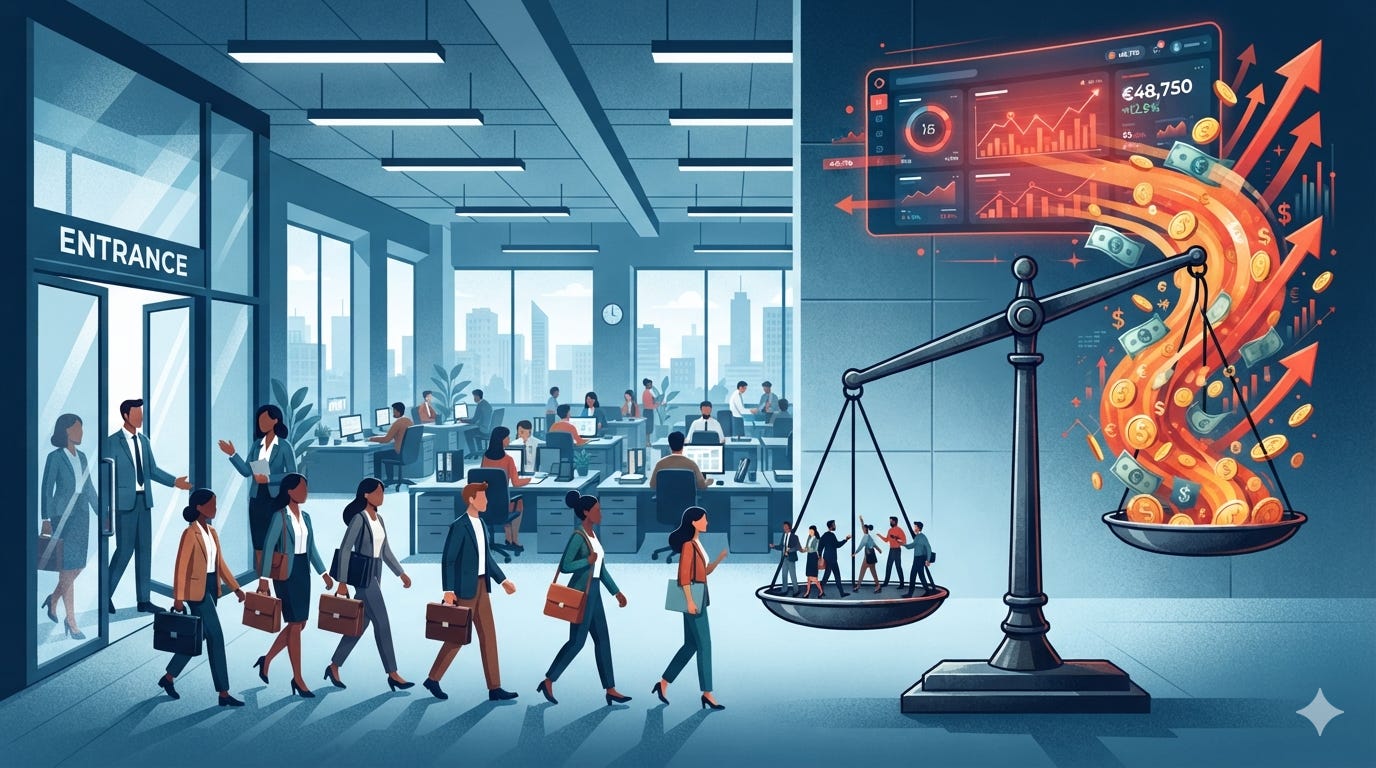
How does this look a year from now, when JPMorgan’s token spend stops being “trivial” and becomes a three-figure line in the budget, and when the next wave of rehired employees has to explain to colleagues still on the outside why her and not them? The door reopens. The chairs go back to their spots. The counter, in the background, keeps climbing.
If this piece connected Dimon, Sivulka, and the Google petition in a way you hadn’t seen before, restack it: it’s the simplest way to get it in front of the people making these calls every day.
The AI Architect is a reader-supported publication. To receive new posts and support my work, consider becoming a free or paid subscriber.