An alternative assessment that values human conversation and personalized ideas over polished scripts
By Mindful AI for Education
Published: 2026-01-15
URL: https://mindfulaiedu.substack.com/p/podcasting-in-the-classroom-promoting
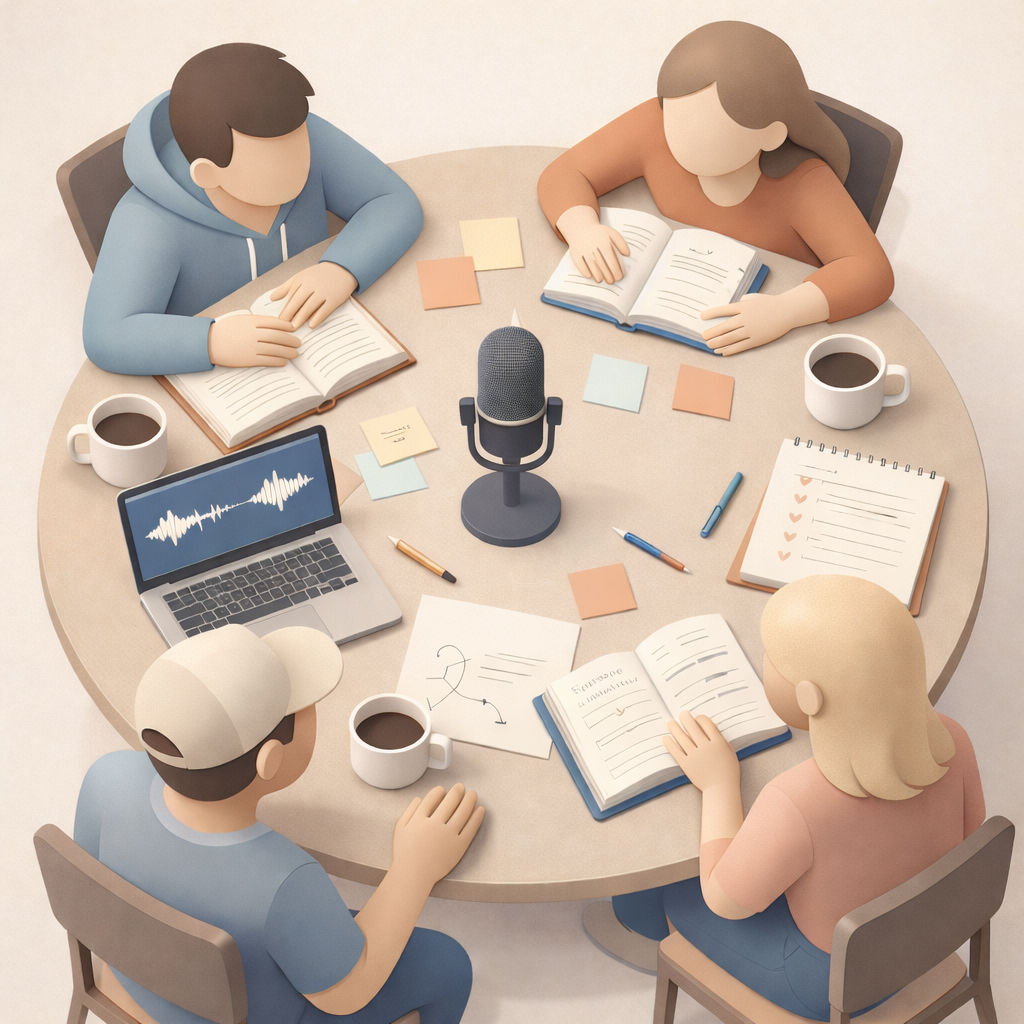
Podcasting gives students a powerful alternative to traditional assessments—one where their authentic voices, ideas, and insights can shine. Image made with ChatGPT.
By Dani Kachorsky, PhD
As an English teacher, I’m constantly asking myself a pretty simple question: What do people actually do with books outside of school?
And the answer is… not: Write five-paragraph essays.
Nobody reads a book for fun—or for their job—and then sits down to bang out a neatly structured essay with an intro, three body paragraphs, and a conclusion. The five-paragraph essay is a fake genre. It exists almost exclusively inside English classrooms, and it doesn’t really map onto authentic, real-world practices.
So if I want my assessments to be meaningful, they should reflect how people actually engage with texts.
What do people do with books in real life?
- They join book clubs and talk about books.
- They go to author talks at bookstores or universities.
- They listen to interviews where authors read excerpts and answer questions.
- They hear people discuss books on the news or on shows like The Daily Show.
- They listen to book-focused podcasts where hosts unpack ideas, themes, and reactions.
Discussion is an authentic literacy practice. Podcasting simply takes that discussion and makes it public—open to an audience that can listen, respond, and engage with those ideas.
That alignment matters to me. I want assessments that are real, connected to the content, and reflective of how literacy actually functions outside of school. Podcasting checks all of those boxes.
Why Podcasting Matters Even More in the Age of AI
Honestly, AI just solidified this for me.
With writing, there is so much that AI can now do. I’ve figured out workflows that allow students to write with AI responsibly, collaboratively, and transparently—and I’m comfortable navigating that space. But I also don’t want every assessment to live in a space where AI temptation is constant.
Podcasting gives me another lane. It allows me to assess students’ understanding in a way that isn’t purely writing-based. It also changes things up. Students like to talk. They like to argue. They like to respond to each other in real time. And listening and speaking are real-world skills they’re going to need long after they leave my classroom.
Podcasting doesn’t replace writing. It complements it. And in the age of AI, having multiple, varied ways for students to demonstrate understanding feels more important than ever.
Podcasting Across the Curriculum
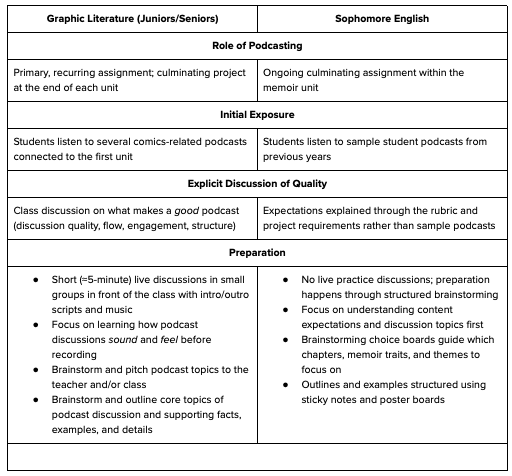
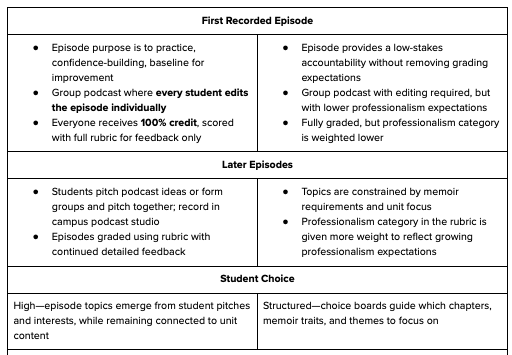
For some quick context, I use podcasting in two of my courses. In Graphic Literature in the Multimodal Age, podcasting is a primary, recurring assignment and serves as a kind of culminating project at the end of each unit.
In my sophomore English class, I use podcasting a little less frequently, but it’s still an ongoing, culminating assignment—specifically in our memoir unit. This year, for example, we read Born a Crime. The book is divided into three parts, and at the end of each part, students recorded a podcast discussion instead of writing something traditional.
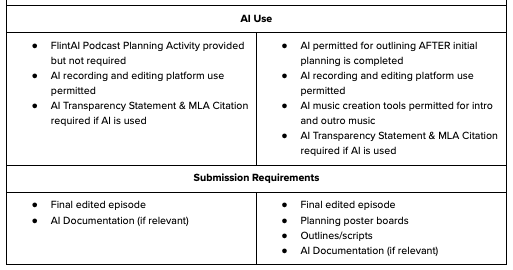
The structure and workflow look a little different in each class. At the core, I’m using the same podcasting philosophy in both classes. The differences come down to scaffolding, structure, and student readiness.
A Quick Point of Clarification
At the outset of this post, I suggested that podcasting can limit AI temptation. Yet, I allow students in my classes to use AI during the podcast planning process, and I want to be explicit about why limited AI use is permitted in this project.
Per our school’s AI Policy, teachers may not prohibit the use of AI outside a lockdown bowser testing environment. Since podcasting projects cannot realistically be conducted within a lockdown testing environment, I cannot require that no AI be used. As a result, I generally allow AI for brainstorming and outlining, which aligns with Tier 1 of our school’s AI policy.
When used appropriately, AI can help students organize ideas they have already generated—such as identifying connections between quotes, clarifying focus, or establishing a logical structure for discussion.
In that role, AI functions as a support for thinking rather than a replacement for it.
Of course, because of AI’s availability, students do become tempted to use AI to script their podcasts. Fortunately, the podcast format and grading for authentic discussion help mitigate this temptation.
Evaluation: Shared Philosophy, Adjustable Weighting
In both classes, I grade podcasts using a rubric that includes:
- Content accuracy and relevance
- Engagement and conversational flow (authentic discussion, not reading)
- Organization and structure (clear intro, logical flow, sticking to the plan)
- Editing and audio quality (balanced voices, clean cuts, no distracting noise)
- Collaboration and participation
- Making the podcast their own (opinions, games, audience engagement, etc.)
- Authentic and transparent AI use
The biggest shared challenge—and the one I care most about—is authentic discussion.
Students will try to script their podcasts, rather than outline them. When they get to the part of the planning process where AI use is permitted, students will allow AI to overwrite their own ideas–despite their ideas being more interesting and more authentic than a lot of what AI generates.
Despite the expectation that AI is not used to script podcast episodes, students will try to sneak AI-generated scripts past me. Often, this stems from a lack of preparation on their part. Either they didn’t read everything they were supposed to, or they didn’t use their in-class planning time wisely and aren’t actually ready to record on their assigned recording day.
In these instances, students try to hide behind polished language. They will let AI write language–word choice and sentence structures–they wouldn’t normally use… and you can hear it immediately. They mispronounce words they’ve never said out loud. They sound unnatural.
It becomes clear they don’t fully understand what they’re saying.
That’s why the professionalism category on the rubric matters so much—and why, especially in Sophomore English, its weight increases over time. The more podcasts students create, the higher the expectation for natural, human conversation. (This is particularly important in the memoir unit. Memoirs depend on honesty and vulnerability, and a scripted, AI-generated discussion actively undermines that goal.)
After the first podcast, students notice that AI-scripted podcasts don’t score as high as those showcasing authentic, natural discussions. Sure, those groups will earn a passing grade–usually a low C, but it is the groups that engage with each other and the material who do well.
That is when the podcasting really starts to work. Students begin to talk to each other: They pose questions, share examples, offer opinions, and respond in real time. They wrestle with ideas. They make meaning together. And in the age of AI, that kind of human, unscripted thinking is something I want to protect—and assess—on purpose.
Podcasting lets me do that.
Follow us on Bluesky at @MindfulAIEdu or on Instagram at @MindfulAIEdu
Who we are: Dr. Dani Kachorsky, Ph.D. Mica Mulloy, M.Ed Jake Kelly, M.A
AI Transparency StatementThis post was created using the AI-assisted workflow I described in a previous essay. I began by audio recording my thoughts and experiences, then used AI to transcribe and synthesize my reflections while maintaining my voice. I added and revised material through a few additional prompts in the LLM interface before copying the content into a document, where I made further revisions.
ChatGPT Prompt for Image Create a professional, minimalist, bird’s-eye view illustration of four high school students seated around a circular table in a podcast recording setup. The style should be clean and modern, inspired by paper-cut or soft 3D flat design with subtle shadows, faceless geometric human forms, and smooth rounded features. Use a cohesive color palette with warm beiges, soft tans, muted blues, gentle corals, and pastels—accenting a warm, inviting, educational atmosphere.
Each student is engaged in a collaborative discussion—some leaning in, one gesturing, another writing, all appearing thoughtful and connected. On the table, place a central podcast microphone, open books (including one titled “My Story” or similar to suggest a memoir), a laptop displaying audio waveforms, notebooks with handwritten brainstorming notes, sticky notes labeled with “Topics” and other podcast planning ideas, pens, pencils, and a few mugs of coffee.
The lighting should be soft and natural with gentle gradients, and the composition should be balanced and clean—conveying a sense of serious academic collaboration, creativity, and authentic connection. The overall image should feel professional, warm, and human-centered—ideal for a thoughtful education and media environment.