By Sebastian Raschka, PhD
Published: 2026-06-06
URL: https://magazine.sebastianraschka.com/p/llm-research-papers-2026-part1
LLM Research Papers: The 2026 List (January to May)
As some of you know, I have the long-running habit of keeping a running list of research papers I want to read, revisit, or cite in future articles and projects.
Last year, I shared two organized paper lists, one covering January to June and another one covering July to December.
Several readers told me that these lists were very useful, so, in a similar spirit, I prepared a new list for the first half of 2026. This one covers papers I bookmarked from January through May 2026.
Please do not treat this as a complete list of everything published this year. There are so many papers published every day that this would be totally infeasible. Instead, this is a curated reference list based on papers I found interesting or relevant for my own work. I went through the titles, abstracts, and topic framing carefully while organizing the list, but I have to admit that I also only read a subset of the papers in detail.
Why make these lists in the first place? When I work on an article, book section, code example, or lecture, I often remember that I saw a relevant paper somewhere, but finding it again can be surprisingly annoying. A categorized Markdown list solves that problem for me, and I hope it is useful to you as well. (Even in the era of LLM-based web searching, having a specific context list is pretty useful, still.)
This year, the list is again heavy on reasoning models, reinforcement learning, and efficient inference, because I am biased towards bookmarking papers that are related to things I am currently working on. However, compared with the 2025 lists, I also bookmarked more papers around agent harnesses, tool use, long context, diffusion language models, and practical serving infrastructure, because that’s what I am currently pretty involved in and where the field is headed.
The categories for this research paper list are as follows. (Pro tip: In the web version of this article, you can use the table of contents on the left to jump directly to the sections that are most relevant to you.)
-
Architecture and Model Design
-
Efficient Training and Scaling
-
Inference Efficiency and KV Cache
-
Sparse Attention and Long Context
-
Reasoning and Test-Time Compute
-
Reinforcement Learning and RLVR
-
Agent Systems and Tool Use
-
Coding Agents and Software Engineering
-
Diffusion Language Models
-
Model Evaluation and Benchmarks
1. Architecture and Model Design
This first section collects papers on model architecture, model-release technical reports, and papers that help explain why current LLMs look the way they do.
One thing I find interesting about 2026 so far is that architecture work goes beyond making transformers larger. There is a lot of work around
-
hybrid architectures (for example, Nemotron 3, and Arcee Trinity),
-
state space layers (Nemotron 3 and Mamba-3),
-
MoE capacity allocation (Scaling Embeddings Outperforms Scaling Experts, and Step 3.5 Flash),
-
activation behavior (The Spike, the Sparse and the Sink),
-
and representation geometry (Symmetry in Language Statistics Shapes the Geometry of Model Representations).
All of these papers are quite interesting, which is why I bookmarked them in the first place. But if I had to pick one must-read, I’d probably be Nemotron 3 Super, because the article is super detailed (no pun intended), and it describes techniques used in a model that is already in production. And it’s one of the best models in its size class after all.
One of the interesting aspects of Nemotron 3 is its hybrid-architecture design, meaning that it alternates between regular attention layers and Mamba-2 (state space model) layers to be more efficient at long contexts. In 2026, long-context efficiency is king as more and more LLMs get plugged into agent harnesses (OpenClaw etc.), which requires working with longer and longer contexts.
That being said, 120B-A12B may be a bit too large for local inference on regular consumer hardware, but there is a Nemotron 3 Nano (4B) version as well.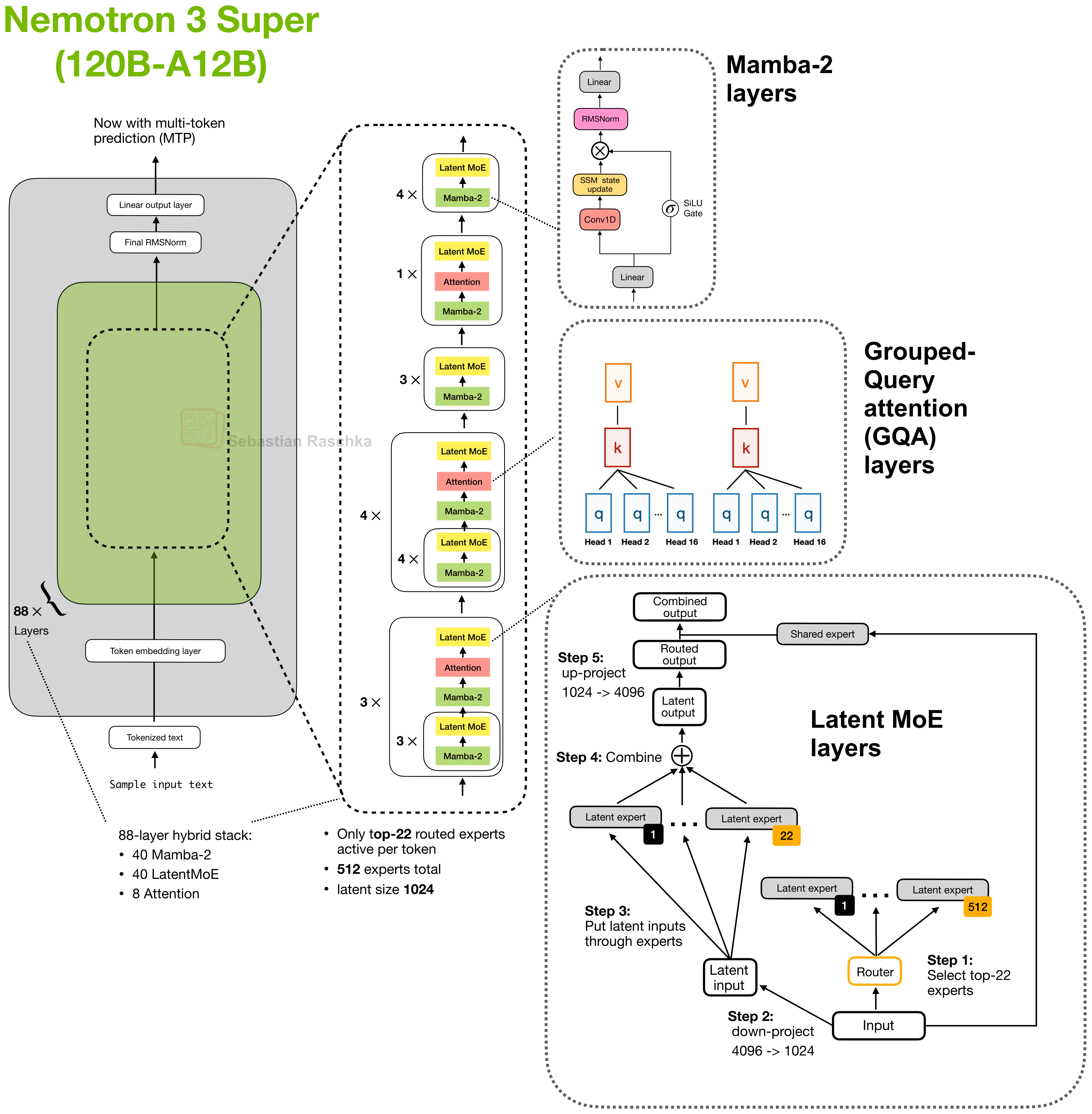 Figure 1: Architecture of Nemotron-3 Super, which is a hybrid architecture using Mamba-2 layers.
Note that 2 days ago, Nvidia also released a scaled up-version of this, Nemotron 3 Ultra (550B-A55B), which scales the embedding and projection dimensions but otherwise uses the same building blocks. If you are interested in a visual, I posted about it on Substack Notes here.
This hybrid-architecture trend with alternating attention and alternative layers is a relatively popular development this year. The probably most popular open-weight LLM series that uses a similar hybrid design is probably Qwen3.6, which uses Gated DeltaNet layers instead of Mamba-2 layers for the non-attention portions. For more information, see my Hybrid Attention (https://sebastianraschka.com/llm-architecture-gallery/hybrid-attention/) write-up, which pools information from several of my previous substack articles where I wrote about these.
Also, in the paper list below, you may notice that there is now a Mamba-3 and Gated DeltaNet-2 (i.e., newer versions of Mamba-2 and GatedDeltaNet), and it will be interesting to see those in the upcoming open-weight LLMs (e.g., Nemotron-4 and Qwen4?).
Next to describing the hybrid-architecture design, the Nemotron-3 paper contains a whole lot of other interesting ablations, for example, around multi-token prediction for speculative decoding, NVFP4 pretraining versus BF16, synthetic MMLU-style data, and post-training quantization recipes, but covering these in detail would be out of scope for this overview.
-
1 Jan, Deep Delta Learning, https://arxiv.org/abs/2601.00417
-
6 Jan, MiMo-V2-Flash Technical Report, https://arxiv.org/abs/2601.02780
-
13 Jan, Ministral 3, https://arxiv.org/abs/2601.08584
-
29 Jan, Scaling Embeddings Outperforms Scaling Experts in Language Models, https://arxiv.org/abs/2601.21204
-
30 Jan, LatentLens: Revealing Highly Interpretable Visual Tokens in LLMs, https://arxiv.org/abs/2602.00462
-
4 Feb, ERNIE 5.0 Technical Report, https://arxiv.org/abs/2602.04705
-
8 Feb, ViT-5: Vision Transformers for the Mid-2020s, https://arxiv.org/abs/2602.08071 (Most of this article is LLM-focused, but I couldn’t resist to include a new major vision transformer design.)
-
11 Feb, Step 3.5 Flash: Open Frontier-Level Intelligence with 11B Active Parameters, https://arxiv.org/abs/2602.10604
-
12 Feb, Nanbeige4.1-3B: A Small General Model That Reasons, Aligns, and Acts, https://arxiv.org/abs/2602.13367
-
16 Feb, Symmetry in Language Statistics Shapes the Geometry of Model Representations, https://arxiv.org/abs/2602.15029
-
17 Feb, GLM-5: From Vibe Coding to Agentic Engineering, https://arxiv.org/abs/2602.15763
-
18 Feb, Arcee Trinity Large Technical Report, https://www.arxiv.org/abs/2602.17004
-
4 Mar, The Spike, the Sparse and the Sink: Anatomy of Massive Activations and Attention Sinks, https://arxiv.org/abs/2603.05498
-
12 Mar, Tiny Aya: Bridging Scale and Multilingual Depth, https://arxiv.org/abs/2603.11510
-
15 Mar, Attention Residuals, https://arxiv.org/abs/2603.15031
-
16 Mar, Mamba-3: Improved Sequence Modeling Using State Space Principles, https://arxiv.org/abs/2603.15569
-
31 Mar, Attention to Mamba: A Recipe for Cross-Architecture Distillation, https://arxiv.org/abs/2604.14191
-
13 Apr, Nemotron 3 Super: Open, Efficient Mixture-of-Experts Hybrid Mamba-Transformer Model for Agentic Reasoning, https://arxiv.org/abs/2604.12374
-
6 May, ZAYA1-8B Technical Report, https://arxiv.org/abs/2605.05365
-
13 May, Delta Attention Residuals, https://arxiv.org/abs/2605.18855
-
21 May, Gated DeltaNet-2: Decoupling Erase and Write in Linear Attention, https://arxiv.org/abs/2605.22791
-
25 May, The MiniMax-M2 Series: Mini Activations Unleashing Max Real-World Intelligence, https://arxiv.org/abs/2605.26494
2. Efficient Training and Scaling
This section is about training systems, adaptation methods, and scaling recipes. These papers are not (all) about pre-training from scratch. Some focus on fine-tuning, distillation, test-time training, or making training work better on constrained hardware.