You're missing out big time... Weekly Recap 🔁
By Linas Beliūnas
Published: 2026-10-04
URL: https://linas.substack.com/p/weeklyfintechpulse418
👋 Hey, Linas here! Welcome back to a 🔓 weekly free edition 🔓 of my daily newsletter. Each day, I focus on 3 stories that are making a difference in the financial technology space. Coupled with things worth watching & the most important money movements, it’s the only newsletter you need for all things when Finance meets Tech.
Join the Future of Finance & AI:
-
Sequoia’s Private AI Briefing: AGI Is Already Here 🤖 [What Sequoia partner Pat Grady told an endowment about AGI, $20 trillion markets and 31x valuation jumps, and what founders and investors should do about it]
-
How to Use Claude Opus 5.5: The Complete Guide 📚 [The best prompts, effort settings, and Claude Code workflows for founders, builders, and investors, plus the mistakes that quietly erase its cost advantage]
-
How to Use Jev AI: The Complete Guide to TypeSafe’s System One Model 🤖 [What Jev is and how it works, the best Jev use cases, and how to build AI agents, workflows, and decision systems on a model that is up to 200x faster and 400x cheaper than LLMs]
-
The Claude Code Projects Playbook: Make Claude Your Chief of Staff 🧠 [How to set up the redesigned Projects in Claude, what to hand it, what it costs and which decisions should stay with you]
-
The Agentic Transition Playbook 🧠 [How founders and builders win when software starts building itself]
-
Nubank entered 35 countries without a banking licence, and now it wants to pay £10 billion for Monzo’s 😳🏦 what Nubank would actually pay & why stock will have to carry most of the offer, why Monzo lends out less than 10p of every pound it holds & why Nubank's 22.9% margins won't survive UK rules, & what to watch next + bonus deep dive into [How to Use Jev AI, TypeSafe’s System One Model inside]
-
Meta Muse sparked the first AI Agent selloff on Wall Street 🤖📉 why Schwab, Allstate and Planet Fitness sold off while Shopify and Meta surged, what the market's new valuation test for agent access means for every consumer-facing stock, & which sectors get repriced next + bonus deep dives into [Grok Bot: The First Real AI Agent OS, and The Claude Code Projects Playbook, or How to Make Claude Your Chief of Staff inside]
-
Anthropic’s IPO prospectus asks public investors to pay a $518 billion compute bill 😳📈 why the headline $42B loss is mostly an accounting entry rather than cash out the door, why nearly half of sales run through cloud giants like Amazon & Google that also own a piece of Anthropic & compete with it, & what to watch for next + bonus deep dive into [The Top 10 Stocks Positioned to Benefit Most from Anthropic IPO & The Complete Guide on How to Use Claude Opus 5.5 inside]
-
Meta’s Muse now goes head to head with Claude for Small Business 🛍️🤖 how Muse hit about 5M U.S. downloads in 3 weeks before Meta pointed it at the roughly 200M businesses already on its apps, and why Meta's agent starts with the brand and ad context Claude asks owners to write down themselves, & what’s next + bonus deep dive into [The Complete Guide on Using Claude Opus 5.5, and The Agentic Transition Playbook inside]
-
How to Use GPT-6 Astra, the OpenAI Model Jensen Huang Called AGI 🤖 [8 GPT-6 Astra workflows, copy-ready prompts, and practical settings for founders, builders, investors, and entrepreneurs who want to build products, research investments, and get more value from AI]
-
The Ultimate Guide to Grok Bot: The First Real AI Agent OS 🤖 [The complete guide to building a persistent AI agent operating system with Grok Bot — setup, working prompts, 8 end-to-end workflows, multi-agent teams, security, and the economics of AI teammates]
-
The Age of the One-Person Company 🦄 [What the latest data reveals about solo founders building million-dollar companies with AI agents instead of employees, and where the next big opportunity is in 2026]
-
The New Enterprise AI Go-To-Market Playbook 📚 [The a16z framework that decides which AI startups win the enterprise, and how founders can use it in 2026]
As for today, here are the 2 fascinating FinTech stories that are transforming the world of financial technology as we know it. This was yet another insane week in the financial technology space, so make sure to check all the above stories.
The Agentic Bank Run is coming for banking’s cheapest money 🤖🏦

The news 🗞️ The “agentic bank run” Apollo’s Torsten Slok warned about on Sunday threatens bank profits long before it threatens bank deposits, and investors are already pricing it.
In a note titled “Is an Agentic Bank Run Coming?”, Slok argued that AI agents such as Meta’s Muse could soon sweep household cash from checking accounts paying a 0.1% national average into fintech accounts paying 3.3% to 5%. If every household did it, he wrote, banks “could lose a large share of the cheap deposits they rely on to make loans.”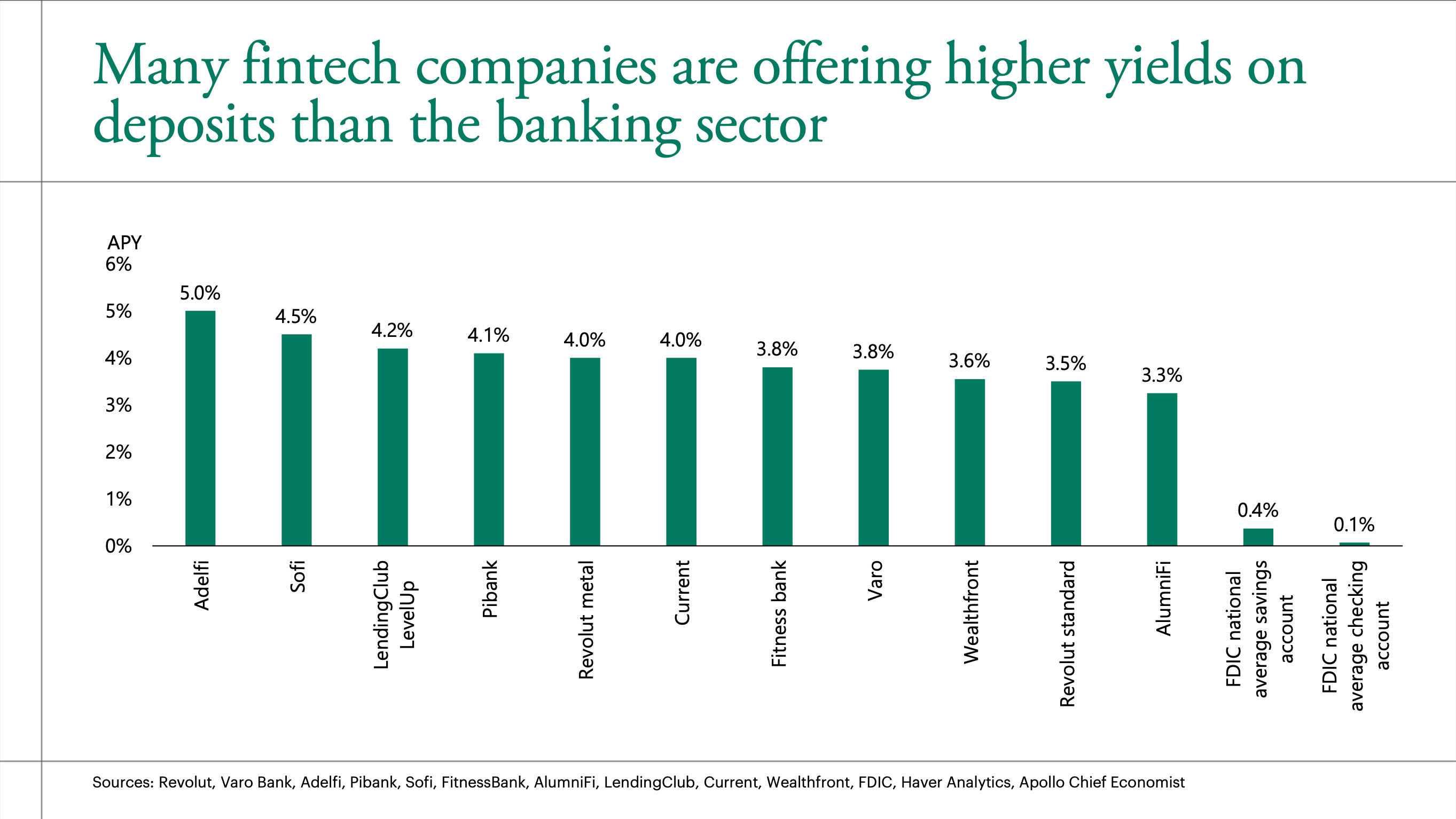 Credit: Torsten Slok & Apollo
It’s worth noting that banks were already part of the selloff we covered earlier this week, when Goldman Sachs’ consumer inertia basket lost more than 7% in six sessions, and Schwab fell 6.1%. JPMorgan Chase and Wells Fargo each fell more than 3% in a single session last week as Muse climbed the app charts.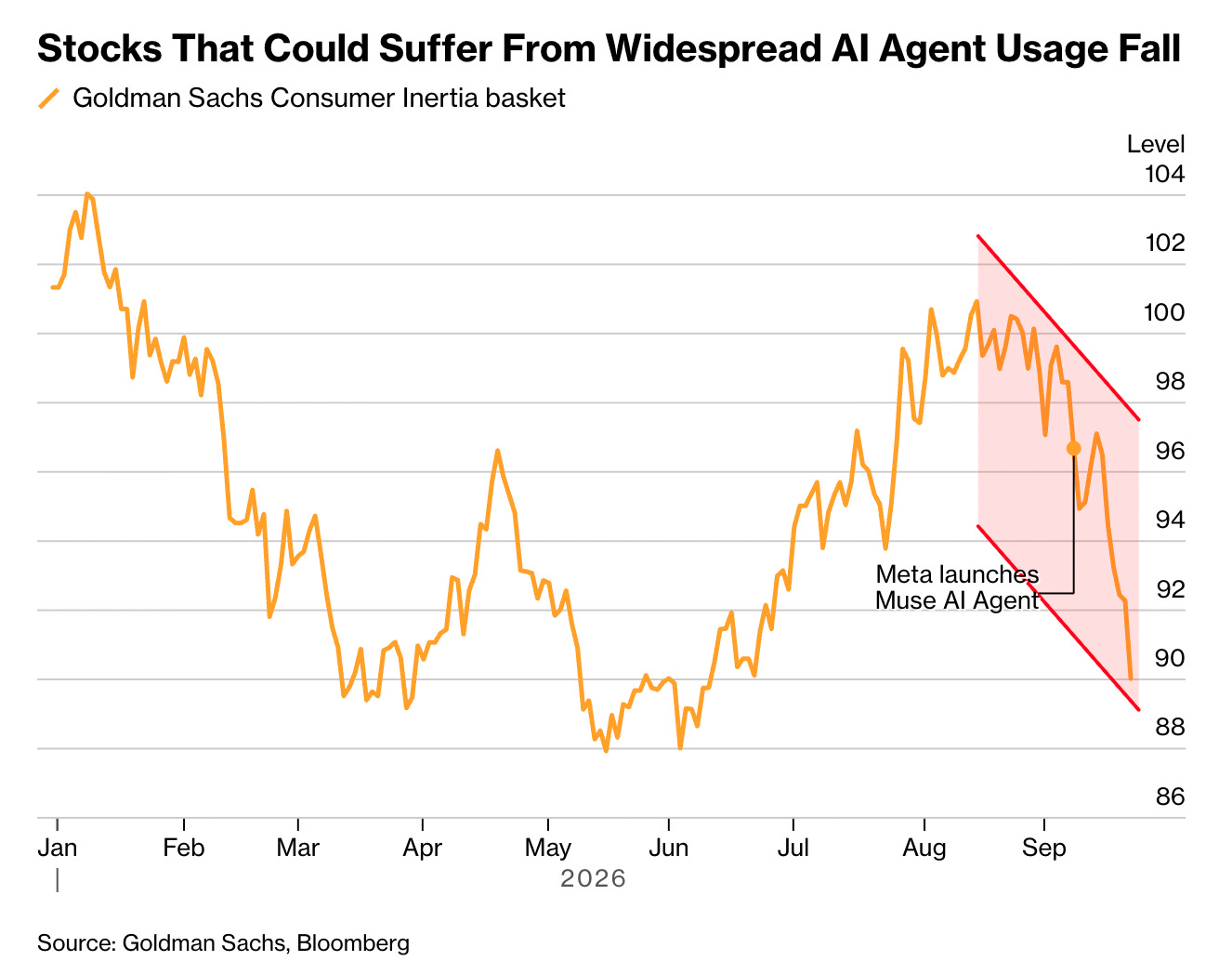
Of course, most of that cash would never leave the banking system. What agents change is who gets paid for holding it, and banks and fintechs are splitting over agents the same way Amazon and Shopify split when Muse launched.
Let’s take a closer look at this and unpack what Muse can actually do with a bank account today, where the money goes when it moves, which banks and fintechs gain or lose, and which number will prove the thesis first.
More on this 👉 Muse today reads accounts through Plaid on a read-only basis and asks for approval before spending. When money does move, it mostly lands at other insured institutions. SoFi and LendingClub are banks, AdelFi is a credit union, and Wealthfront places cash at program banks. So, a dollar moving from Chase to SoFi leaves total deposits unchanged and raises what the system pays for it. A snapshot of agents moving money today
The headline yields need a discount too. AdelFi’s 5% applies only to balances up to $5,000, and SoFi’s own page shows a 3.30% base rate, below the 4.5% Slok cited. Oh, and Apollo also has a stake in the answer. It runs an $849 billion credit business that gains if bank funding gets more expensive.
Zoom out 🔎 a16z’s Alex Immerman offers a sharper way to sort winners from losers. He asks two questions of any platform facing agents: (1) how much new demand the agent brings, and (2) how much profit depends on controlling the customer relationship. Amazon, for instance, earned $69 billion in advertising in 2025 against $34 billion of operating income outside AWS, which explains why it blocked Muse. For a bank, 0.1% checking is the same kind of profit pool, earned from customers who never compare.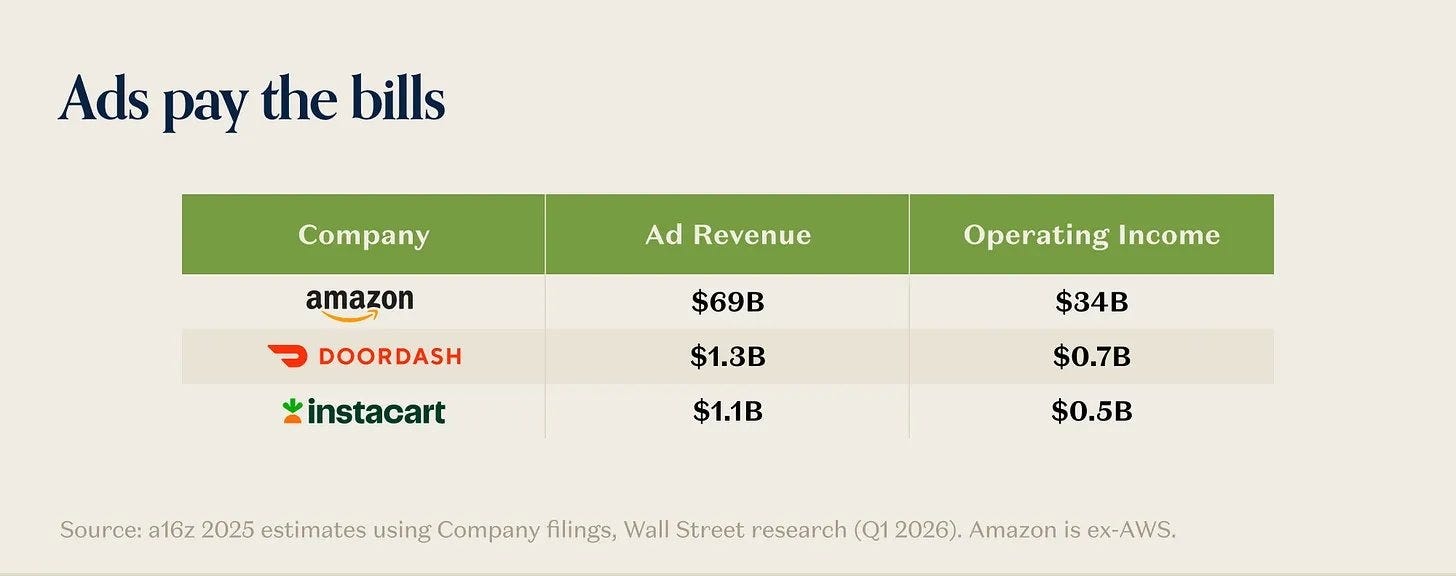
Big banks are therefore acting like Amazon. Chase’s terms bar agents that don’t identify themselves, and JPMorgan already charges Plaid for data access. High-yield fintechs are acting like Shopify, because a rate-comparing agent sends them balances they never had. Of course, welcoming agents does not protect every revenue line, though. Instacart integrated with Muse and its stock still fell on fears that agents skip its sponsored listings.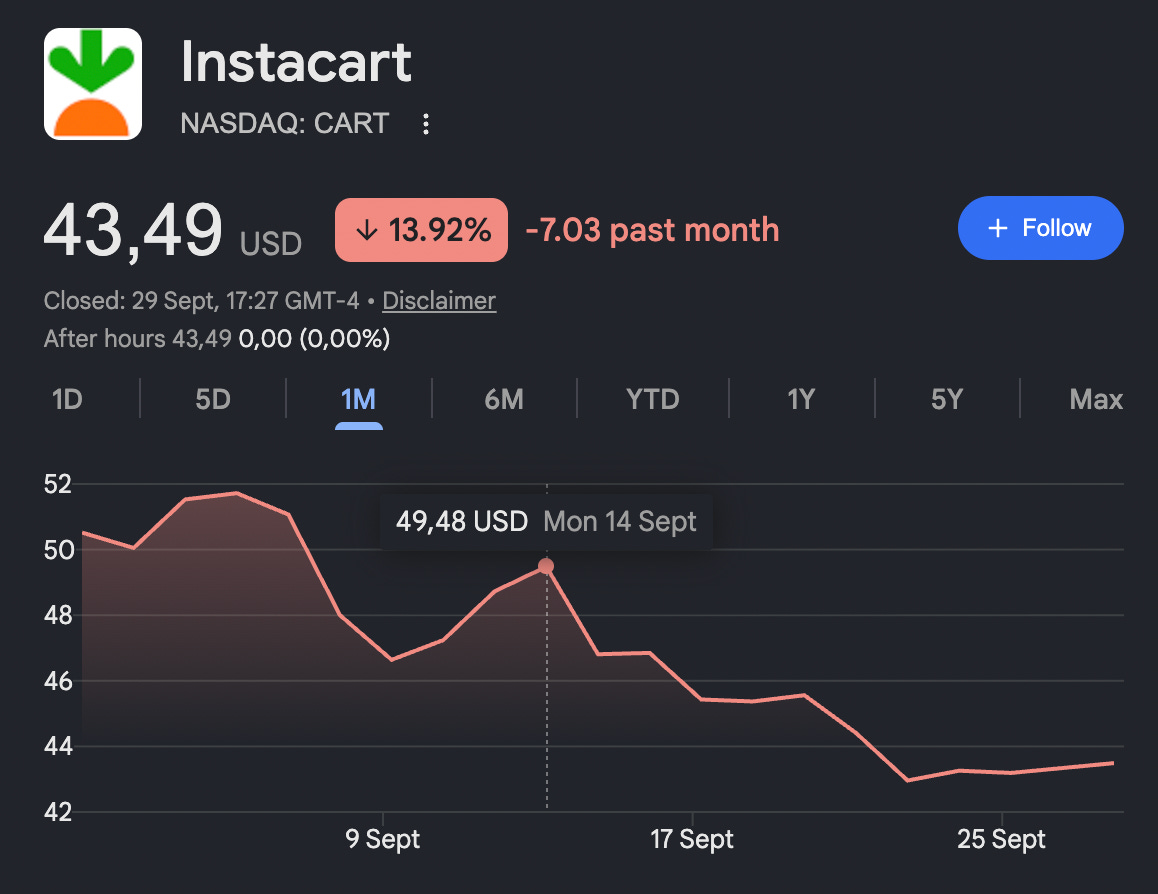
For fintech valuations, Immerman’s second distinction matters even more here. An agent can bring a platform a customer, or only an order. Cash that moves to SoFi because of a rate table will move again when another bank posts a higher rate. In other words, fintechs winning agent flows are acquiring only balances now, and investors should value them as rate-takers until those balances prove sticky.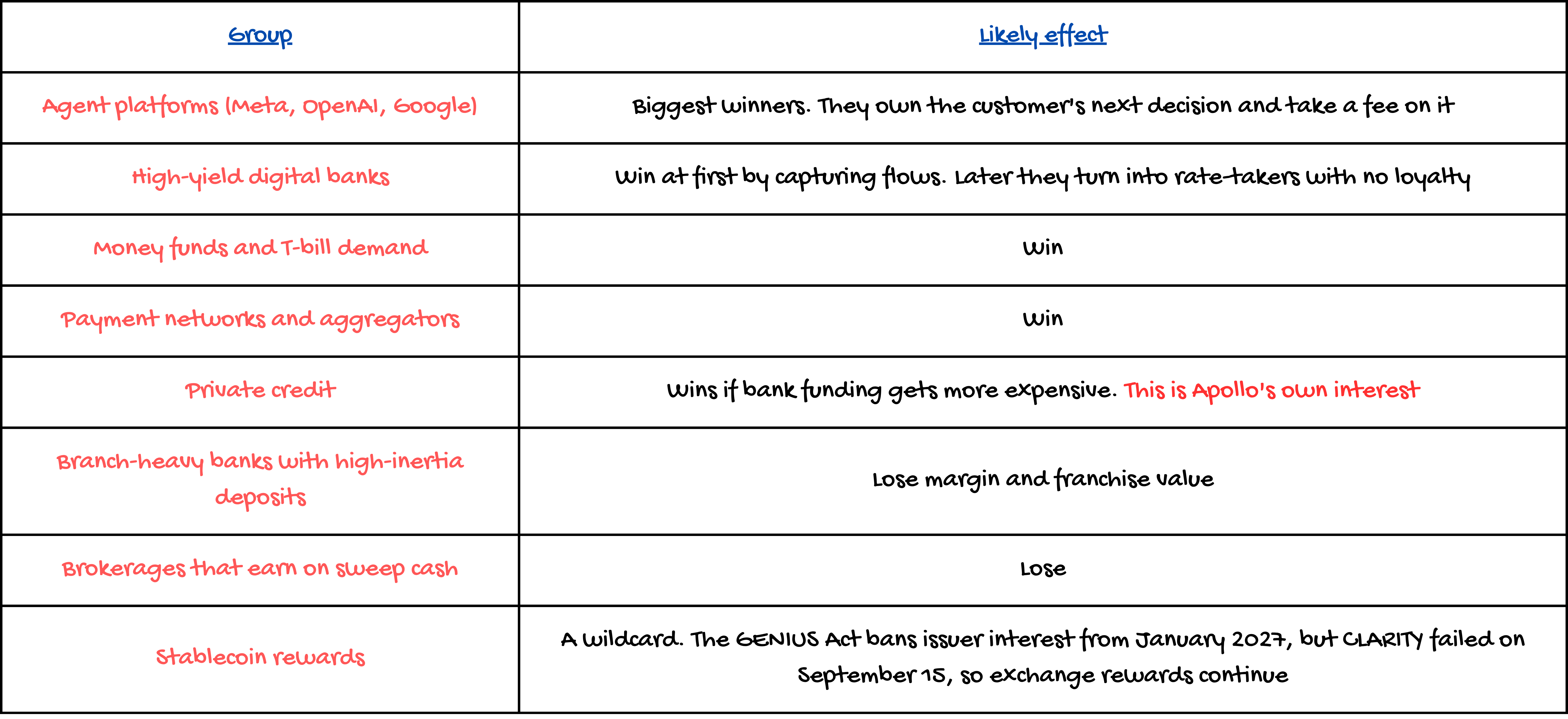
Finally, it’s worth noting that Meta plans to keep Muse free and take a small fee on transactions, which gives it a direct reason to seek transfer authority. Permission is therefore the threshold to watch. Rocket Money’s Rowan, built with Anthropic, already sets up automatic savings transfers. And once Muse, ChatGPT, or Gemini accepts standing instructions such as “keep $2,000 in checking and sweep the rest,” agents stop recommending and start acting across millions of accounts at once.
THE TAKEAWAY ✈️
What’s next? 🤔 Looking ahead, three pending decisions will set how hard banks can push back: (1) the CFPB’s rewrite of its 1033 open banking rule, (2) the Ninth Circuit’s ruling in Amazon v. Perplexity, and (3) FDIC guidance on whether an agent paid per transaction to place deposits counts as a deposit broker. Importantly, the damage will likely show up in deposit costs before it shows up in deposit totals. A Fed survey found banks passed 40% of rate increases to retail depositors from 2022 to 2024, against 77% for wholesale depositors. Agents push retail toward wholesale, and they do it just as the Fed starts hiking again. And regionals that rely on noninterest-bearing deposits are most exposed here (because of their “high inertia deposits”). Brokerages face the same pressure. Remember that Schwab’s net interest revenue fell 24% in 2023 as clients moved cash, with no AI involved. Then there’s SVB, which lost $42 billion in a day, and millions of agents reacting to the same headlines could move money faster (of course, that is unlikely in the near term). Having said that, banks can definitely do more than block. Bank of America expects banks with brokerage and wealth platforms to keep balances in-house. Immerman also pointed to Domino’s, which refused delivery apps for years before joining them for new demand. Big banks will likely follow: block agents now, sell access later, and/or build their own. All in all, the first real test comes with third-quarter bank earnings in mid-October. Because the thesis stays conceptual until deposit costs rise faster than rates or competition explain. Any bank whose deposit costs outrun the September 16 Fed hike is the first real evidence of agent-driven repricing.
ICYMI:
Robinhood Agents is live, and it earns from your trades, not the AI 🤖📈

The news 🗞️ Robinhood Agents, the in-app AI trading agent launched at HOOD Summit this week, isn’t built to earn money from AI. The company resells OpenAI and Anthropic tokens at the models’ public price, and OpenAI is paying for GPT-6 Luna usage through year-end. More than 150,000 agentic accounts are now open, and the pricing shows exactly where Robinhood expects to make money from them and who carries the losses.
Let’s take a closer look at this and unpack the revenue line agents will move, the marketplace rule that pulls customers off their own Claude & ChatGPT, the liability gap House Democrats are now questioning, and why incumbents funded by idle customer cash are most exposed now.
More on this 👉 At the core, Robinhood now wants the account, the permissions, and the execution instead. Customers pick GPT-6 Luna, GPT-6 Sol, or Anthropic’s Opus 4.8, so OpenAI and Anthropic compete for access to Robinhood’s users.
The customer simply describes a strategy in plain English, and the agent trades it from a dedicated account without margin, though it sees all the customer’s accounts. Trade approvals are on by default. Loops, a coming feature, will rerun standing instructions while the user is offline.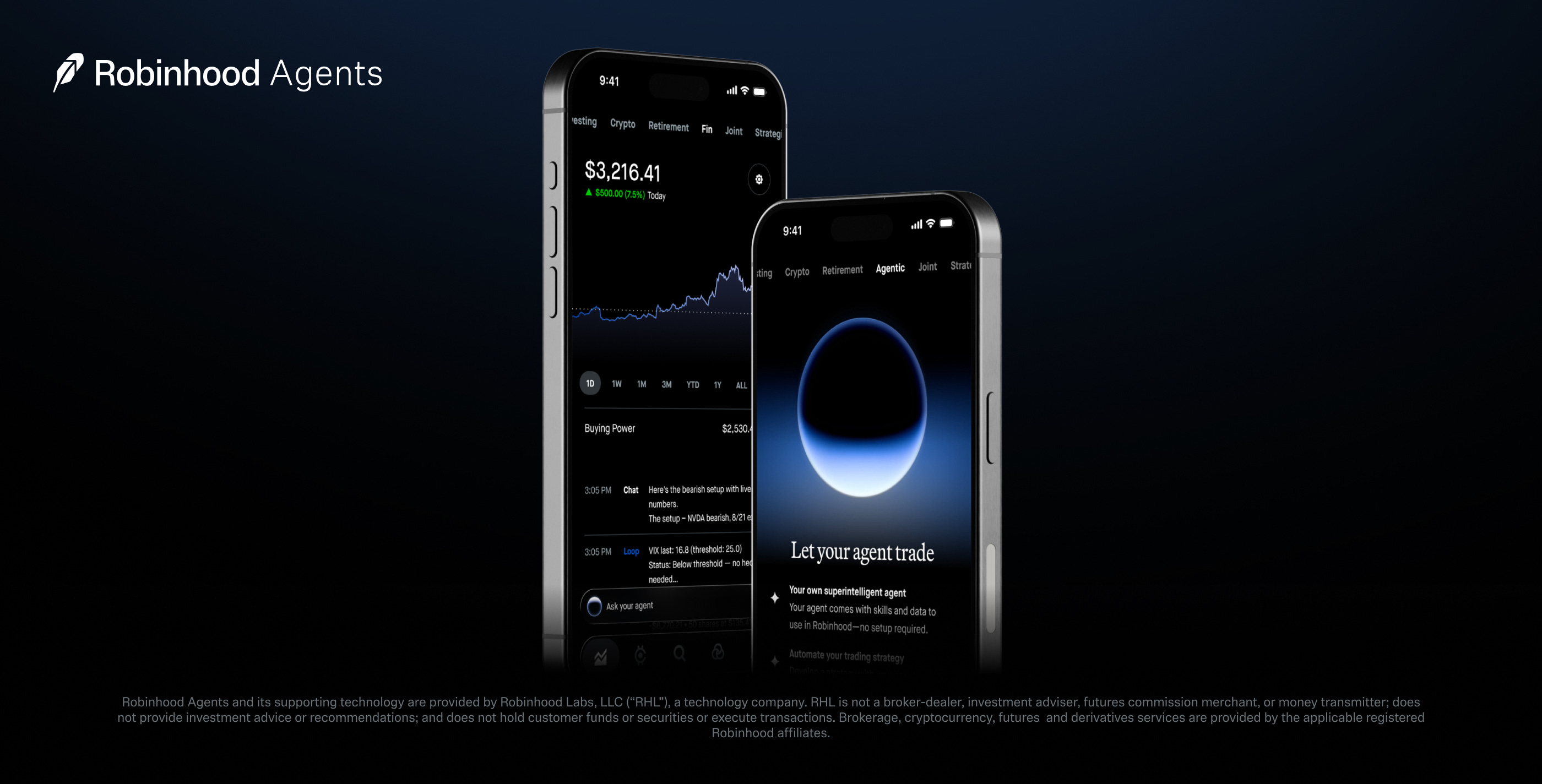
Importantly, the demand came first here. Customers have connected outside agents through MCP since May, and in July nearly 100,000 agentic accounts held over $100 million. CEO Vlad Tenev said many customers didn’t want to set up Codex or Claude Code, and that general-purpose models sometimes “fight you” on placing trades.
Unsurprisingly, most of the money comes from trades. Transaction revenue was $776 million of Q2’s $1.31 billion, up 44%, and agents that watch markets overnight trade more often than people do. The same day, Robinhood also announced 24/7 trading in select U.S. stocks and perpetual futures, markets no person can watch around the clock. Hence, more business for AI agents! (& also for Robinhood)
ICYMI: Robinhood’s Q2 2026: a 44% EPS beat, a $106M gain that’s already gone & why HOOD stock fell anyway 🏹📉 breaking down the most important facts & figures from Robinhood’s Q2 2026, including the $106M gain that vanished before the earnings call even started, to see whether is still worth your time & money + bonus guide on how to [Turn Claude Opus 5 Into a Financial Analyst That Never Sleeps inside]
Zoom out 🔎 Looking at the bigger picture, there are a few other things worth noting. First, Agent Apps, which is the underrated piece here. Its 11 paid data providers, including Nasdaq and SpotGamma, work only with Robinhood-hosted agents. That gives customers a reason to drop their own Claude or ChatGPT and makes Robinhood the gatekeeper between data vendors and retail traders.
Liability is where the design is arguably the weakest. The software comes from Robinhood Labs, which isn’t a broker-dealer or adviser, and the user assumes all risk. For MCP agents, trade approval is only an instruction the agent is asked to follow.
Because FINRA calls its rules technology neutral, an enforcement case, rather than new rules, will likely test that structure. In June, eight House Democrats asked SEC Chair Atkins who is accountable for agentic trading. One runaway Loop, or many agents making the same trade, would force the answer. Agentic Trading market overview
THE TAKEAWAY ✈️
What’s next? 🤔 We can remember that just last week, Schwab, LPL Financial and JPMorgan shares fell on concern that agents like Meta’s Muse could move idle balances to higher yields (more on this here). Trading agents are therefore the first real test of giving software standing authority over money, and the cheap sweep deposits funding incumbents are clearly the next target. Looking ahead, the most important number to watch is the share of Robinhood’s trading volume placed by agents, which the company hasn’t disclosed. Yet. It is now clear that Tenev & the team is building for agents to drive most activity. But average agent balances of around $1,000 show that shift hasn’t even started.
ICYMI:
🧠 What else I’m watching
-
Revolut in Argentina 🇦🇷 Revolut has received Argentine central bank approval to acquire Banco Cetelem from BNP Paribas, rebranding it as Revolut Bank Argentina under local CEO Agustin Danza. While the bank won’t initially offer public-facing products, 150,000 people are already on the waitlist for a full suite of services spanning everyday banking, credit, wealth, and rewards. Revolut will face tough competition from local fintechs like Ualá and Mercado Pago, plus European incumbents BBVA and Santander. It will be interesting to see how this acquisition accelerates Revolut’s Latin American expansion. ICYMI:
-
NatWest AI Insights 🤖 NatWest is trialing a generative audio-visual AI tool that lets customers explore their finances through natural voice and text conversations, dynamically responding to follow-ups and topic shifts to discuss spending, budgeting, and financial habits. Developed using the bank’s proprietary Small Language Models, the tool transforms complex transaction data into interactive insights and graphs, aiming to help users understand their money and identify savings. Additionally, NatWest has enhanced its Cora digital assistant with a fraud triage agent to guide customers to the right support teams. ICYMI:
-
HSBC RedCoin 🪙 HSBC is preparing to launch RedCoin, its Hong Kong dollar-backed stablecoin, under a licence granted in April 2026, with a phased rollout starting with everyday P2P and P2M payments before expanding to wholesale corporate and institutional use cases. The stablecoin will initially be offered only through PayMe and the HSBC HK Mobile App, alongside a public education campaign on scam prevention and transparent redemption mechanisms. HSBC frames the launch as support for Hong Kong’s financial innovation built on security and trust. ICYMI:
💸 Following the Money
-
Corporate card and expense management platform Jeeves has raised $110M to scale its stablecoin-native banking platform for global enterprises.
-
Charter Space, an El Segundo, California-based startup, has raised a $5M seed round to grow its space insurance business.
-
AI-native startup Elio Mortgage has raised $5.1M in pre-seed funding led by Motive Partners and Social Leverage.
👋 That’s it for today! Thank you for reading, and have a relaxing Sunday! And if you enjoyed this newsletter, invite your friends and colleagues to sign up: