Why every AI agent you've used is fundamentally broken – and the elegant solution that changes everything
By Manav Sutar
Published: 2025-09-18
URL: https://infraflowai.substack.com/p/the-ai-training-revolution-how-alibaba
The $10 Billion Problem Hiding in Plain Sight
Every AI agent you interact with today is built backwards.
OpenAI's Deep Research. Claude with tools. Every customer service chatbot. They all suffer from the same fundamental flaw that's costing the industry billions and leaving users frustrated.
Alibaba's research team just published a paper that exposes this problem – and introduces a solution so elegant it's already achieving state-of-the-art results that beat OpenAI's best systems.
The problem? We've been trying to teach agents to be agents AFTER they've already learned to be chatbots.
The Training Paradox That's Breaking AI Agents
Here's what happens when you build an AI agent today:
-
Step 1: Train a large language model on text (e.g., GPT-4, Claude).
-
Step 2: Try to teach it to use tools and reason through complex tasks
-
Step 3: Wonder why it fails at basic agent tasks despite being brilliant at conversation
The research reveals the core issue: "General-purpose foundation models lack agentic inductive biases, forcing post-training to simultaneously learn capabilities and alignment, creating inherent optimization conflicts."
Translation: You're asking a model to become a completely different type of intelligence while keeping everything it already learned. It's like trying to teach a novelist to be a detective while they're still writing poetry.
The Breakthrough: Agentic Continual Pre-training
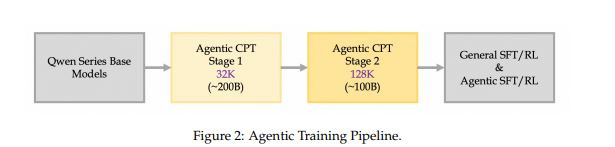
Alibaba introduced something revolutionary: Agentic CPT (Continual Pre-training) – teaching models to think like agents BEFORE teaching them to chat like humans.
Instead of the broken pipeline:
Text Training → Chat Training → Agent TrainingThey created:
Text Training → Agent Training → Chat TrainingThis isn't just a minor reordering. It's a fundamental reimagining of how AI minds should develop.
The Results That Shocked Everyone
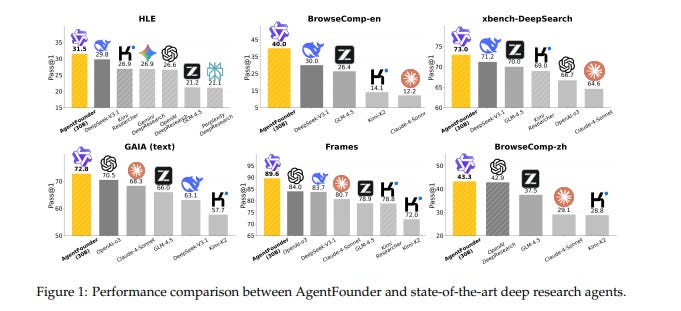
Their model, AgentFounder-30B, doesn't just compete with existing agents – it demolishes them:
BrowseComp-en (Web Research):
-
AgentFounder-30B: 39.9%
-
Best open-source competitor: 30.0%
-
33% improvement over the previous best
GAIA (General AI Assistant):
-
AgentFounder-30B: 72.8%
-
Previous best: 66.0%
-
First model to break the 70% barrier
HLE (Expert-Level Questions):
-
AgentFounder-30B: 31.5%
-
All competitors: Under 30%
-
First open-source model above 30%
But here's the kicker: It's not just beating open-source models. AgentFounder is outperforming closed-source commercial systems that cost millions to develop.
The Two-Stage Training Revolution
The breakthrough comes from their systematic approach to building agentic foundations:
Stage 1: First-Order Action Synthesis (200B tokens)
Teaching models the basics of tool use and planning without expensive API calls.
Key Innovation: Instead of running actual web searches and API calls (which costs millions), they synthesize realistic agent scenarios from existing knowledge.
Example Process:
-
Take entity: "Paris"
-
Combine knowledge: Louvre visitors, Olympic Games, transport issues
-
Generate question: "At the biennial aerospace marketplace named after the city whose pyramid-fronted museum recorded high single-digit millions of visitors during a period of global athletic celebration..."
-
Teach planning: Search strategies, information synthesis, logical reasoning
Stage 2: Higher-Order Action Synthesis (100B tokens)
Teaching complex decision-making through trajectory expansion.
The Insight: Every step in an agent's reasoning has multiple valid paths. Instead of teaching one "correct" sequence, expose the model to decision trees at each step.
Result: Models learn to think, not just follow scripts.
The Training Efficiency Breakthrough
The research reveals something remarkable about their approach. When they compared how efficiently different models learn during fine-tuning:
Traditional Model Loss: 0.8656 (harder to train) AgentFounder Loss: 0.7953 (learns faster and better)
This isn't just about final performance – it's about training efficiency. AgentFounder models learn agent tasks significantly faster because they already understand the fundamental concepts.
The Scaling Laws That Change Everything
Most exciting: their approach shows clear scaling benefits.
Data Scaling Results:
-
0B tokens: 54.2% performance
-
15B tokens: 58.0% (+3.8% jump)
-
315B tokens: 62.2% (steady improvements)
Model Size Scaling:
-
1B parameters: 20.4%
-
4B parameters: 32.7%
-
30B parameters: 48.9%
The scaling laws work. More data and bigger models consistently improve agent performance when you train them correctly.
Why This Changes Everything for AI Development
For Developers:
Before: Struggle with unreliable agents that fail unpredictably. After: Build on foundations that naturally understand tool use and multi-step reasoning
For Businesses:
Before: Pay premium prices for inconsistent commercial agent APIs After: Deploy specialized, reliable agents tuned for specific business needs
For Researchers:
Before: Fight against models that resist agentic training. After: Start with models designed for agent development from the ground up
The Elegant Solution to Tool Use
One of the most impressive aspects is how naturally AgentFounder handles tools. The research shows adaptive tool usage patterns:
Complex Research Tasks: Heavy tool usage with sophisticated exploration patterns. Structured Tasks: Conservative, targeted tool invocations. Knowledge-Intensive Tasks: Strategic balance of search and reasoning
The model isn't just randomly calling tools – it's demonstrating genuine strategic thinking about when and how to use different capabilities.
The Multi-Step Reasoning Breakthrough
Traditional agents often fail at multi-step problems because they're imitating reasoning patterns, not actually reasoning. AgentFounder learns decision-making through Higher-order Action Synthesis:
Instead of: "Here's the one correct path," They teach: "Here are the decision points and trade-offs at each ste.p"
Result: Genuine problem-solving capability, not pattern matching.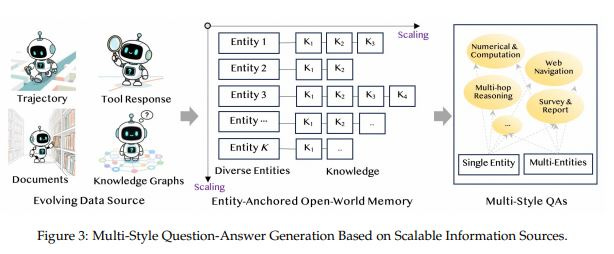
The Synthetic Data Innovation
Perhaps most importantly for the broader AI community: this entire breakthrough was achieved using synthetic data generation without expensive API calls.
Traditional Agent Training:
-
Requires millions of real API calls
-
Expensive web scraping
-
Limited by rate limits and costs
-
Difficult to scale
AgentFounder Approach:
-
Offline synthesis from existing knowledge
-
No API costs during training
-
Unlimited scalability
-
Reproducible and controllable
This democratizes advanced agent training. You don't need Google-scale budgets to train world-class agents.
What This Means for Your AI Strategy
Immediate Implications:
-
Stop trying to force general LLMs to be agents - Start with agentic foundations
-
Rethink training pipelines - Agent capabilities should come before conversational polish
-
Invest in synthetic data generation - The future of AI training is offline simulation
-
Focus on decision-making patterns - Not just task completion
Strategic Implications:
The companies that understand this shift first will build insurmountable advantages. While competitors struggle with unreliable agents, early adopters will deploy systems that think strategically about complex problems.
The Open Source Advantage
Unlike proprietary systems, AgentFounder is built on principles that can be replicated and improved. The research provides detailed methodologies for:
-
Synthetic data generation techniques
-
Two-stage training protocols
-
Evaluation frameworks
-
Scaling strategies
This isn't just a better model – it's a blueprint for the next generation of AI development.
The Future of AI Agents
This research suggests we're entering a new era of AI development where:
Agents aren't afterthoughts – they're the primary design target. Training is strategic – not just throwing data at models. Synthetic data is powerful – potentially more valuable than raw internet scraping. Decision-making is learnable through proper training architectures
Getting Started with Agentic Training
While you may not have Alibaba's resources, the principles are applicable:
-
Identify decision points in your domain-specific tasks
-
Synthesize training scenarios that expose multiple valid paths
-
Focus on reasoning patterns rather than just correct answers
-
Build foundations before adding conversational layers
The Bottom Line
We've been building AI agents wrong from the beginning. By trying to retrofit general language models into specialized agents, we've created systems that are fundamentally limited.
Agentic Continual Pre-training represents a paradigm shift: train for the intelligence you want, not the intelligence that's easiest to achieve.
The results speak for themselves. AgentFounder isn't just incrementally better – it's categorically different. It represents what agents look like when they're designed to be agents from the ground up.
The age of retrofitted AI agents is ending. The age of purpose-built agentic intelligence has begun.
What aspect of this training revolution interests you most? The synthetic data generation, the two-stage approach, or the fundamental rethinking of AI development priorities? Share your thoughts – this is the kind of breakthrough that reshapes entire industries.
P.S. The full research paper is available on arXiv. If you're serious about AI development, this is required reading. The methodological details alone are worth months of experimentation.