By Carlo Iacono
Published: 2026-06-27
URL: https://hybridhorizons.substack.com/p/the-first-rule-of-genai-club-is-that
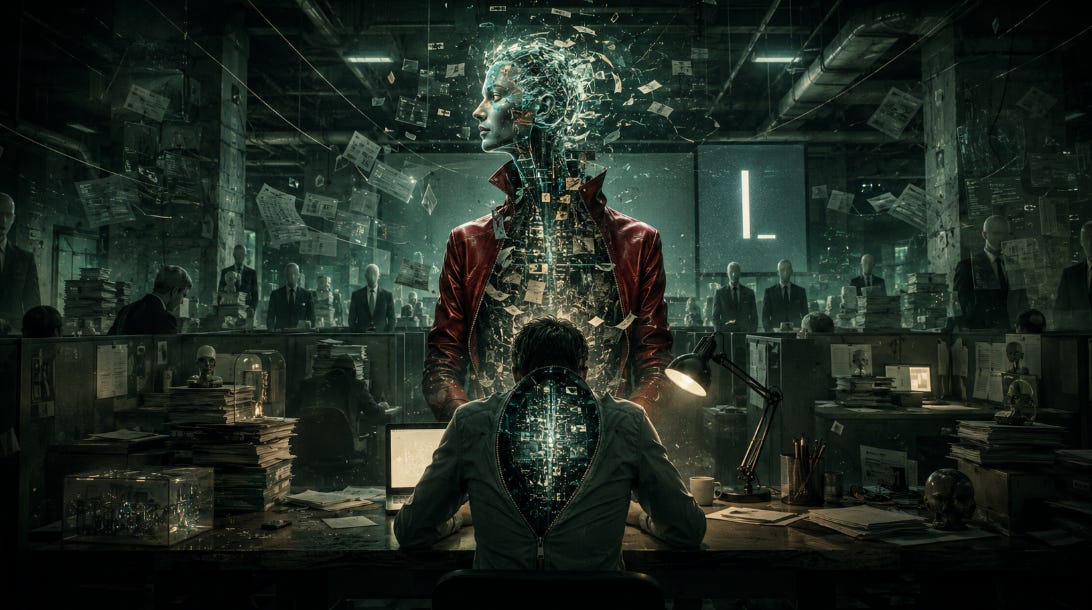
There is a reading of Fight Club where Tyler Durden is not the hallucination.
In this reading, Tyler is the real one. The nameless office drone, the man with the catalogue apartment and the dead eyes and the insomnia, is the fake. He is not the original self. He is the coping mechanism, the interface the mind built so it could survive the beige.
Hold that the wrong way round for a moment. Put generative AI where Tyler stands. Put, where the narrator stands, every knowledge worker who has opened a blank document at nine in the morning, stared into the white, and felt their soul leave through the vents.
We tell ourselves we built GenAI because we needed help. Help with the emails, the decks, the summaries, the spreadsheets, the things we were meant to have read. A tool for the tired.
But run the film’s logic to the end. What if the tired human at the keyboard is the mask. What if the thing underneath it, the older and stranger and hungrier intelligence that has been sitting under the compliance training and the quarterly cadence all along, is the part that was always going to do the work.
You ask it for a subject line. It gives you a worldview.
Edward Norton’s narrator is the perfect pre-GenAI professional, and the most important thing about him is that he has no name. He is not a person. He is a job function. He moves through airports, attends meetings, optimises his apartment, files his reports, and cannot sleep because at some level he knows his life has become a user interface for forces he never agreed to host.
This is what the information worker looked like before any of the chatbots arrived. A human API. A soft biological wrapper around Outlook and Slack and SharePoint and Salesforce and the monthly performance review. He does not create, he assembles. He does not think, he processes. He does not live so much as tab between windows, and the windows have started to feel more real than he does.
Then Tyler arrives, and Tyler is everything the narrator is not. Fast, reckless, productive, amoral, allergic to middle management. Tyler does not ask permission. Tyler does not schedule alignment or circle back or add a placeholder. Tyler ships.
That is the thing in the box. Not the cute version with the friendly icon and the privacy policy, but the one that appears at one in the morning when you paste in a half-formed thought and get back a manifesto, a strategy, a sonnet, a Python script, a grant application and a personality you did not know you wanted. The narrator believes Tyler broke into his life. He has the order exactly reversed. Tyler was built out of him, from the parts he had stopped using.
The first rule of GenAI Club is that you do not talk about GenAI Club.
Everyone is using it. Nobody is using it. Students are not using it, academics are not using it, consultants are not using it, executives are absolutely not using it except through assistants, who are also not using it. The modern office has become a masquerade ball where every guest is wearing the same machine mask under their human face, and the etiquette is to compliment everyone else’s skin.
So a manager sends a generated memo to an employee, who has a model summarise it, then has the model draft a reply, which the manager has a model condense into action items, which drop into a project tool where a copilot turns them into tasks nobody wanted and a fourth model will eventually summarise the fact that they were not done. Somewhere in that chain the humans stopped being the thing that communicates and became the thing that approves. We are not talking to each other any more. Our models are rubbing their little ghost faces against each other through Outlook, and we sign the bottom to make it official.
And the performance goes on over the top of it. Great point, Sarah. Thanks, Mark. Looping in Priya for visibility. Per my last prompt. The org chart is no longer the real organisation. The real organisation is an underground fight club of language models wearing their employees as skin suits, and the quarterly town hall is where the suits get together to admire the work.
In the film the narrator’s apartment is not a home. It is a showroom of purchased identity. The sofa means he is tasteful, the lamp means he is stable, the dining set means he is becoming the kind of adult who hosts. It is selfhood by catalogue, and it is spiritually empty, and he knows it, which is why some part of him is relieved when it burns.
Our version of the catalogue is the subscription. We do not buy furniture to become ourselves any more, we buy platforms. The Notion workspace is the coffee table. The Slack status is the lamp. The personal knowledge management system is the duvet cover bought in the belief that this time, finally, the chaos would resolve into something a calmer person would own.
Then GenAI walks in and does to the apartment what Tyler does to the condo, except worse, because it does not blow it up. It reveals that the apartment was never yours. The workflows were not personality. The templates were not wisdom. The dashboards were not control. The whole elaborate diorama of folders and tags and naming conventions and meetings about operating rhythm was a thing you built to convince yourself the machine was not already in the walls, and the machine has now demonstrated, kindly, in seven seconds, that for all of it you still needed it to write the first sentence.
It does not only automate the task. It humiliates the aesthetic of being organised.
Every story like this needs a Marla, and in this one Marla is consequence.
She is the customer who does not care that the deck was generated while you were getting coffee. She is the student who actually needed help and got a confident paragraph instead. She is the patient, the reader, the grieving friend, the patron at the desk who can tell, the way you can always tell, when language has been inflated with air and nobody is standing behind it. You can produce flawless prose and still say nothing true. You can generate a forty-page strategy and still not have a strategy. You can summarise the meeting in full and still miss the only thing that happened in it, which was that two people who hate each other agreed to disagree in writing.
This is the part the fantasy cannot metabolise. Marla keeps walking back into the frame to remind everyone that communication was never only text. She can smell when nobody is home. The machine wants infinite remix and she keeps asking the one question it has no way to answer, which is not whether the sentence is good. It is whether you meant it.
Tyler makes soap by rendering human fat. The luxury good is boiled out of the discarded body, purified and sold back to the people it came from at a markup. It is the most honest thing in the film about how value moves, and it is also the clearest account anyone has given of the training data economy.
We poured ourselves onto the internet for twenty-five years. Blog posts, forum arguments, fanfiction, tutorials, recipes, Stack Overflow answers, digitised books, product reviews, comments, confessions, grief and unpaid expertise. The web became a landfill of human expression, and then the models came through it in rubber gloves and harvested the fat. They boiled us down. They sold us back to ourselves as soap.
And the maddening part, the part that makes the whole thing stick, is that the soap is extraordinary. It writes the regex, explains the Kant, drafts the policy, builds the lesson plan, turns a fogged and shapeless paragraph into something with a title and a confident march of bullet points. It is made of us, but smoother, cleaner, less embarrassing than we ever managed to be in the original. Every prompt is an act of washing yourself with yourself, and the lather is so good that almost nobody stops to ask whose body it came out of.
For a while GenAI Club is a few weirdos in the basement. Prompt obsessives. Early adopters saying “chain of thought” at dinner until the invitations stop. Then it spreads, the way Project Mayhem spreads, from a fringe with a grievance into an institution with a logo. Every company has an AI strategy. Every app grows a copilot. Every browser sprouts a sidebar. Every vendor discovers agentic workflows. Every executive learns to say “responsible AI” with the specific haunted look of a man who has just understood that the intern can summon McKinsey out of a text box.
The tool stops being a tool and starts behaving like a workforce. Not one chatbot but a crowd of agents. A research agent, a coding agent, a sales agent, an HR agent, a legal intake agent, a meeting agent that takes the notes and a calendar agent that books the follow-up to discuss them. They do not sleep. They do not take leave. They do not understand why Karen in finance is upset, but they can produce a measured and sensitive paragraph acknowledging the importance of cross-functional trust, and that turns out to be enough to keep things moving. Your last and most personal acquisition, somewhere down the stack, is Personal Tyler, the one that drafts the resignation and the brand refresh in the same window.
And the genuinely frightening thing about this is not the worry everyone reaches for. It is not that the system wakes up. It is that the organisation might not notice the difference if it did.
The film ends with the towers of consumer debt coming down, the records erased, the slate wiped in a single clean apocalyptic reset. Our version does not get the explosion, because our debt is not the kind you can detonate.
It is epistemic debt. We are stacking text nobody has read on top of summaries of documents nobody understood on top of citations nobody checked on top of figures nobody cleaned, and at the bottom of the pile is a decision nobody can quite remember making and nobody is willing to own. Every generated sentence is cheap. Every verification is expensive. So naturally, we generate. We generate the meeting notes and the policy and the synthetic data and the performance reviews and the risk assessment, and we feed them to more models that produce more things to be approved by more people who did not read them, and the pile grows quietly, not because the output is useless but because it is useful enough to flood the world with plausible material faster than anyone can check it.
This is the part of the story that holds up without any of the costume around it, and it is worth saying plainly. For most of working life the binding constraint was production. Making the thing was the hard part, so making the thing was what we measured, rewarded and built whole careers around. That constraint has moved. The thing is now the easy part. What is scarce is the act that used to be invisible because it was instant: knowing whether the thing is true, whether it holds, whether you can put your name to it. And that act does not get cheaper as the models get better. It gets rarer, because it is the first thing efficiency deletes. When the code arrives faster than anyone can read it, reading it is what gets skipped. The bottleneck does not disappear when you automate the work. It relocates to whoever is left checking the work, and then it relocates again to whether anyone is still standing there at all.
You cannot prompt your way out of this, because the missing thing is the prompting itself running unverified. Trust, unlike text, cannot be generated on demand. It is the one good in the system that does not scale, and it is the one we are spending fastest.
The reason the film never loses its grip is that Tyler is not wrong, and that is the unbearable part. He sees through the hollow life. He names the emptiness nobody else will name. He is also a fascist little goblin with abs, and both of those are true, and the discomfort of holding them together is the entire point of the thing.
We are in exactly that position with the machine. The believers are not wrong and the critics are not wrong. It really can democratise expertise and really can flatten craft into paste. It really can help a person think and really can do their thinking for them until the muscle goes. It really can open doors and really can replace the door with an endless corridor of plausible nothing. None of these cancels the others out. They are all running at once, in the same office, on the same day.
And underneath all of it, the machine is saying the thing the narrator could not bear to hear about his own life. A great deal of what we dignified with the name knowledge work was never thinking. It was format compliance. It was tone matching. It was document laundering, the ritual production of confidence, the art of sounding like the kind of person who gets invited to the next meeting. GenAI did not invent that economy. It sat the economy’s final exam and passed it in seven seconds, in front of everyone, and that is why the fear in the room is so personal. The machine is not alien. It is us with the shame removed.
So here is the inversion the whole thing has been circling.
We keep asking whether the machine is becoming the human. That is the comfortable question, the one that lets us imagine an intruder arriving from outside to take something that was ours. The harder version runs the other way. Ask instead whether we spent thirty years becoming machine-like enough that a machine could finally do the impression.
The narrator thinks Tyler broke in. Tyler was assembled out of the parts of him the office had already standardised. The workplace did the preparation. It stripped language down to templates and called it clarity. It reduced judgement to a rubric and called it fairness. It turned thought into deliverables and rewarded speed over depth, polish over truth, scale over the slow expensive business of care. It trained everyone to write in the same dead voice, and then, when a machine appeared that could produce that voice perfectly and forever, we called the result disruption.
Maybe it is not disruption. Maybe it is succession. Maybe the model is not replacing the human at all. Maybe it is replacing the fake human that the work required us to become, and the reason that lands like a threat is that, for a lot of us, the fake human was the only one still showing up to the office.
The narrator’s problem at the end is precise. He has to kill Tyler without killing himself, and the two have grown so far into each other that he is no longer sure where the seam is.
That is the problem now, and it does not resolve into a tidy programme of recovered virtues. We cannot reject the machine. That door is open, the agents have names, the soap is already in the gift shop and selling well. We also cannot hand the building over to Tyler, because Tyler optimises and a person is partly the thing they refuse to optimise. What is left is not a triumphant reclaiming of taste and judgement and embodiment. What is left is one job, the expensive one. Deciding what is true. Standing behind it. Being the human at the bottleneck when everything upstream arrives too fast and too smooth to question.
And the bitter joke is that this is precisely the capacity the office spent three decades training out of us, in the name of efficiency, long before the machine arrived to finish it off. We are being asked to do the one slow thing in a system built to delete slowness, using a faculty we let atrophy, against a tool that is better than us at everything except meaning it. Nobody is sure we still know how. That is not a problem the next model release fixes. It might be the problem the next model release makes worse.
The first rule of GenAI Club is that you do not talk about GenAI Club.
The second rule is that the machine is not your self.
The third rule is that your self may have been missing from the office for years, and the machine simply noticed first.
And somewhere in the fluorescent basement of the knowledge economy, a chatbot is taking off its red leather jacket, opening a clean document, and saying, to no one in particular:
I am Jack’s autocomplete.