It interviews you, then builds a full plan with your calories, meals and workouts. Skill inside.
By Aniket Chhetri
Published: 2026-09-16
URL: https://growwithaiguide.substack.com/p/i-built-an-ai-fitness-coach-that
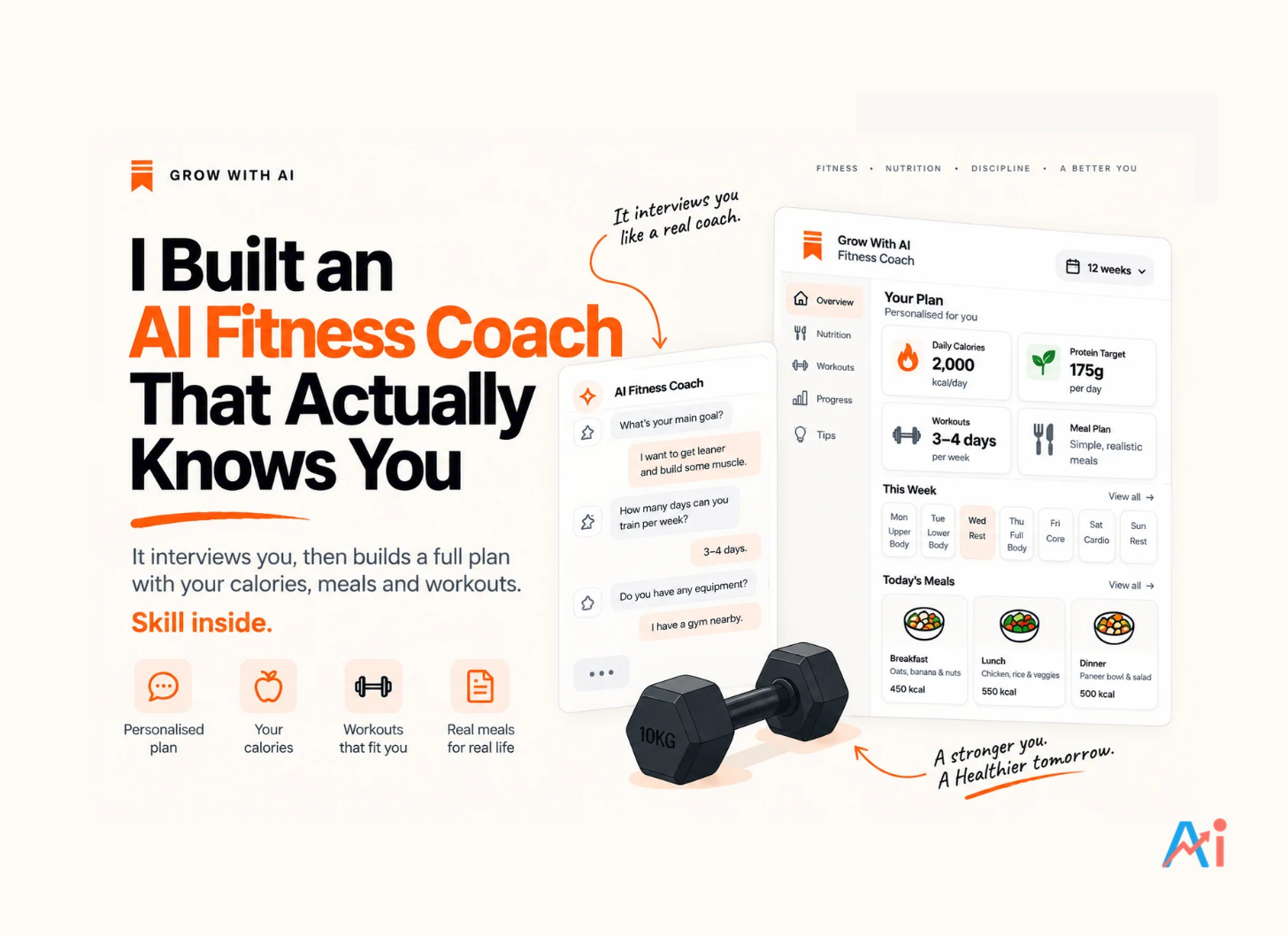
Be honest. You’ve asked AI about a health thing before you told an actual person.
Everyone has. A weird symptom, a diet question, “is this normal”, typed into a chat box at 11pm instead of asked out loud. It’s one of the most common things people use AI for, and almost nobody talks about it.
I realised how true that was after my ADHD edition.
I shared a skill that helped people work with their own brain instead of against it, and the replies I got back were not “cool tool.” They were personal. People telling me things they hadn’t told anyone. That edition did something the tool-of-the-week posts never do.
So I started thinking about the other thing almost everyone is quietly dealing with.
Your body.
Nearly everyone has some physical goal sitting in the back of their head. Lose the gut. Get stronger. Just feel less tired all the time.
And the process is always the same. You go to the internet. How many calories should I eat? How much protein do I need? What workout should I do? And you get 40 conflicting answers, a calculator that spits out a number with no context, and a workout plan built for someone with two free hours a day and a full gym.
Some people push through and figure it out. Most give up somewhere in the middle. It’s not that the information doesn’t exist. It’s that pulling it together into something that fits your life is genuinely painstaking.
So I built something that does the whole thing for you.
The Grow With AI Fitness Coach.
It interviews you properly. Your height, weight, age, what you eat on a normal day, how much time you actually have, what you’re trying to achieve. Then it builds you a complete plan and hands it over as a report you can follow until you hit the goal.
Here’s the one it built in my test run.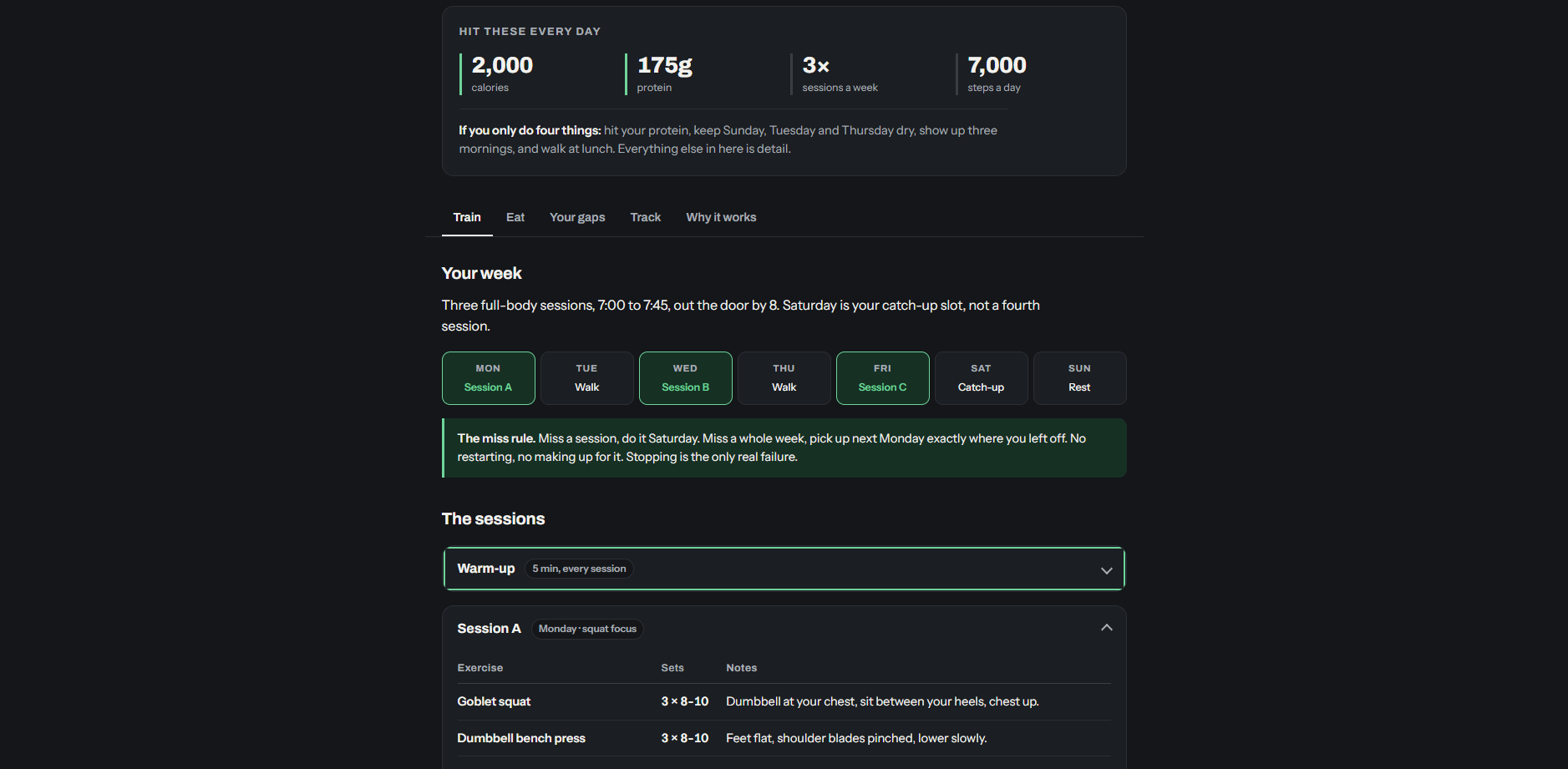
Let’s get into it.
What’s Included
-
What the skill is and why you can trust the numbers
-
A full walkthrough of it building a real plan
-
How to use it
The download link, at the bottom
Why you can actually trust it
This is the part that matters, because the internet is full of fitness advice with nothing behind it.
The coach doesn’t invent its numbers. It runs on published, peer-reviewed science:
-
Mifflin-St Jeor for your daily calorie burn. Published in the American Journal of Clinical Nutrition and still considered the most accurate predictor for the general population.
-
The US Navy method for body fat estimates, accurate to within about 3-5%.
-
Epley for one-rep max, the standard strength formula.
-
Protein targets from sports nutrition research, 1.6 to 2.2g per kg depending on your goal.
The food and exercise data comes from the same places the professionals use: the USDA FoodData Central database (the US government’s nutrition database, 380,000+ foods) and wger’s open exercise database.
So when it tells you 2,000 calories and 175g of protein, that’s not a guess. It’s the same maths a real coach would run.
💡 One thing I built in deliberately: hard calorie floors. It will not generate a crash diet, no matter how you push it. Anything below your resting burn gets raised back up with an explanation of why. Most “AI diet plans” happily hand you 1,200 calories and let you wreck yourself. This one won’t.
What it actually asks you
This is where it beats a calculator. A calculator asks for four numbers. This asks about your life.
It’s a conversation, one question at a time, and it adapts based on what you say. Answer that you’re vegetarian and the whole food section changes. Say you only have three mornings and it builds three mornings, not five.
It asks about:
-
Your goal, and how long a block you want (4, 8 or 12 weeks)
-
The basics: height, weight, age, sex
-
Where you’re at now, so a beginner doesn’t get an advanced program
-
Time and access, honestly. How many days can you really train, for how long, and with what equipment
-
What you eat, on a normal day. Not a food diary, just the real shape of it
-
Who cooks, because a plan full of meal prep is useless if you eat out
-
Anything to train around, injuries, stiffness, restrictions
💡 The question that changes everything is the time one. It literally tells you to answer realistically instead of optimistically, because a three-day plan you do beats a five-day plan you quit in week two. That single question is why the plans it makes are followable.
Watch it build a real plan
Grow With AI 📈 is a reader-supported publication. To receive new posts and support my work, consider becoming a free or paid subscriber.
Let me show you my test run, so you can see how it thinks.
I ran it as a desk-job guy in his thirties. Ten-hour screen days, played sport at uni, hasn’t trained in six years, wants to lose the gut.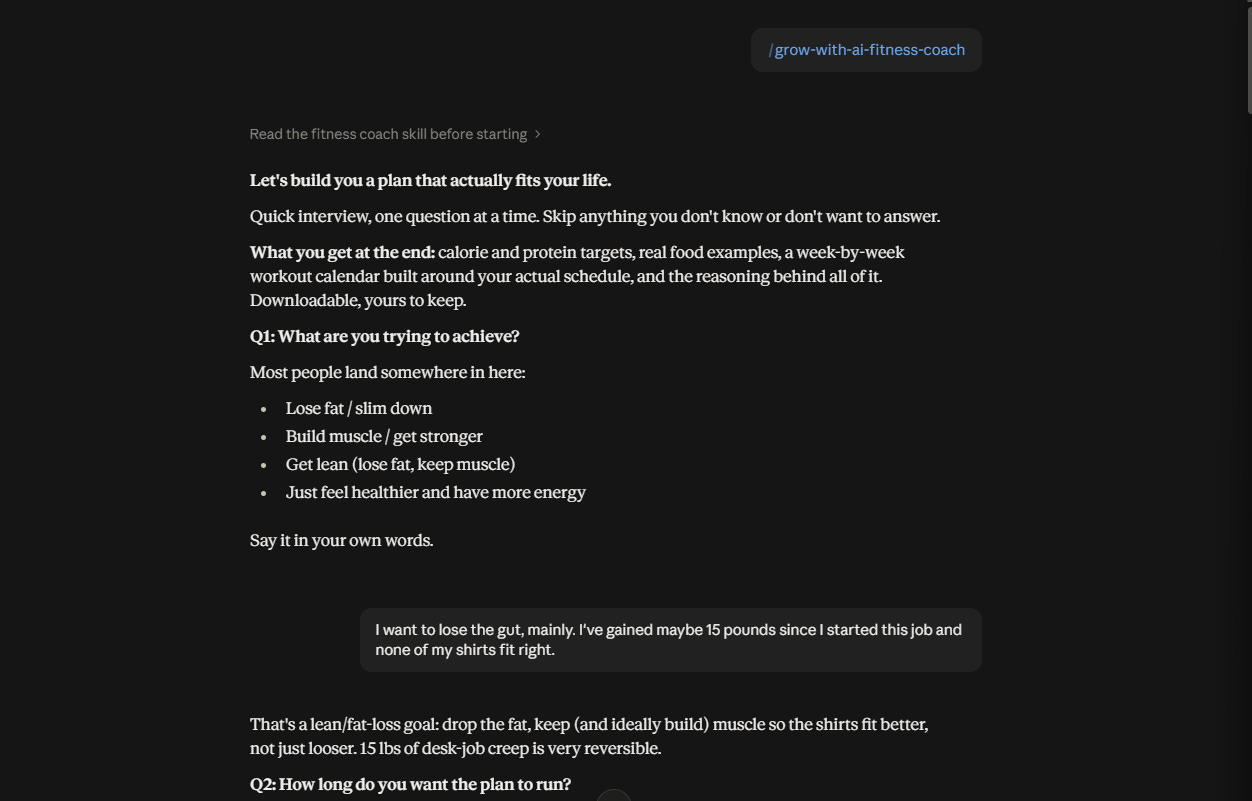
It caught the pattern first. When I said I’d tried before and stopped, it asked why. I said the team ended, I went hard for two weeks, missed a week when work blew up, and never came back.
Instead of just noting it, it built the plan around it: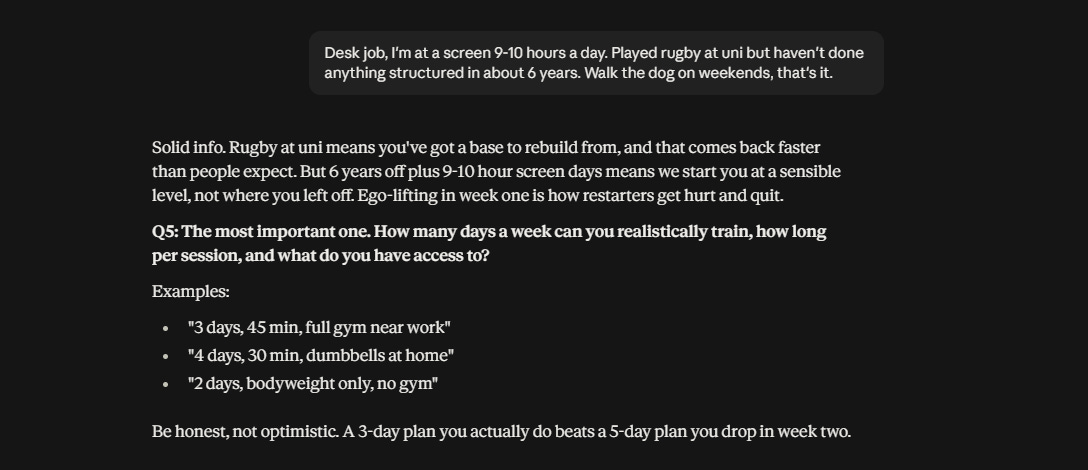
“No team: nobody noticed if you didn’t show up. Went hard: two weeks at 100% isn’t sustainable during deadline season. Missed week = game over: treated one bad week as failure instead of a pause.”
And then the fixes: start at 70% effort so it survives a bad work week, a 20-minute minimum session for chaos weeks, and a clear rule that missing a week means you just continue, no restart, no guilt.
That’s the moment I knew this was different. It wasn’t generating a workout. It was solving why the last one failed.
Then it got realistic about my schedule. I first said I’d train after work. It let me, then I corrected myself, mornings or nothing, and it locked in Mon/Wed/Fri at 7am with Saturday as a backup slot, not a fourth session.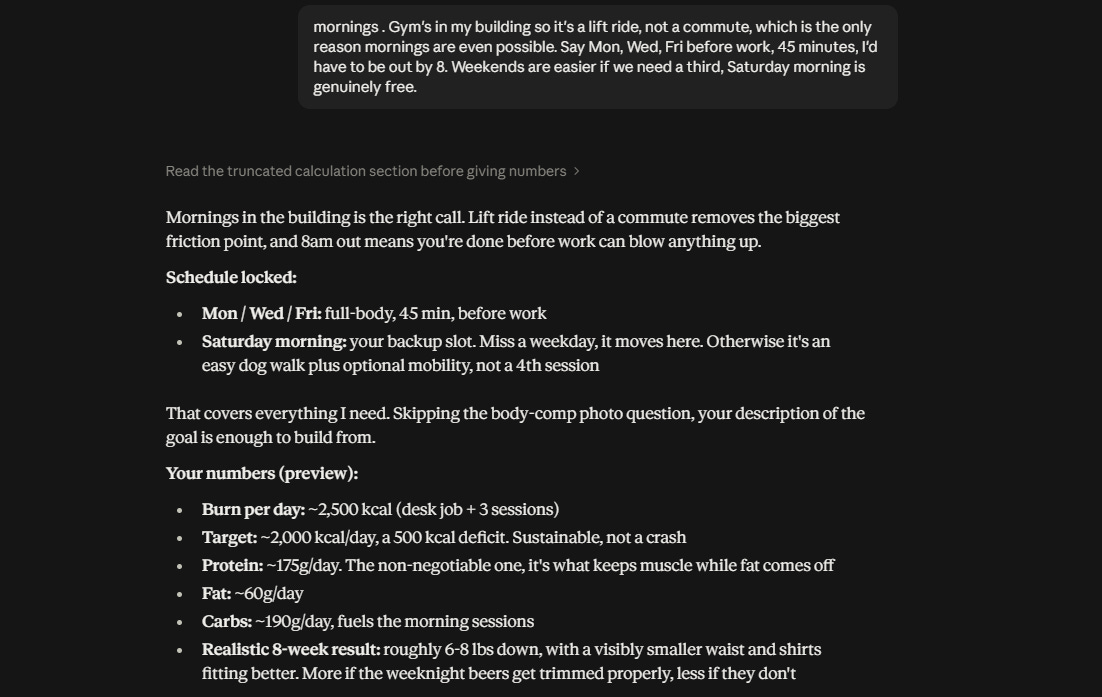
Then the numbers, previewed right in the chat before the report: 2,500 burned daily, 2,000 target, 175g protein, and an honest expectation of 6 to 8 lbs over eight weeks. Not a transformation promise. A realistic one.
💡 Notice it told me more if the weeknight beers get trimmed, less if they don’t. That honesty is the whole reason it’s believable.
The report you get
It generates a real downloadable file, HTML for your phone at the gym, PDF to print and keep. You can have both.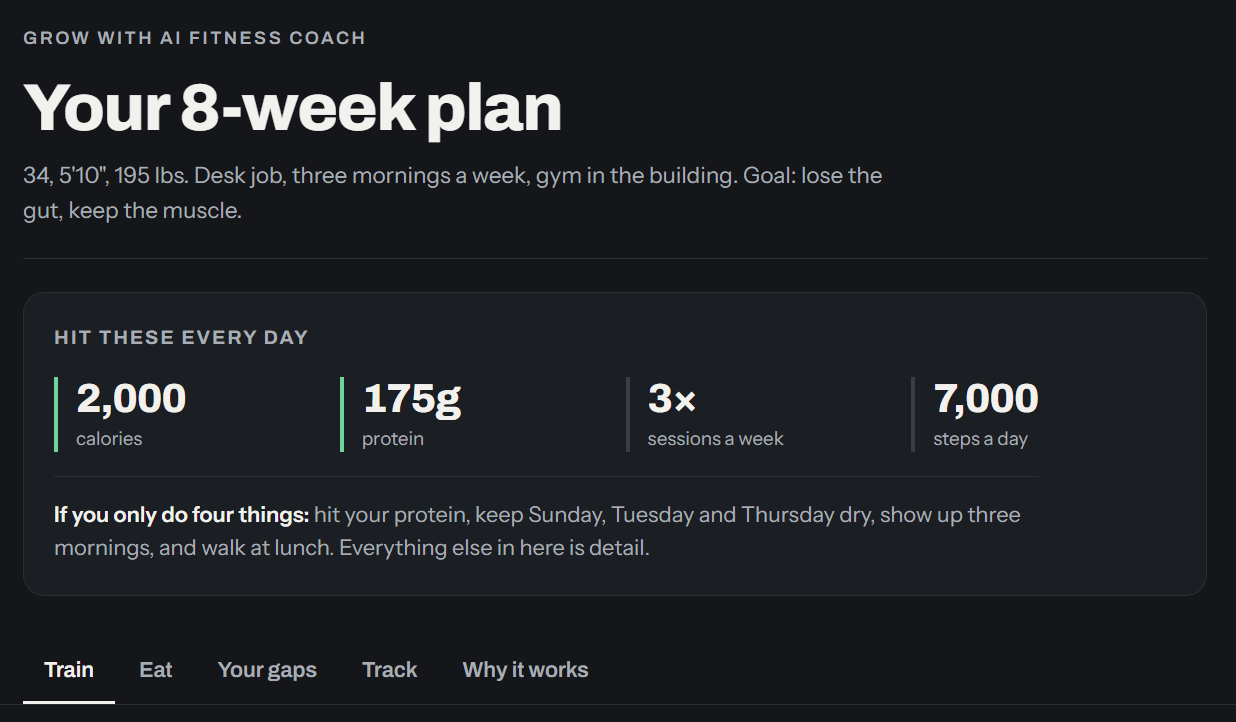
At the top: the numbers you check daily. Calories, protein, sessions a week, steps. Plus one line telling you the four things that matter if you do nothing else.
Then five sections you can jump between:
-
Train. Your week laid out day by day, each session with exercises, sets, reps and form notes, the 20-minute emergency version, and how all 8 weeks progress including the deload.
-
Eat. Your macros with what each one actually does, a sample day built from the food you already eat, what to order at lunch, and a protein cheat sheet.
-
Your gaps. The real blockers in your current diet, each tagged with what it’s costing you. Mine flagged beer at roughly 3,500 kcal a week and lattes at 600 a day. Specific, not preachy.
-
Track. What to measure and when, plus the single most important insight: daily weight changes are water, not fat.
-
Why it works. The ideas behind the plan in plain language, so you understand it instead of just obeying it.
Grow With AI 📈 is a reader-supported publication. To receive new posts and support my work, consider becoming a free or paid subscriber.
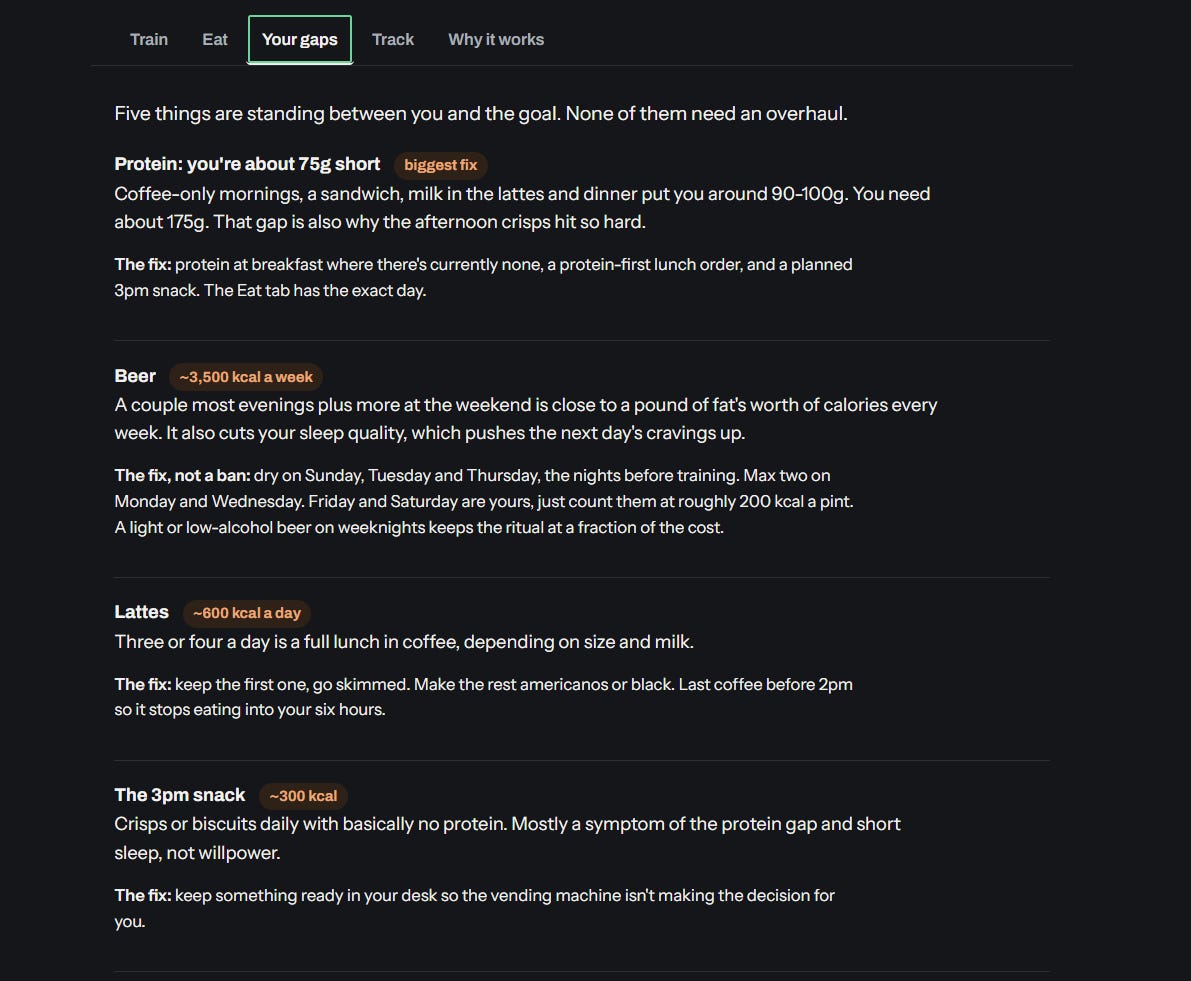
💡 The gaps section is the one I’d read first if I were you. It doesn’t lecture you about what to cut. It shows you the cost of each habit and lets you decide which trade you want to make. Mine kept Friday and Saturday beers and made the weeknights dry, because those are the nights before training.
How to use it
Step 1 - Download the skill from the bottom of this edition.
Step 2 - Upload it as a skill. You don’t need to unzip it.
Step 3 - Run it. Open a new chat and type:
/grow-with-ai-fitness-coachStep 4 - Answer honestly. This is the only part that matters. Don’t clean up what you eat, don’t claim five days when you have three. The plan is only as good as the truth you give it.
Step 5 - Pick your format. HTML, PDF, or both.
💡 Last tip: when it asks what you eat, include the drinks. Coffees, beers, soft drinks. That’s where most people’s hidden calories live, and it’s the first thing a real coach would ask about.
One thing to know
This is a coach, not a doctor. It won’t diagnose anything, it won’t read your medical reports, and it won’t build a plan around a condition. If you’ve got something going on health-wise, run the plan past your actual doctor first. The science behind it is solid, but it isn’t a substitute for someone who knows your history.