My chat with filmmaker Greg MacGillivray
By James Pethokoukis
Published: 2026-07-03
URL: https://fasterplease.substack.com/p/to-fly-the-most-up-wing-film-of-the
My fellow pro-growth/progress/abundance Up Wingers:
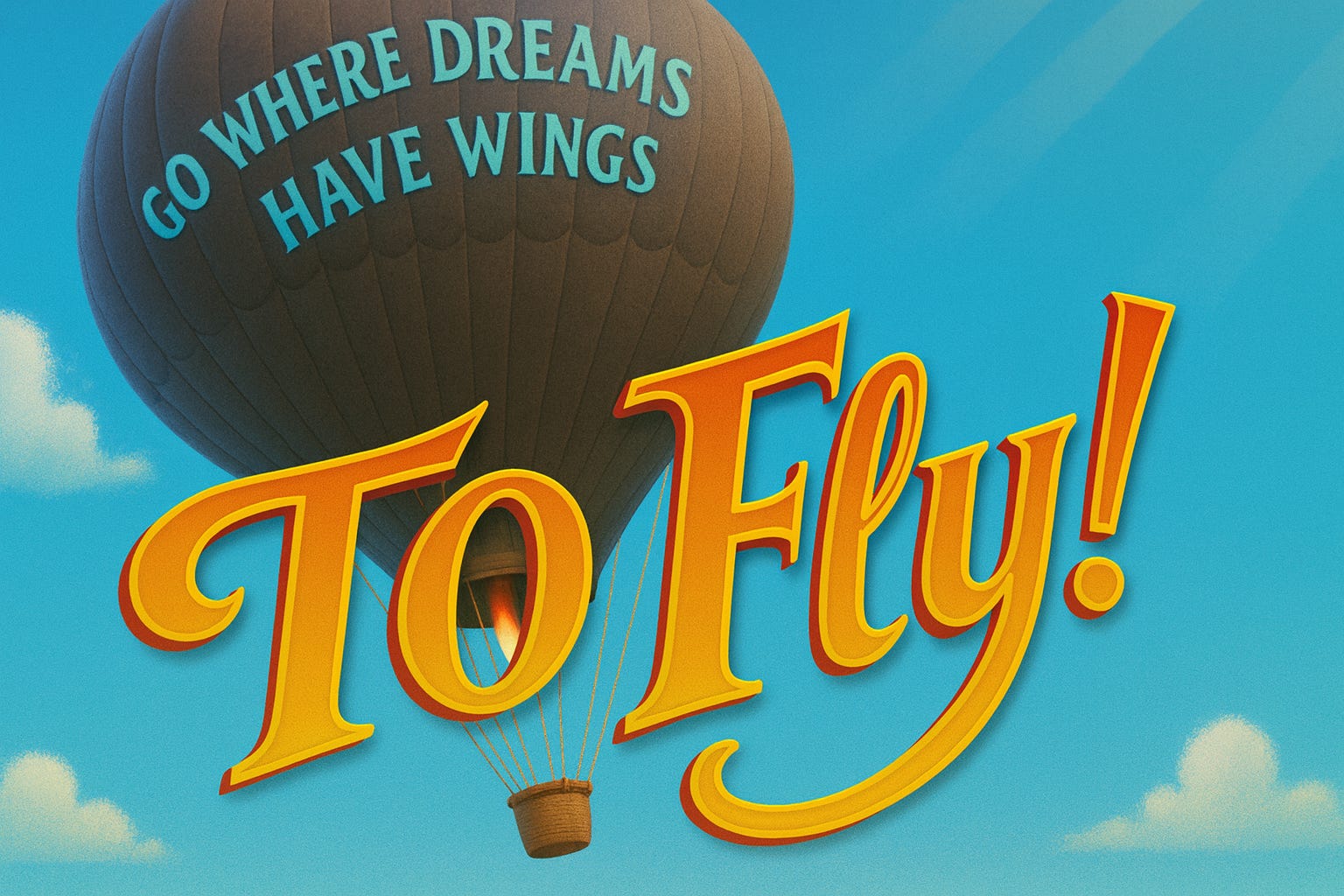
In 1976, America celebrated two hundred years of independence, democracy, and progress. Part of that celebration was the release of To Fly!, a powerful half-hour docudrama on the history of American flight. With To Fly!, Greg MacGillivray and co-director Jim Freeman created one of the earliest IMAX films, bringing cinematography to new heights, literally.
After a decade of war, political disappointment, and social unrest, To Fly! celebrated the American identity and the freedom to innovate. Commissioned by the Smithsonian Institution, To Fly! premiered at the IMAX theater of the new National Air and Space Museum on the National Mall during Bicentennial week in 1976. (Freeman died in a helicopter crash just before the film was to be screened for members of Congress in June 1976.)
Since then, some 100 million people have watched the film in IMAX theaters around the world, including 15 million in Washington, DC. You can still watch it at the NASM today.
I urge you to check out this neat Gold Derby story from earlier this week in which MacGillivray and director Christopher Nolan (The Odyssey, Interstellar, Oppenheimer) discuss the lasting impact of To Fly!
From that piece:
One notable To Fly! fan is director Christopher Nolan, who tells Gold Derby that his first viewing of To Fly! occurred during a childhood trip to the Great America theme park outside of Chicago, now operated by Six Flags. “A buddy of mine and I were riding the roller-coasters and we saw they had an Imax theater there that was showing To Fly!” the director says now. “There was a moment in the film where we’re flying over a ridge, and then the camera banks to one side. I looked at the audience and saw that all of the heads were tilted in that direction at the same time in unison. “That always stuck with me,” Nolan adds. “I fell in love with the Imax format then, and I’ve been using it myself for years. Many years later, I shot Dunkirk with Imax cameras mounted to airplanes, and when I went to see the film at the Cinesphere, there’s a moment during a dogfight where the camera banks on the plane. I looked at the audience, and I could see everybody’s head tilting to one side like they had when I was watching To Fly!” Nolan specifically sought out MacGillivray's advice when he started to incorporate Imax cameras into his own films, starting with 2008’s The Dark Knight.
Last September, I published a podcast chat with MacGillivray, who has produced and directed films for over 60 years. In that time, his production company has earned two Academy Award nominations, produced five of the Top 10 highest-grossing IMAX films, and has reached over 150 million viewers.
Below is a lightly edited transcript of our conversation (and you can go back to the original piece to listen, or check it out wherever you get your podcasts.)
The thrill of watching To Fly! (1:38)
What Jim and I tried to do is put as many of the involving, experiential tricks into that film as we possibly could. We wrote the film based on all of these moments that we call “IMAX moments.”
Pethokoukis: The film To Fly! premiered at the Smithsonian Air and Space Museum, at the IMAX Theater, July 1976. Do you happen know if it was it the 4th of July or. . . ?
MacGillivray: No, you know, what they did is they had the opening on the 2nd of July so that it wouldn’t conflict with the gigantic bicentennial on the 4th, but it was all part of the big celebration in Washington at that moment.
I saw the film in the late ’70s at what was then called the Great America Amusement Park in Gurnee, Illinois. I have a very clear memory of this, of going in there, sitting down, wondering why I was sitting and going to watch a movie as opposed to being on a roller coaster or some other ride — I’ve recently, a couple of times, re-watched the film — and I remember the opening segment with the balloonist, which was shot in a very familiar way. I have a very clear memory because when that screen opened up and that balloon took off, my stomach dropped.
It was a film as a thrill ride, and upon rewatching it — I didn’t think this as a 10-year-old or 11-year-old — but what it reminded me upon rewatching was of )Henry V), Lawrence Olivier, 1944, where the film begins in the Globe Theater and as the film goes on, it opens up and expands into this huge technicolor extravaganza as the English versus the French. It reminds me of that. What was your reaction the first time you saw that movie, that film of yours you made with Jim Freeman, on the big screen where you could really get the full immersive effect?
It gave me goosebumps. IMAX, at that time, was kind of unknown. The Smithsonian Air and Space Museum was the fourth IMAX theater built, and very few people had seen that system unless you visited world’s fairs around the world. So we knew we had something that people were going to grasp a hold of and love because, like you said, it’s a combination of film, and storytelling, and a roller coaster ride. You basically give yourself away to the screen and just go with it.
What Jim and I tried to do is put as many of the involving, experiential tricks into that film as we possibly could. We wrote the film based on all of these moments that we call “IMAX moments.” We tried to put as many in there as we could, including the train coming straight at you and bashing right into the camera where the audience thinks it’s going to get run over. Those kinds of moments on that gigantic screen with that wonderful 10 times, 35-millimeter clarity really moved the audience and I guess that’s why they used it at Great America where you saw it.
You mentioned the train and I remember a story from the era of silent film and the first time people saw a train on silent film, they jumped, people jumped because they thought the train was coming at them. Then, of course, we all kind of got used to it, and this just occurred to me, that film may have been the first time in 75 years that an audience had that reaction again, like they did with first with silent film where they thought the train was going to come out of the screen to To Fly! where, once again, your previous experience looking at a visual medium was not going to help you. This was something completely different and your sense perception was totally surprised by it.
Yeah, it’s true. Obviously we were copying that early train shot that started the cinema way back in probably 1896 or 1898. You ended up with To Fly! . . . we knew we had an opportunity because the Air and Space Museum, we felt, was going to be a huge smash hit. Everyone was interested in space right at that moment. Everyone was interested in flying right at that moment. Basically, as soon as it opened its doors, the Air and Space Museum became the number one museum in America, and I think it even passed the Louvre that year in attendance.
Our film had over a million and a half people in its first year, which was astounding! And after that year of run, every museum in the world wanted an IMAX theater. Everyone heard about it. They started out charging 50 cents admission for the 27-minute IMAX film, and halfway through the season, they got embarrassed because they were making so much money. They reduced the admission price to 25 cents and everyone was happy. The film was so fun to watch and gave you information in a poetic way through the narration. The storytelling was simple and chronological. You could follow it even if you were a 10-year-old or an 85-year-old, and people just adored the movie. They wrote letters to the editor. The Washington Post called it the best film in the last 10 years, or something like that. Anyway, it was really a heady of time for IMAX.
An innovative filming process (8:25)
It was one of those things where our knowledge of technology and shooting all kinds of various films prior to that that used technology, we just basically poured everything into this one movie to try to prove the system, to try to show people what IMAX could do . . .
I may have just read the Washington Post review that you mentioned. It was a Washington Post review from just three or four years later, so not that long after, and in the conclusion to that piece, it said, “You come away from the film remembering the flying, the freedom of it, the glee, the exaltation. No Wonder ‘To Fly’ is a national monument.” So already calling it a national monument, but it took some innovation to create that monument. This isn’t just a piece of great filmmaking and great storytelling, it’s a piece of technological innovation. I wonder if you could tell me about that.
We’ve worked with the IMAX corporation, particularly Graeme Ferguson), who is gone now, but he was a filmmaker and helped us immensely. Not only guiding, because he’d made a couple of IMAX films previously that just showed at individual theaters, but was a great filmmaker and we wanted three more cameras built—there was only one camera when we began, and we needed three, actually, so we could double shoot and triple shoot different scenes that were dangerous. They did that for us in record time. Then we had to build all these kind of imaginative camera mounts. A guy named Nelson Tyler, Tyler Camera Systems in Hollywood, helped us enormously. He was a close friend and basically built an IMAX camera mount for a helicopter that we called the “monster mount.” It was so huge.
The IMAX camera was big and huge on its own, so it needed this huge mount, and it carried the IMAX camera flawlessly and smoothly through the air in a helicopter so that there weren’t any bumps or jarring moments so the audience would not get disturbed but they would feel like they were a bird flying. You needed that smoothness because when you’re sitting up close against that beautifully detailed screen, you don’t want any jerk or you’re going to want to close your eyes. It’s going to be too nauseating to actually watch. So we knew we had to have flawlessly smooth and beautiful aerials shot in the best light of the day, right at dawn or right at sunset. The tricks that we used, the special camera mounts, we had two different camera mounts for helicopters, one for a Learjet, one for a biplane. We even had a balloon mount that went in the helium balloon that we set up at the beginning of the film.
It was one of those things where our knowledge of technology and shooting all kinds of various films prior to that that used technology, we just basically poured everything into this one movie to try to prove the system, to try to show people what IMAX could do . . . There are quiet moments in the film that are very powerful, but there’s also these basic thrill moments where the camera goes off over the edge of a cliff and your stomach kind of turns upside down a little bit. Some people had to close their eyes as they were watching so they wouldn’t get nauseated, but that’s really what we wanted. We wanted people to experience that bigness and that beauty. Basically the theme of the movie was taking off into the air was like the opening of a new eye.
Essentially, you re-understood what the world was when aviation began, when the first balloonists took off or when the first airplane, the Wright Brothers, took off, or when we went into space, the change of perspective. And obviously IMAX is the ultimate change of perspective
When I watched the entire film — I’ve watched it a few times since on YouTube, which I think somebody ripped from a laser disc or something — maybe six months ago, I had forgotten the space sequence. This movie came out a year before Star Wars, and I was looking at that space sequence and I thought, that’s pretty good. I thought that really held up excellent. As a documentary, what prepared you to do that kind of sequence? Or was that something completely different that you really had to innovate to do?
I had loved 2001: A Space Odyssey, the Kubrick film, and one of the special effects supervisors was Doug Trumbull. So we called Doug and said, “Look, I want to make the sequence. It’s going to be short, but it’s going to pay homage to space travel and what could happen in the future.” And he guided us a little bit, showed us how to make kind of the explosions of space that he’d done in 2001 using microscopic paint, so we had to develop a camera lens that fit on the IMAX camera that could shoot just a very small area, like half an inch across, where paint in a soluble mixture could then explode. We shot it in slow motion, and then we built a Starship, kind of like a Star Wars-looking — though, as you mentioned, Star Wars had not come out yet — kind of a spaceship that we then superimposed against planets that we photographed, Jupiter and Saturn. We tried to give the feeling and the perspective that that could give us with our poetic narrator, and it worked. It kind of worked, even though it was done on a very small budget. We had $690,000 to make that movie. So we only had one SAG actor who actually got paid the regular wage, that was Peter Walker).
Was that the balloonist?
Yeah, he was the balloonist. And he was a stage actor, so he was perfect, because I wanted something to obviously be a little bit overblown, make your gestures kind of comically big, and he was perfect for it. But we only had enough money to pay him for one day, so we went to Vermont and put him in the balloon basket, and we shot everything in one day. We never actually shot him flying. We shot him hanging in the balloon basket and the balloon basket was hanging from a crane that was out of the picture, and so we could lift him and make him swing past us and all that stuff, and he was terrific.
Then we shot the real balloon, which was a helium balloon. We got the helium from the Navy — which would’ve been very costly, but they donated the helium — and went to West Virginia where the forest was basically uncut and had no power lines going through it so we could duplicate 1780 or whatever the year was with our aerial shooting. And we had a guy named Kurt Snelling, who was probably the best balloonist at that particular moment, and he dressed like Peter in the same costume and piloted the balloon across. And balloons, you can’t tell where they’re going, they just follow the wind, and so it was a little dangerous, but we got it all done. It was about a week and a half because we had to wait for weather. So we had a lot of weather days and bad rain in West Virginia when we shot that, but we got it all done, and it looks beautiful, and it matches in with Peter pretty well.
Just what you’ve described there, it sounds like a lot: You’re going to Maine, you’re in West Virginia, you’re getting helium from — it sounds like there were a lot of moving parts! Was this the most ambitious thing you had done up until that point?
Well, we’d worked on some feature films before, like The Towering Inferno and Jonathan Livingston Seagull, and things like that, which were involved and very complicated. But yeah, it was very much the biggest production that we put together on our own, and it required us to learn how to produce in a big fashion. It was a thrill for us. Essentially, we had about 10 people working on the film in Laguna Beach, and none of them, except for maybe Jim and I, who we’d worked on feature films and complicated shoots with actors and all that, but a lot of our team hadn’t. And so it was an adventure. Every day was a thrill.
A “you can do it” movie (19:07)
. . . we were celebrating 200 years of democracy, of individual freedom, of individual inspiration, getting past obstacles, because you can do it — you have that belief that you can do it.
There’s a version of this podcast where we spend a half hour talking about The Towering Inferno. I just want you to know that it’s very hard for me not to derail the conversation into talking about The Towering Inferno. I will not do that, but let me ask you this, the movie is about flight, it’s about westward expansion, but that movie, it came out for the bicentennial, we’d gone through a tumultuous, let’s say past 10 years: You had Vietnam, there’s social unrest, you had Watergate. And the movie really must have just seemed like a breath of fresh air for people.
As you put the movie together, and wrote it, and filmed it, did you feel like you were telling a message other than just about our connection with flight? It really seemed to me to be more than that, a movie about aspiration, and curiosity, and so forth.
It was, and pretty much all of our films have been that positive spirit, “You can do it” kind of movie. Even our surfing films that we started with 20 years, maybe 10 years before To Fly!, you end up with that spirit of the human’s ability to go beyond. And obviously celebrating the bicentennial and the beginning of democracy here in this country and the fact that we were celebrating 200 years of democracy, of individual freedom, of individual inspiration, getting past obstacles, because you can do it — you have that belief that you can do it.
Of course, this was right there when everyone had felt, okay, we went to the moon, we did all kinds of great things. We were inventive and a lot of that spirit of invention, and curiosity, and accomplishment came from the fact that we were free as individuals to do it, to take risks. So I think To Fly! had a lot of that as part of it.
But the interesting thing, I thought, was I had one meeting with Michael Collins), who was the director of the Air and Space Museum and the astronaut who circled the moon as Neil and Buzz Aldrin were on the moon walking around, and here he is, hoping that these two guys will come back to him so that the three of them can come back to Earth — but they’d never tested the blast-off from the moon’s surface, and they didn’t know 100 percent that it was going to work, and that was the weirdest feeling.
But what Collins told me in my single meeting that I had with him, he said, “Look, I’ve got a half an hour for you, I’m building a museum, I’ve got two years to do it.” And I said, “Look, one thing I want to know is how much facts and figures do you want in this movie? We’ve got a little over a half an hour to do this film. The audience sits down in your theater, what do you want me to do?” And he said, “Give me fun. Give me the IMAX experience. I don’t want any facts and figures. I don’t want any dates. I don’t want any names. I’ve got plenty of those everywhere else in the museum. People are going to be sick of dates and names. Give me fun, give me adventure.” And I said, “Oh gosh, we know how to do that because we started out making surfing films.” and he goes, “Do that. Make me a surfing film about aviation.” It was probably the best advice, because he said, “And I don’t want to see you again for two years. Bring me back a film. I trust you. I’ve seen your films. Just go out and do it.” And that was probably the best management advice that I’ve ever received.
So you weren’t getting notes. I always hear about studios giving filmmakers notes. You did not get notes.
The note I got was, “We love it. Put it on the screen now.” What they did do is they gave me 26 subjects. They said, “Here’s the things that we think would be really cool in the movie. We know you can’t use 26 things because that’s like a minute per sequence, so you pick which of those 26 to stick in.” And I said, “What I’m going to do then is make it chronological so people will somewhat understand it, otherwise it’s going to be confusing as heck.” And he said, “Great, you pick.” So I picked things that I knew I could do, and Jim, of course, was right there with me all the time.
Then we had a wonderful advisor in Francis Thompson) who at that time was an older filmmaker from New York who had done a lot of world’s fair films, hadn’t ever done IMAX, but he’d done triple-screen films and won an Academy Award with a film called To Be Alive! and he advised us. Graeme Ferguson, as I mentioned, advised us, but we selected the different sequences, probably ended up with 12 sequences, each of which we felt that we could handle on our meager budget.
It was delightful that Conoco put up the money for the film as a public service. They wanted to be recognized in the bicentennial year, and they expected that the film was going to run for a year, and then of course today it’s still running and it’s going into its 50th year now. And so it’s one of those things that was one of those feel-good moments of my life and feel-good moments for the Air and Space Museum, Michael Collins, for everyone involved.
Competing views of technology (25:50)
Our film was the feel-good, be proud to be an American and be proud to be a human being, and we’re not messing up everything. There’s a lot that’s going right.
When rewatching it, I was reminded of the 1982 film Koyaanisqatsi by Godfrey Reggio, which also had a very famous scene of a 747 looming at the camera. While yours was a joyous scene, I think we’re supposed to take away an ominous message about technology in that film. That movie was not a celebration of flight or of technology. Have you wondered why just six years after To Fly!, this other film came out and conveyed a very different message about technology and society.
I love Koyaanisqatsi, and in fact, we helped work on that. We did a lot of the aerial shooting for that.
I did not know that.
And Godfrey Reggio is an acquaintance, a friend. We tried to actually do a movie together for the new millennium, and that would’ve been pretty wild.
Certainly a hypnotic film, no doubt. Fantastic.
Yeah. But their thesis was, yeah, technology’s gotten beyond us. It’s kind of controlled us in some fashions. And with the time-lapse sequences and the basic frenetic aspects of life and war and things like that. And with no narration. That film lets the audience tell the story to themselves, guided by the visuals and the technique. Our film was absolutely a 100 percent positive that the 747 that we had was the number one 747 ever built. Boeing owned it. I don’t think they’d started selling them, or they were just starting to use them. Everyone was amazed by the size of this airplane, and we got to bolt our IMAX camera on the bottom of it, and then it was such a thrill to take that big 747.
The guy took off from Seattle and the pilot said, “Okay, now where do you want to go?” I said, “Well, I want to find clouds. And he goes, “Well, there’s some clouds over next to Illinois. We could go there,” so we go two hours towards Illinois. And I’m in a 737 that they loaned us with the IMAX camera in a brand new window that we stuck in the side of the 737, just absolutely clear as the sheet of glass, just a single pane, and the camera’s right up against that piece of plexiglass and with the 40-millimeter lens, which is a 90-degree lens.
So I said, “We’ve got to fly the 737 really close to the 747 and through clouds so that the clouds are wisping through, and so the 747 is disappearing and then appearing and then disappearing and then appear, and we have to do this right at sunset in puffy clouds, these big cumulus clouds.” And so they said, “We can do that, let’s go find it!” The two guys who were piloting were both military pilots, so they were used to flying in formation and it was a delight. We shot roll, after roll, after roll and got some of those moments where that 747 comes out into light after being in the white of the cloud are just stunning. So we made the 747 look almost like a miniature plane, except for the shot from underneath where you see the big wheels coming up. So it was a really cool, and I don’t know what it cost Boeing to do that, but hundreds of thousands, maybe.
Another public service.
But they got it back. Obviously it was a heroic moment in the film, and their beautiful plane, which went on to sell many, many copies and was their hero airplane for so many years.
Yeah, sure.
It was a fun deal. So in comparison to Koyaanisqatsi, our film was the exact opposite. Our film was the feel-good, be proud to be an American and be proud to be a human being, and we’re not messing up everything. There’s a lot that’s going right.
I feel like there’s a gap in what we get out of Hollywood, what we get out of the media. You don’t want just feel-good films. You don’t want just celebrations. You want the full range of our lives and of human experience, but I feel like, Koyaanisqatsi is about being out of balance, I think we’ve gotten out of balance. I just don’t see much out there that has the kind of aspirational message with To Fly! I’m not sure what you think. I feel like we could use more of that.
Yeah, I’m hopeful that I’m going to be able to make a movie called A Beautiful Life, which is all about the same thing that I was talking about, the freedom that the individual has here in America. I was hopeful to do it for the 250th anniversary, but I’m not going to get it done by that time next year. But I want to do that movie kind of as a musical celebration of almost a “family of man” sort of movie located around the world with various cultures and positive spirit. I’m an optimist, I’m a positive person. That’s the joy I get out of life. I suppose that’s why Jim and I were perfect to make To Fly! We infused beauty into everything that we tried to do.
On sale everywhere The Conservative Futurist: How To Create the Sci-Fi World We Were Promised