And almost no one in charge seems to care
By Engine AI
Published: 2026-05-23
URL: https://exploringaiworld.substack.com/p/ai-is-quietly-destroying-the-way
---
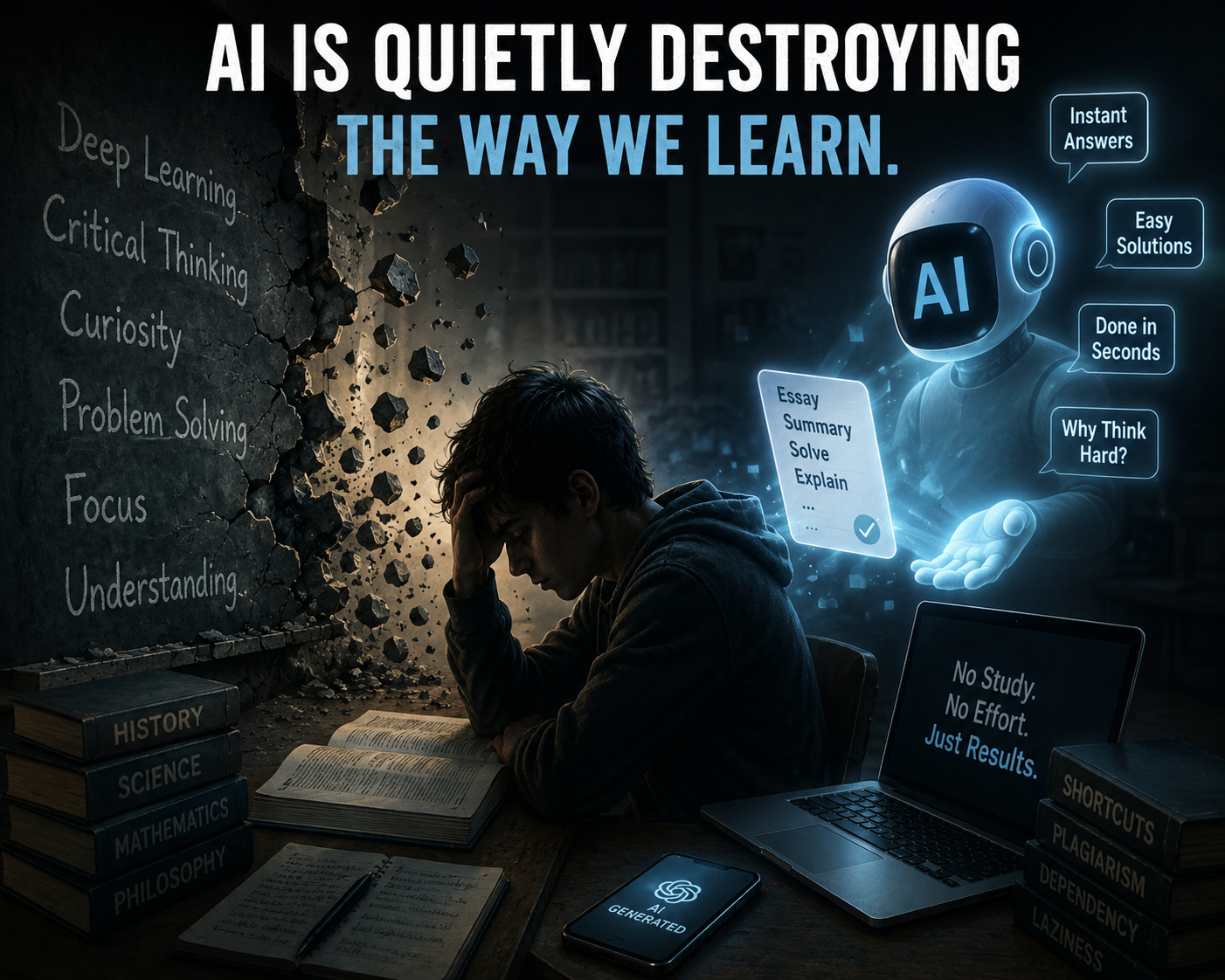
Teaching used to be one of those rare jobs where the reward was not the paycheck.
It was the moment a struggling student finally understood something difficult.
That moment made everything worthwhile.
That joy is disappearing and generative AI is the reason why.
The shortcut that changes everything
When ChatGPT arrived, it did not just give students a new tool.
It gave them a way to skip the entire point of education.
A recent College Board survey of 600 high school students found that 84 percent had used generative AI for schoolwork.
That number alone should stop everyone in their tracks.
Students have always found ways to cheat through cheat sheets, Wikipedia copy-paste.
These were manageable problems.
But AI is something else entirely.
It doesn’t just help students cheat.
It makes cheating almost invisible, almost effortless, and almost impossible to prove.
Why the effort was never the problem, it was the point
Here’s what most people misunderstand about education.
The struggle is not an obstacle to learning.
The struggle is the learning.
Using an AI to write your essay is like hiring someone else to do your workout for you.
The weights still get lifted.
Nothing changes in your body.
When a student hands off a question to ChatGPT and pastes the answer back they have not thought.
They have not connected ideas.
They have not grown.
They’ve just moved paper from one place to another.
The numbers don’t lie
Consider this quiet but telling data point.
One Earth science course asked students a critical thinking question every semester since 2019, a question designed to make them independently connect ideas, not just recall facts.
Before AI, about one in three students figured it out on their own.
After ChatGPT became widespread? More than half now get it right.
But the specific language in those answers now mirrors exactly what ChatGPT produces when given the same question.
The scores went up.
The learning went down.
Teachers are now part-time detectives
What used to be a teaching job has quietly turned into something exhausting and demoralizing.
Instructors now spend enormous amounts of time investigating submissions, documenting suspicions, and preparing evidence for institutional review panels, just to address one case of possible AI use.
A single suspected submission can take four to eight hours to process.
That’s time taken away from actual teaching.
And here is the haunting part: even when a student seems genuinely engaged, there’s now a quiet doubt in every instructor’s mind.
Did they actually understand this or did they just use AI more cleverly than I can detect?
That uncertainty is corrosive.
It changes the entire relationship between teacher and student.
The students who suffer most
Online courses exist for a reason.
They serve students with disabilities, students in rural areas, working parents, and people building a better life while juggling full-time jobs.
As AI makes it harder to run meaningful online assessments, the pressure grows to eliminate these courses entirely or strip them of anything that could be handed to a chatbot.
The students who relied on these courses the most would lose the most.
Meanwhile, even in physical classrooms, the solutions being adopted are often a step backward.
Oral exams & written tests under supervision.
These are useful but come with their own limitations harder to standarize, easier for bias to creep in.
The assignments that were actually enjoyable and effective creative writing, reflective essays, open-ended projects are quietly disappearing.
Not because they were bad assignments.
Because they take 10 seconds for AI to complete and hours to investigate.
What administrators are getting wrong
The response from many institutions has been frustrating in its simplicity.
Teach students how to use AI effectively, they say.
The most common example offered: have students generate an essay with AI and then critique it.
But if the entire lesson is built around showing students why they should not trust AI to write for them.
Why is the assignment using AI to write for them?
The contradiction is obvious to every instructor living it.
It seems invisible to the people making the decisions.
Meanwhile, institutions are signing enterprise AI contracts and calling it innovation.
Instructors on the ground are left to deal with the consequences alone.
Students already know they are not learning
Here is perhaps the most telling detail of all.
Overheard recently a group of college students discussing their workload.
One mentioned an assignment due that night. Another asked why they would not just use ChatGPT.
The reply: “This is my major. I actually need to learn stuff in this class. I use AI for my other classes.”
Students are not confused about what is happening.
They know when they ae learning and when they are just managing a to-do list.
AI has not convinced them that shortcuts equal education.
It has just made the shortcuts much easier to take.
The Uncomfortable Truth
No one has a clean solution to this.
AI is not a calculator.
A calculator does not write your essay, fake your reflection, or complete your entire online course with a single prompt.
The scale of disruption is categorically different.
What’s being lost is not just academic integrity.
It is the friction that makes growth possible.
The confusion that precedes understanding.
The failure that teaches more than any correct answer ever could.
Education has always been about the climb not just arriving at the top.
Right now, it is becoming very hard to stop students from bypassing the mountain entirely.
And the people with the power to address it are busy rebranding the problem as an opportunity.