Industries, Nutrien, and Mosaic are still cheap after a $838/ton urea spike and what happens next
By Harry Colt
Published: 2026-04-10
URL: https://eltoromarketinsights.substack.com/p/70-urea-fertilizer-companies-are
Hi and welcome back for a Quant data driven analysis. [Full Disclaimer]
My Daily Update is now premium.
📢 You can lock in at the crazy price of $1.5/month or $18/year → SPECIAL LINK.
For the past year I have consistently posted news summaries, daily market intelligent brief for free, and we have crossed 15,000 daily reads on every email sent. I haven’t missed a single day, spends 3 hours daily to create the brief.
That’s 1 coffee/month.

Hormuz is shut. Urea topped $838/ton. The ceasefire is cosmetic. Here's the ma[th]gic on five US-listed fertilizer names and why the expected value still favors being long.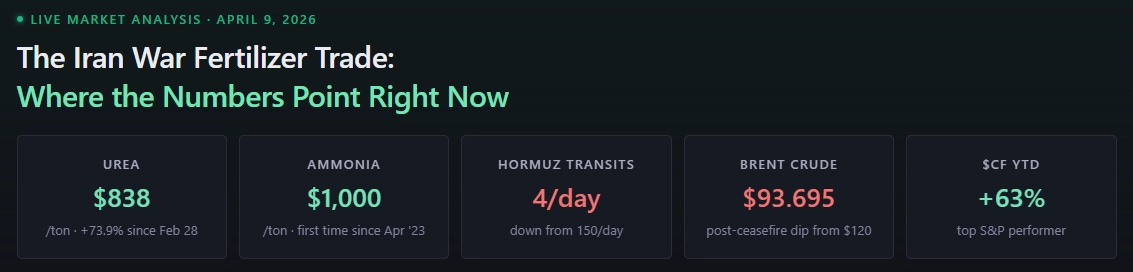
Watching the fertilizer sector for weeks now, and the numbers are screaming. What started as a geopolitical disruption on February 28 has turned into one of the most asymmetric setups in commodity equities I’ve seen since the Russia/Ukraine shock in 2022. The math is straightforward. The opportunity is real. And most people are sleeping on it.
Let me walk you through the full picture.
The Fertilizer Sector: Why It Matters More Than You Think
Fertilizers supply three macronutrients, nitrogen (N), phosphorus (P), and potassium (K), that drive roughly 80% of modern crop yields. Without synthetic NPK blends, global calorie production collapses by 40 to 50%. That’s not an exaggeration. That’s the USDA’s own estimate.
The global fertilizer cap sits around $180 to $200 billion in 2025, with projections reaching $260 to $280 billion by 2034 at a 4.0 to 5.6% CAGR. Population growth toward 8.5 billion by 2030, dietary shifts, precision agriculture adoption; all of it feeds this number higher.
Here’s how the three segments break down:
-
Nitrogen (~60% of volume): Dominated by urea and ammonia. Produced via the Haber Bosch process where natural gas accounts for 70 to 80% of production costs. Global urea production exceeds 190 to 200 million tonnes annually. New capacity additions in low cost regions (US, Russia, Iran, Middle East) totaled roughly 4.4 million tonnes of new N in 2025.
-
Phosphate (~20 to 25%): Derived from phosphate rock via sulfuric acid reaction into phosphoric acid, then DAP/MAP. Supply is concentrated in Morocco, China, US, Russia, Saudi Arabia. China’s export curbs (down 40 to 60% in 2024 and 2025) created structural tightness before the war even started.
-
Potash (~15 to 20%): Mined from sylvinite (KCl). Supply from Canada, Russia, Belarus with new capacity in Laos. Least volatile of the three segments.
Demand is inelastic short term because it’s tied to planted acres and soil nutrient depletion, but sensitive to farmer margins and crop prices. Here’s the number that matters for the Iran story: roughly one third of global fertilizer seaborne commerce transits the Strait of Hormuz.
What the Iran War Did to Fertilizer Supply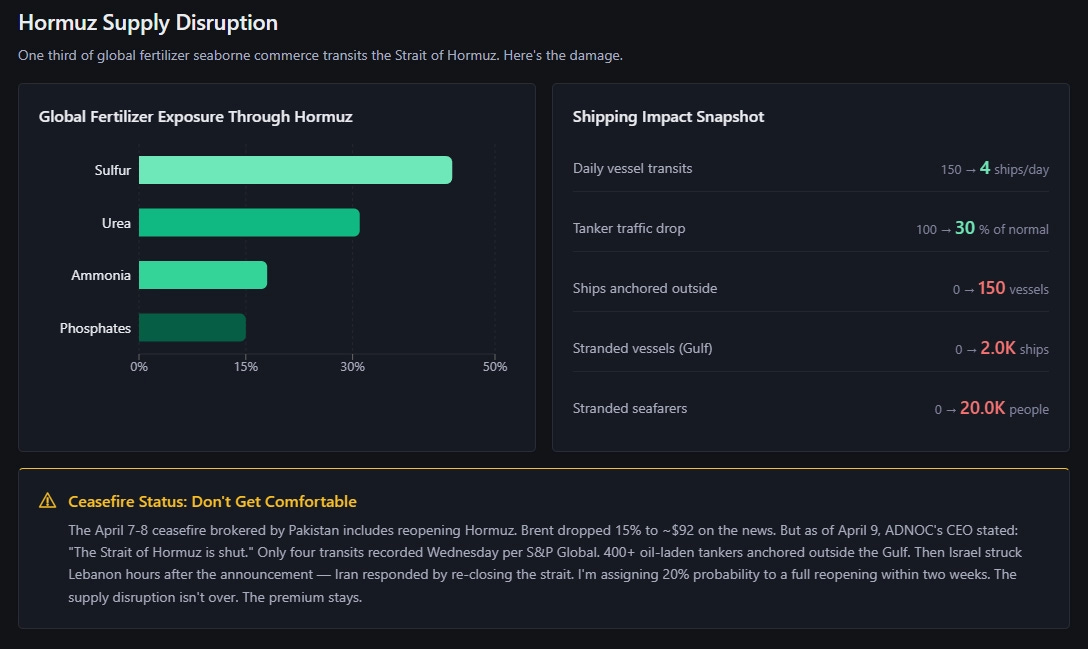
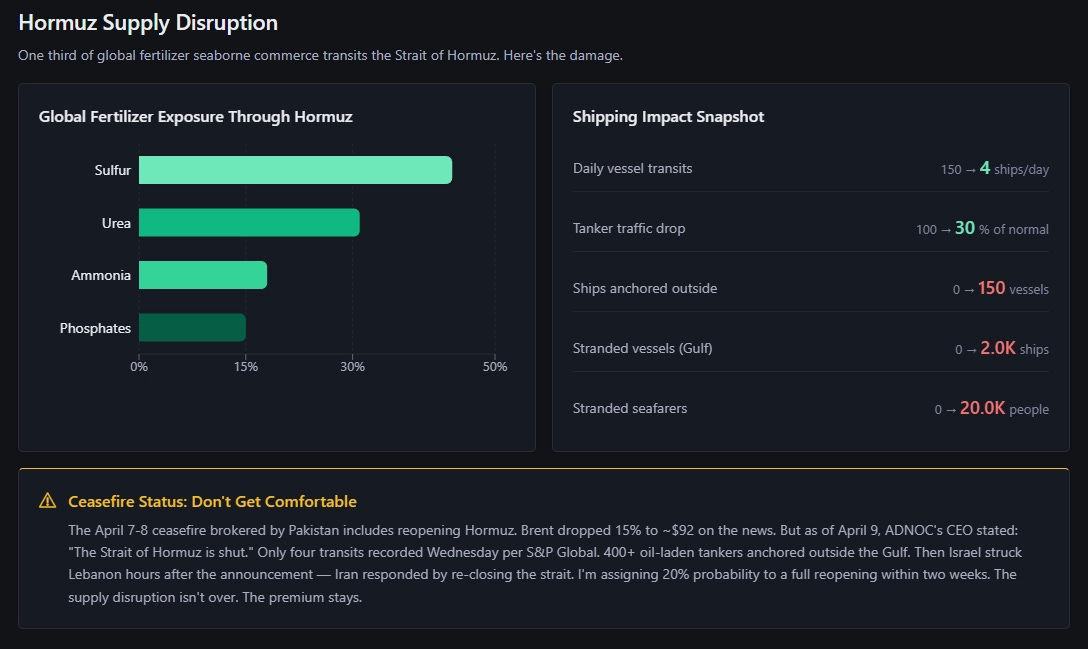
On February 28, 2026, the US and Israel launched joint strikes against Iran. Iran retaliated by effectively shutting down the Strait of Hormuz. Tanker traffic dropped roughly 70%, with over 150 ships anchoring outside the strait. Before the conflict, about 150 vessels passed through every day. That number dropped to four or five.
The IMO estimates roughly 2,000 ships, including oil and gas tankers, bulk carriers, and cargo ships, remain stranded in the Persian Gulf. Around 20,000 seafarers are currently aboard those vessels. There have been 21 confirmed attacks on international shipping with 10 fatalities.
The fertilizer exposure through Hormuz is massive:
Want to Know More? Detail for Members only