Why transparency matters more than the tool and what your comments taught me about who we leave behind
By Cristina
Published: 2025-11-10
URL: https://cristinapatrick.substack.com/p/how-owning-my-use-of-ai-sparked-my
 \Photo by Google DeepMind from Pexels\
Disclaimer: This article was written by me, a human, with assistance from an AI writing tool for editing purposes. I am responsible for the final content and its accuracy. Any brilliance or questionable commas are entirely my fault.
Four days ago, I got called out for using AI to write, so I wrote a note about it.
The note went viral, at least by my standards. The irony? I write about Responsible AI, and I’ve never hidden my process. I use AI tools and I I’ve been transparent about it because that’s literally what I believe responsible AI use also looks like.
But something fascinating happened in the comments, about 100 of you took the time to get involved in the conversation with thoughtful perspectives that continued the conversation and brought up great points and shared lived experiences.
Thank you for your support!
What Your Comments Revealed
Some of you pointed out that we’ve always used tools. Some compared AI writing assistance to editors who restructure your arguments and refine your prose. Others drew parallels to spell-checkers, thesauruses, even ghostwriters.
Someone mentioned that AI detectors flag excerpts from Jane Austen as machine-generated and I had to test it.
When I ran part of the first chapter of Pride and Prejudice through a popular AI detector, it returned a result of 71.84% AI-generated content. Jane Austen died in 1817, nearly two centuries before GPT existed. If the tools can’t distinguish between one of history’s most celebrated authors and a language model, what does that say about their accuracy? That may be a great topic for one of my future posts.
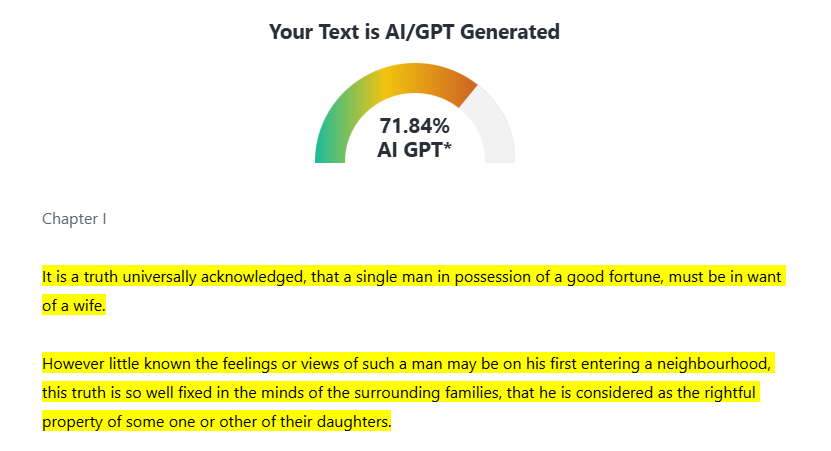 \Screenshot of AI detector\
Many mentioned that they don’t care about the process if the output is valuable, and there is a human author behind it who controls the tool.
All valid comments.
The People We Forget When We Say “Just Write It Yourself”
Several people shared how Large Language Models help them with dyslexia, they have brilliant ideas, ideas worth sharing, but the act of writing has been a barrier their entire lives. AI doesn’t think for them but it translates their thoughts into readable text.
Others mentioned ADHD, how they can conceptualize complex arguments but lose the thread when trying to organize them linearly. AI helps them structure their ideas without replacing the substance.
Many non-native English speakers reached out, professionals who, like me, think and create in a second or third language. Perhaps AI, when used with intention, is widening the circle of voices we get to hear, offering perspectives that were once out of reach.
The assumption that everyone can “just write it themselves” erases millions of people who have something to say but face barriers the rest of us may not even know about.
This post is public so feel free to share it.
The Three Tensions We’re Navigating
Reading through all your responses, three tensions kept showing up around trust, authorship, and what we value in human expression.
1. Transparency vs. Deception
Many of you said that as long as we’re honest about using AI, there’s no issue. We’ve always relied on help like editors, translators, research assistants. What matters is disclosure.
Others pushed back: readers deserve to know where the human ends and the machine begins. Without that clarity, how can we build real trust?
Here’s where I land: transparency is everything. If I use AI to draft, edit, reorganize, or polish, I say so because responsible use starts with honesty about what role the technology actually played.
2. Tool vs. Replacement
Some people worry that using AI risks outsourcing creativity, that we’ll lose the messy, human process that makes ideas our own. Others see it differently: AI doesn’t erase our thinking, it helps remove friction so ideas can flow faster.
Who is leading this process?
If I’m using AI to clarify, expand, or challenge what I’ve already thought through, it’s collaboration. If I’m letting it decide what to say before I even know what I think, that’s when I’ve stepped out of the driver seat.
Creativity starts before we start writing, before we use LLMs or any other tools.
3. Value and Authenticity
Another theme came up: what actually makes writing valuable? Is it the struggle? The craft? Or is it the ability to create something that resonates and helps people?
Some argued that the process is the point, that writing is thinking made visible, and if we skip the writing, we skip the thinking.
I see truth on both sides. Writing does clarify thought, but so do conversation, teaching, or sitting quietly with a hard question.
My Framework for Responsible AI-Assisted Writing
I ask myself three questions:
- Who originated the thinking? If the core ideas, arguments, and perspectives aren’t mine, I shouldn’t be publishing them under my name, AI-assisted or not.
- Am I being transparent? Would my readers feel deceived if they knew exactly how I used AI in this piece? If yes, either disclose it or don’t do it.
- Who does this serve? Am I using AI to overcome a genuine barrier (accessibility, language, etc.) or to express ideas more clearly? Or am I using it to avoid doing the thinking altogether?
If I can answer those three honestly, I’m on solid ground.
Here’s What I Learned from Your Comments
This conversation is more about humanity than technology.
I write about Responsible AI because I believe we’re at a crossroads. We can use these tools to amplify human capability, to include voices that have been excluded, to make expertise more accessible. Or we can use them to automate away the very things that make us human, curiosity, critical thinking, genuine connection.
So here’s my commitment: I’ll keep using AI where it helps me think more clearly and write more effectively, I’ll keep being transparent about it. And I’ll keep asking whether what I’m creating serves you, the reader.
❤️ A note to you, my readers
If you liked, commented, restacked, or even disagreed, thank you. You made these last few days more alive than any algorithm could.
If you’re new here: welcome. This newsletter is about building a thoughtful, inclusive, and responsible digital future, one honest reflection at a time.
And I’d love to know: What does authenticity mean to you in the age of AI? And if you have one more moment, feel free to respond to the poll below, do you use LLMs to refine your writing?
Thanks for reading The Responsible AI Brief! Subscribe for free to receive new posts and support my work.