Effort counts twice. Here’s why that equation matters more than ever in the AI era.
By Chris Chambers
Published: 2026-01-13
URL: https://consultingafterlife.substack.com/p/the-friday-firing-meeting-what-survival
Every Friday afternoon at my first client engagement, leadership would gather in a conference room. No consultants invited.
They were deciding who to fire that week.
For twelve straight weeks, they had been cutting one or more consultants from our team. Partners. Managers. Associates. Nobody was safe. The client believed they were paying for seasoned experts and getting freshly minted graduates instead. They weren’t wrong. I was one of them.
I had arrived just days earlier, and I realized something that changed the trajectory of my career: if I didn’t overdeliver—immediately and consistently—I could be gone by next Friday.
So I made a decision that still shapes how I work today. If I was going to fail, it would never be because I hadn’t put in the work.
The Effort Equation
Angela Duckworth’s research on grit crystallizes something I learned the hard way in those early consulting years:
Talent × Effort = Skill
Skill × Effort = Achievement
Effort shows up twice. It’s the multiplier that bridges the gap between raw talent and meaningful achievement. I wasn’t the most polished or experienced consultant in that room. But I could out-prepare, out-research, and outwork just about anyone.
That first engagement, I worked fourteen to sixteen hour days, seven days a week. Arrived at 7 a.m., stayed until 9 p.m., then went home and prepared for another three to four hours for the next day. Every client question got treated like a final exam. Every meeting felt like a performance review.
There’s an old saying in consulting: you only have to be one day ahead of the client. I tried to stay three. Sometimes I barely managed one or two, but the intent and preparation mattered.
Fear may have been the initial driver. Discipline was what kept me going.
What’s Dying vs. What Endures
Here’s the thing about discipline in the AI era: the nature of the work has transformed, but the underlying principle hasn’t moved an inch.
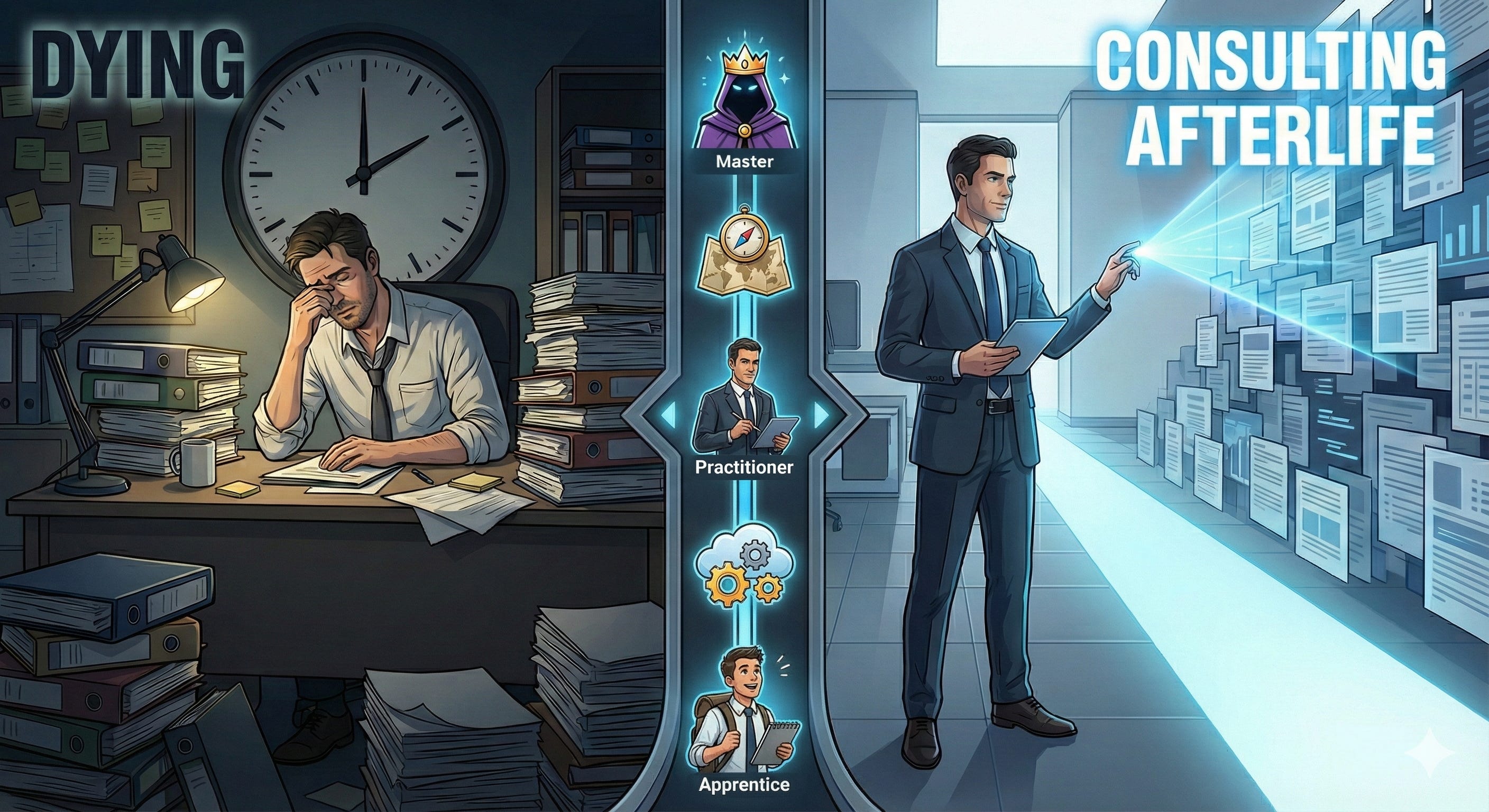
What’s dying: The endless manual slog of preparation that once consumed consultants’ evenings. Hours spent combing through binders, building slide decks by hand, tracking data across disconnected systems. That grinding mechanical labor? AI handles it now.
What endures: The mental habits that let you perform consistently when it matters most. The ability to prepare thoroughly when others cut corners. To stay focused when distractions multiply. To maintain quality standards even under pressure.
In the old days, my fourteen-hour days were a form of manual navigation through dense technical complexity. I used raw grit to painstakingly map out SAP manuals and client requirements, staying one step ahead through sheer volume of effort.
Today, discipline has evolved from manual labor to systematic orchestration. You still need grit, but you apply it to calibrating the tools. Instead of spending ten hours trekking through data, you spend those hours perfecting the prompts and logic that allow AI to illuminate ten thousand pages in ten seconds.
Your value is no longer found in how much complexity you can endure, but in how quickly you can dissolve it to reveal the path forward.
Four Principles That Still Apply
Effort as the Great Equalizer. Just as I learned facing those Friday firing meetings, discipline and preparation can overcome experience gaps. Endurance outlasts enthusiasm. Clients will always value consultants who show up ready, informed, and dependable. AI handles the mechanical prep now—but the consultant’s role shifts from performing manual labor to gathering insights, validating assumptions, and making strategic decisions.
Preparation Over Guesswork. I tried to stay three days ahead of the client instead of the traditional one. Consultants have always been judged on their readiness. Preparation signals respect for the client, the project, and the stakes. Today, AI can simulate client interactions and anticipate challenges before you ever walk into the room. Preparation becomes proactive planning rather than reactive scrambling.
Knowledge Compression. Great consultants digest massive amounts of information and present it back with clarity. I absorbed SAP’s complexity by treating it like video game levels—each area of configuration like a new challenge, each deadline like a boss fight. That skill of simplifying complexity remains timeless. AI accelerates it. The role shifts from absorbing everything manually to asking the right questions, validating outputs, and applying insights at a higher strategic level.
Trust as Currency. No matter how advanced technology becomes, consulting runs on trust. My survival at that first client came down to them believing in my reliability and preparation, not just my technical knowledge. AI can supply knowledge at speed, but consultants must channel it into human presence and judgment. Trust remains paramount—AI just helps you earn it more effectively.
The Paradox
Discipline creates freedom.
When preparation becomes automatic, you’re free to focus on higher-level thinking. When your work habits are solid, you can take bigger risks. When clients trust your thoroughness, they give you access to more interesting challenges.
This isn’t about perfectionism or burnout. It’s about building a foundation strong enough to support the career you actually want.
In a world where knowledge is abundant and AI can generate answers instantly, your competitive advantage isn’t what you know. It’s how reliably you can apply what you know to create value for others.
That reliability is entirely within your control.
What’s your take? Did you have a “Friday firing meeting” moment early in your career that shaped your work ethic? I’d love to hear your story in the comments.