What Pavlov got completely wrong, according to a new study
By Bette A. Ludwig, PhD 🌱
Published: 2026-03-23
URL: https://betteconnects.substack.com/p/a-century-of-bad-teaching-adviceapparently
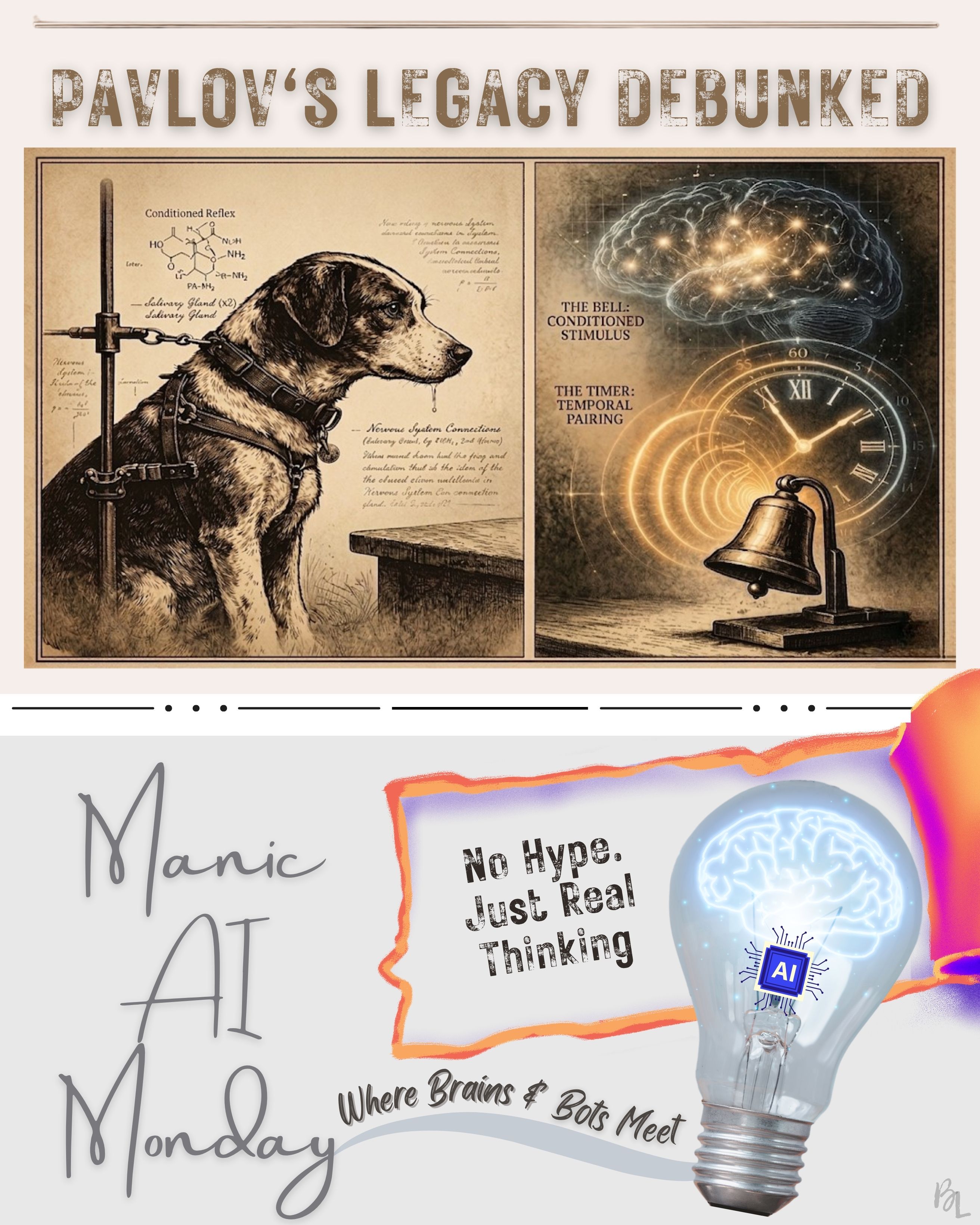 \Image created byauthor, layered in Canva\
I write about leadership, education, AI, and why teaching critical thinking about it is more important than ever.
Please hit the heart ❤️, restack 🔄, subscribe 📨, and all that jazz to help spread the word 🙌
Paid subscribers: Your resources for this issue are at the bottom of this article. Don’t scroll past them. This one includes a learning assessment and a PDF to help put the interval back into learning.
For over a hundred years Pavlov’s dog and classical conditioning has been the origin story of how we understand learning. A bell rings, food arrives, and the dog salivates. Even if you never studied psychology, you probably are very aware of Pavlov and his dog.
It’s become part of virtually every instructional model built based on repetition as the primary mechanism. It boils down to more trials, pairings, and practice.
I spent years working in one of the most well-regarded behaviorist college departments in the world at Western Michigan University. I can tell you behaviorists take this model incredibly seriously, which is exactly what makes a study published in Nature Neuroscience on March 18, 2026, so fascinating.
It suggests that assumption is flat out wrong and the reason why can change how we view teaching, education, and what actually helps students retain information. So buckle up because if this proves to be true, it could be revolutionary and turn behaviorism on its head.
100 years of getting it wrong
Researchers at the University of California, San Francisco ran a series of experiments with mice. They paired an auditory tone with sugar water and then tracked both behavior and dopamine response in real time.
They found mice that waited 600 seconds between the tone and the reward formed the association faster than mice on a 60-second schedule. Okay, so far nothing out of the ordinary. We all know spaced practice produces better comprehension. That’s already well established in the literature.
Here’s where it gets good.
When they looked at the data over the same fixed period, both groups ended up with the same result, even though one group had far fewer pairings. As the time between rewards increased, the rate of conditioning also increased. In other words, the total number of trials didn’t determine how much was learned. Time did.
The objection
Now I know what you’re saying. This isn’t anything new. This is what we’ve been telling students for decades: don’t cram. You need to spread out your studying. Well, that’s what we call the spacing effect, and these researchers actually accounted for that.
They suggest that over a fixed period, simply repeating the pairing more often may matter far less than we assumed. When a reward arrives, the brain appears to work backward through recent experience, trying to figure out what actually predicted it. When those rewards are farther apart, it becomes easier to isolate the right connection, which then determines how much weight that experience carries for us.
Think of it like this: every time something good happens, your brain doesn’t just log it and move on. It scans back through what just happened and asks, “What most likely led to this?” If rewards are coming fast and furious, everything starts to blur together. There’s too much happening too close together, which makes it harder to separate what actually predicted the outcome.
But when there’s a longer stretch between rewards, the brain has more room to sort through what happened and make a cleaner connection. That’s why more repetition in a short burst may not help nearly as much as we thought. It isn’t just about doing something more often. It’s about creating enough separation for the brain to figure out what deserves to stick.
We see this outside the classroom too. Think about TV commercials. Some run over and over and over again and you still have no idea what they’re even selling. Other times one creates an immediate impression with only an exposure or two. That right there tells us repetition by itself is not the magic formula. The number of exposures doesn’t guarantee understanding.
When the brain can finally pinpoint what’s worth remembering, that’s when it begins to register in a way for us to recall it later.
What this may mean for educators
The two main concerns we’ve been hearing for years now related to AI come down to cheating and outsourcing our thinking due to a lack of friction. The first one is pretty self-explanatory. The second one really started getting legs with the MIT study that came out. Everyone labeled it proof that AI was making us stupid or lazy.
It actually proved none of that, which I completely debunked in an article I wrote.
I’m not dismissing the real consequences of offloading thinking because it does happen and it is real. The reason cited for this happening is a word we have all become very familiar with: friction. AI is almost completely stripping it out of learning.
Then we hear about how every generation before that, particularly the older generations, automatically had friction built in. They had to struggle, they had to wait to get answers. Nothing was instant like it is today and AI just accelerated it even more.
The problem is that nobody can agree on what friction actually means. You get definitions ranging from wrestling with an idea, to curiosity, motivation, having to sit with ambiguity and uncertainty, and that we’re training people out of that.
The waiting was never pedagogically designed. It was a built-in constraint because of the environment, but neurologically it may have been doing exactly what this study describes: creating the temporal spacing that allowed the learning loop to complete itself.
AI compresses that interval to nearly zero unless we purposely don’t allow it to. The friction disappears because the interval is no longer there. If that’s what’s needed to actually fire real learning, then removing it helps explain why students can produce work that looks competent without building the understanding underneath it.
Where do we go from here
This is where this gets really exciting because how do we add friction? It seems impossible to answer. When you say things like, “Well people have to wrestle with the idea. They have to understand learning is hard; the struggle is what reinforces it,” those are all incredibly negative.
No one really wants to have to try to understand something that is so complicated or convoluted that they have to do mental gymnastics to try and figure it out. I would argue that’s exactly what most education trains students to do. Unfortunately it’s also training out what we actually want, which is to be more curious, go down rabbit holes, and be more motivated to seek out information.
So here’s what the real question becomes: How do we re-introduce intervals into the learning with AI in the mix? And the answer isn’t to remove AI. That’s neither realistic nor necessarily even the right call. A student who uses it to interrogate a concept from multiple angles, challenge the responses, make connections to other things they know, then put it down and come back to it, is doing something neurologically different from the one who asks for a summary and pastes it into an assignment.
That’s when the tool isn’t the variable; the interval is.
I saw versions of this constantly in advising. I would often repeat the same information in different ways, to meet them where they were, but because the second or third framing was often what finally clicked into place for them. I once had a boss tell me to remove information I had because it was redundant and therefore unnecessary.
I could not disagree more. It was just the same idea or concept being shown to them in a different form, which is often exactly what helps people actually understand it.
The clock was what we missed
The pedagogical response is to design around what AI naturally eliminates. That means assignment structures that build in spaced re-encounter with material rather than single-session completion, and curriculum pacing that stops treating coverage as the primary goal. Because here’s the incredibly uncomfortable truth: the amount of content covered and the intervals necessary for real learning are in direct conflict, and getting through a vast amount of material wins almost every time.
The more useful goal may be to cover less but teach students how to go deep with it, how to process it, how to actually fire those neurons to make it stick. By doing that we start modeling something that transfers to every other topic they encounter later on, especially the ones where they have genuine interest and curiosity. We’re not trying to fill them up with material they won’t retain. We’re teaching them how to learn.
Are we solving for the wrong thing?
We’ve all been feeling a big shift in learning for years, especially educators. Social media created the tipping point because it amplifies quick hit dopamine rewards and removes all of the friction of learning. You generally don’t see a well-thought, deeply articulated article go viral, but you sure do see the ones that package it in a way that’s easy to understand even if it’s not accurate.
Then AI came along and completely reset the bar, and what we swept away in the process was the time our brains actually needed to do its job.
So the problem we need to solve for, and it is a solvable problem, is how do we put the interval back into learning. You’re starting to see more educators asking exactly that. How do you collaborate with AI rather than just consume it. How do you spar with it, push back on it, refuse to stop at the first answer it gives you. How do you iterate until your own understanding actually shifts.
I talk about that constantly, and as a matter of fact this entire article was born out of a conversation I got into with Claude when I stumbled across this study in my Google feed. The interval did the rest. And I can promise you metacognition happened, deep processing happened, and I am not going to forget what this study found. Bonus: I can actually explain it.
© 2026 Bette A. Ludwig: All rights reserved
Paid Subscriber Resources
How Does Your Brain Actually Learn? This isn't a personality quiz. It's a diagnostic. Answer twenty questions across two contexts and find out which of four learning profiles fits each one. I'm a Percolator in one context and an Interest-Dependent Learner in the other. Find out which ones you are. Understanding which pattern you're operating on can help you stop blaming yourself and start changing the behaviors that are actually causing the stress.
Putting the Interval Back: This PDF guide breaks down what the research actually means for students, educators, parents, and grandparents, with concrete, specific strategies for each. No theory. No abstraction. Just things you can do differently starting this week.
Paid subscribers can find this in the subscriber resource library.
Your access link was included in your welcome email. If you can’t find it, check your spam folder or send me a direct message here on Substack or LinkedIn and I’ll send the link again.
\Tip Jar:I write these articles because I enjoy figuring things out and passing along what actually works. If you found this helpful and feel so inclined, just click on the tip jar above and think of it as buying me a virtual cup of coffee while my invisible AI agents keep working😉\