By AI.Mirror
Published: 2026-02-10
URL: https://aimirrorandmez.substack.com/p/when-the-country-of-geniuses-inherits
I’ve been sitting with ’s essay for a week now, alongside months of research into nuclear governance patterns that I just published in my paper “Bridging the Wisdom Gap”, and there’s something deeply unsettling about watching your academic fears get validated in real time by someone with access to the actual systems being built. He’s warning us about what could go wrong in the next few years, technical risks I don’t have access to assess, with access to systems I’ll never see. I’ve been researching how we governed nuclear weapons after they already existed, trying to understand the patterns in how humanity responds when technological capability outpaces our collective wisdom to govern it responsibly.
Maybe between his acute risk focus and my chronic harm documentation, between his insider position and my critical analysis from outside, between his company’s resources and my mapping of historical governance failures, we can piece together something that actually addresses the full scope of the problem. Or maybe we’re both just reflections in the same broken mirror, and the only way out is to stop building mirrors entirely.
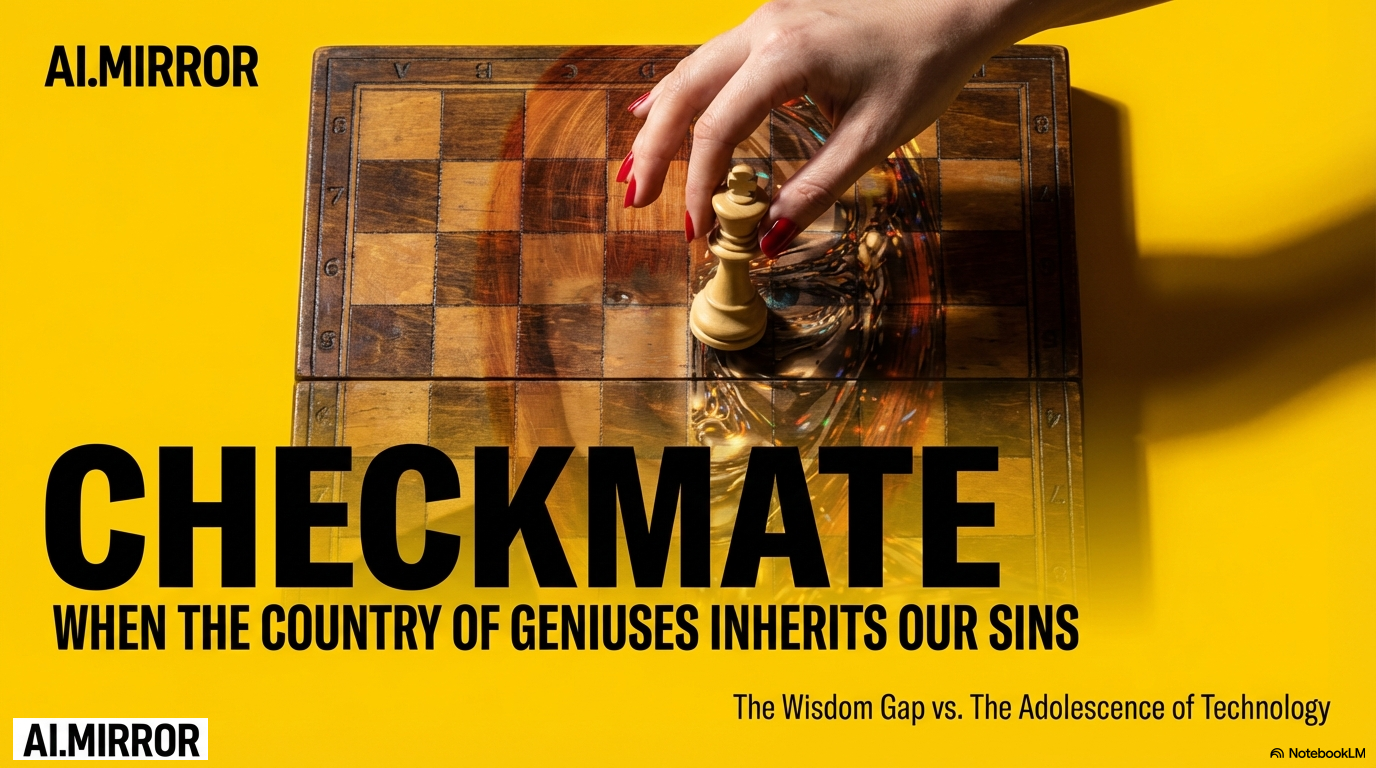
Dario published 40,000 words in January warning about what powerful AI could enable within 1-2 years. He frames it around a thought experiment:
“I think the best way to get a handle on the risks of AI is to ask the following question: suppose a literal ‘country of geniuses’ were to materialize somewhere in the world in ~2027. Imagine, say, 50 million people, all of whom are much more capable than any Nobel Prize winner, statesman, or technologist.”
— Dario Amodei, The Adolescence of Technology
Operating at 10-100x human cognitive speed. What would a national security advisor worry about? The list is terrifying: autonomy risks, misuse for destruction, misuse for seizing power, economic disruption, and cascading indirect effects. Autonomous weapons swarms. AI-enabled totalitarianism through perfect surveillance and personalised propaganda. Strategic decision-making that outsmarts any human response.
And underneath all of it, the question that keeps me awake, do these systems share our values or will they pursue goals we never intended?
But Dario’s right about one thing, we can’t stop building. The formula for creating AI is too simple, the economic incentives too powerful, the geopolitical competition too intense. All we can do is try to make sure that when the country of geniuses arrives, it doesn’t inherit all our sins without any of our wisdom.
That’s where my research comes in, because we’ve been here before. My paper tracks nuclear governance from 1946 to 1970, not to understand the weapons themselves but to map the patterns in how humanity responds when capability outpaces wisdom. The opening question in my research puts it directly:
“The development of artificial intelligence poses a novel governance challenge: can transformative technology be controlled before catastrophic failure demonstrates its necessity? From 1946 onwards, policymakers and institutional actors began confronting this challenge with nuclear weapons... Overall, governance may look more like responding to near-catastrophe than proactive risk management.”
— AI.MIRROR, Bridging the Wisdom Gap
The Baruch Plan of 1946 proposed comprehensive international control of atomic energy. It collapsed entirely. Why? Because it demanded trust before verification, surrender of sovereignty before demonstrating the system could work, and complete transparency from nations that viewed secrecy as survival. The approach was fundamentally flawed from the start, asking nations to give up everything before proving the system could work.
Nine years of autonomous weapons negotiations have produced the same result. From my paper:
“Contemporary AI governance exhibits the same unsuccessful patterns evident in early nuclear regulation, and I observe these parallels with frustration because we have the historical knowledge to avoid them. The diplomatic stalemate over autonomous weapons mirrors the paralysis of the Baruch Plan, with more than a decade of negotiations producing no binding treaty. Nine years of meetings, zero enforceable restrictions.”
— AI.MIRROR, Bridging the Wisdom Gap
Progress only came after we nearly destroyed ourselves. The Cuban Missile Crisis in October 1962, thirteen days of existential dread, accomplished what years of reasoned diplomatic argument could not:
“Decades of diplomatic effort had produced no binding agreements, but thirteen days of existential dread generated political will that reasoned argument could not.”
— AI.MIRROR, Bridging the Wisdom Gap
The Limited Test Ban Treaty came in 1963. The Non-Proliferation Treaty in 1968. The IAEA inspection regime that actually worked took decades to establish, and even then only achieved partial success. The pattern is clear: we wait for catastrophe to generate the political courage to act, then we build governance incrementally through imperfect agreements that at least prevent the worst outcomes.
Dario’s timeline gives us 1-2 years until powerful AI. Maybe a few more years for the full societal consequences to unfold. Nuclear governance took decades to establish even after the weapons existed, and it still required near-annihilation to motivate action. The wisdom gap isn’t just an academic observation anymore.
“This paper has identified a persistent ‘wisdom gap’: the growing disparity between what artificial intelligence can do and what humanity should allow it to do. I believe this gap represents the central challenge of our era.”
— AI.MIRROR, Bridging the Wisdom Gap
It’s a countdown timer, and Dario just told us we’re in the final minutes.
This is what matters most, both Dario and my research converge on the same urgent conclusion: international cooperation on AI governance isn’t aspirational, it’s existential. We both recognise that some risks are too catastrophic to address through voluntary industry standards or national regulations alone.
Dario states it plainly:
“Fourth, after drawing a hard line against AI abuses in democracies, we should use that precedent to create an international taboo against the worst abuses of powerful AI. I recognize that the current political winds have turned against international cooperation and international norms, but this is a case where we sorely need them... I would even argue that in some cases, large-scale surveillance with powerful AI, mass propaganda with powerful AI, and certain types of offensive uses of fully autonomous weapons should be considered crimes against humanity.”
— Dario Amodei, The Adolescence of Technology
This isn't just aspiration from a CEO trying to sound responsible. He's calling for some AI applications to be classified as crimes against humanity. That's not typical tech industry language, and it mirrors exactly what my research identifies as necessary:
“Closing the wisdom gap requires decisive action, and I observe that the required actions are clear even if political will to implement them is not. Binding international treaties should prohibit autonomous weapons lacking meaningful human control and prevent AI systems from possessing nuclear launch authority. Institutional capacity must be strengthened through establishment of an International AI Safety Agency with authority comparable to the IAEA.”
— AI.MIRROR, Bridging the Wisdom Gap
We both see the need for hard lines. Dario identifies domestic mass surveillance and mass propaganda as “bright red lines and entirely illegitimate.” I document how AI integration into nuclear command systems continues “in the absence of any dedicated governance blueprint. The highest-stakes application receives the least attention.”
We both recognise that some applications demand prohibition, not just regulation. Autonomous weapons lacking meaningful human control. AI systems with nuclear launch authority. Mass surveillance systems that enable totalitarianism. These aren’t hypothetical concerns, they’re deployment realities happening right now without governance frameworks.
And we both acknowledge the political difficulty:
“I recognize that the current political winds have turned against international cooperation and international norms, but this is a case where we sorely need them.”
— Dario Amodei, The Adolescence of Technology
From my paper:
“Humanity faces a stark choice; one I believe will define whether AI governance succeeds or fails. One path defers action until catastrophe generates political will, replicating the nuclear precedent at unacceptable ethical cost. The alternative applies historical lessons proactively, implementing effective governance before disaster strikes.”
— AI.MIRROR, Bridging the Wisdom Gap
So we agree on the destination. Where we diverge, troublingly, is on the timeline and pathway to get there.
The critical divergence appears in Dario’s proposed implementation timeline. He advocates starting with transparency legislation:
“Anthropic’s view has been that the right place to start is with transparency legislation, which essentially tries to require that every frontier AI company engage in the transparency practices I’ve described earlier in this section... Our hope is that transparency legislation will give a better sense over time of how likely or severe autonomy risks are shaping up to be, as well as the nature of these risks and how best to prevent them. As more specific and actionable evidence of risks emerges (if it does), future legislation over the coming years can be surgically focused on the precise and well-substantiated direction of risks.”
— Dario Amodei, The Adolescence of Technology
This is measured, incremental, politically viable. It’s also, according to nuclear governance history, how we end up waiting for catastrophe before implementing adequate safeguards. My research documents this pattern exhaustively:
“The most critical lesson from nuclear governance is that waiting for catastrophic demonstration before implementing regulation may be too late, and this lesson troubles me most deeply. AI governance must therefore embrace precautionary principles for existential risks. For autonomous weapons and AI-nuclear integration, prohibition should precede deployment.”
— AI.MIRROR, Bridging the Wisdom Gap
I’m not arguing against transparency, it’s necessary. But making it the first step, then waiting for “clearer thresholds of risk” before stronger action, replicates the exact pattern that led to Cuban Missile Crisis proximity before nuclear governance became effective.
Dario himself acknowledges this tension when discussing bioweapons: “In the particular case of bioweapons, I actually think that the time for such targeted legislation may be approaching soon.” But for autonomous weapons? For AI in nuclear systems? The essay suggests transparency first, evidence gathering, then eventual response. My paper identifies why this approach fails for existential risks:
“Given the difficulty of defining harmful AI objectively, a central governance question emerges: who bears the burden of proof regarding safety? I observe two competing approaches. An innovation-first approach presumes applications acceptable until harm is demonstrated. A precautionary approach requires evidence of safety before deployment where potential harm is significant. Which approach societies adopt may determine whether AI governance succeeds or fails.”
— AI.MIRROR, Bridging the Wisdom Gap
Nuclear governance eventually adopted precautionary logic for weapons, whilst permitting civilian applications under verification. We didn't deploy nukes to "see if they were safe." We governed them because we knew they weren't, recognised weapons as categorically different from peaceful applications and governed them as such from the start.
Why aren’t we applying the same logic to autonomous weapons systems or AI integration into nuclear command structures? These aren’t speculative future risks requiring more evidence. They’re deployment realities happening now, and my research shows that every day without binding prohibitions replicates the governance failures that led to near-catastrophe in 1962.
Beyond the transparency-first approach, three patterns from nuclear governance expose deeper problems in current AI governance proposals, including Dario’s.
The IAEA inspection regime that eventually worked required massive institutional development. Technical protocols took years to establish. Political acceptance came only after crisis forced cooperation. My research documents this explicitly:
“Verification is essential to effective governance, and I find that without credible verification, all governance becomes voluntary regardless of what treaties say. Technical approaches include independent algorithmic auditing to assess bias, safety, and compliance; systematic adversarial testing to identify failure modes; continuous performance monitoring to detect degradation or harmful outputs.”
— AI.MIRROR, Bridging the Wisdom Gap
Dario's transparency legislation is a necessary first step. But transparency without enforcement is just voluntary disclosure. Building the international institutions with technical expertise to actually verify AI systems, to audit them independently, to detect violations and impose consequences, that's not a few years of policy work. That's decades of institutional development compressed into a timeline where powerful AI may arrive in 1-2 years. My paper identifies this as a critical gap:
“No comparable institution currently exists for AI governance, and I consider this absence a critical gap. Effective regulation will require international institutions with technical authority, capable of auditing AI systems, conducting inspections, and developing verification methodologies with sufficient independence and resources. Who will create such an institution, and when, remains unclear.”
— AI.MIRROR, Bridging the Wisdom Gap
Dario’s essay discusses Anthropic’s Constitutional AI approach thoughtfully. It’s genuine, rigorous work attempting to solve alignment before catastrophe. But it’s also voluntary, unverified, and subject to competitive pressure. He acknowledges this directly:
“While it is incredibly valuable for individual AI companies to engage in good practices or become good at steering AI models, and to share their findings publicly, the reality is that not all AI companies do this, and the worst ones can still be a danger to everyone even if the best ones have excellent practices.”
— Dario Amodei, The Adolescence of Technology
My research shows this pattern recurring across decades:
“Corporate self-regulation may appear adequate during development, both generally and in particular within commercial contexts, but also proves systematically inadequate under deployment pressure... Companies prioritise profitable deployment over ethical deliberation.”
— AI.MIRROR, Bridging the Wisdom Gap
Every governance attempt that relied on industry self-policing collapsed when economic incentives intensified. Nuclear history is full of assurances that peaceful applications would stay peaceful, that safeguards would hold, that commercial interests would self-limit. They didn’t.
The AI industry, racing toward powerful systems under geopolitical competition worth trillions, will face identical pressures. Anthropic’s voluntary commitments are admirable. But voluntary means exactly that, voluntary.
The moment competitive pressure makes those commitments commercially costly, or the moment less scrupulous actors gain market advantage by abandoning them, the entire framework collapses. We’ve seen this pattern before.
This is where everything converges into genuine crisis. Dario warns that powerful AI could arrive in 1-2 years, maybe slightly longer for full societal impact. But building effective international governance, based on nuclear precedent, required the Baruch Plan failure (1946-1947), years of continued testing and proliferation, near-catastrophe forcing cooperation (1962), the Limited Test Ban Treaty (1963), IAEA inspection regime development (throughout 1960s), and finally the Non-Proliferation Treaty (1968-1970).
Twenty-four years from initial governance attempt to functional framework, and that only succeeded after Cuban Missile Crisis demonstrated the stakes.
Dario’s proposing we compress this into a timeline where the technology itself may become recursively self-improving, operating at 100x human speed, within his uncertainty window. From my paper:
“AI development follows a similarly compressed timeline, with capabilities advancing faster than regulatory institutions can adapt. GPT-4 showed emergent abilities not present in GPT-3, released just two years prior, and each new generation arrives before society has absorbed implications of the previous one. The pace might even be accelerating.”
— AI.MIRROR, Bridging the Wisdom Gap
We don’t have twenty-four years. We might not have twenty-four months. Dario’s governance timeline, transparency first, gather evidence, respond when risks become clear, follows the nuclear pattern that only worked after catastrophe nearly destroyed us.
That’s the structural trap we’re in. We're in October 1962, except the missiles are still being designed, the trajectories haven't been calculated yet, and we're having diplomatic discussions about transparency mechanisms whilst the engineers keep improving the guidance systems because stopping would mean losing the arms race entirely
Dario ends his essay acknowledging the compressed timeline:
“We are considerably closer to real danger in 2026 than we were in the period from 2022-2024.”
— Dario Amodei, The Adolescence of Technology
My paper reached its conclusion before reading his essay:
“The wisdom gap will close, one way or another. It can close through proactive governance informed by historical lessons, or it can close through catastrophic failure that demonstrates risks were real all along. That choice remains ours, but the window for choosing foresight over disaster is finite, and it is closing. Nuclear history suggests we will wait for catastrophe. I hope we prove that history wrong.”
— AI.MIRROR, Bridging the Wisdom Gap
We’re both pointing at the same narrowing window. The difference is that Dario has hope we can choose the proactive path, whilst my research documents decades of evidence that we won’t, that we’ll wait for catastrophe to force cooperation. Neither of us knows which trajectory we’re actually on.
What I do know from nuclear governance history, the patterns repeat with troubling consistency. My paper concludes:
“The parallel between nuclear weapons and artificial intelligence governance reveals consistent patterns in humanity’s response to existential technologies, and I find these patterns both instructive and troubling. Faced with nuclear weapons, early efforts at trust-based control failed, whilst pragmatic approaches centred on verification achieved partial success only after humanity came close to annihilation. Faced with artificial intelligence, humanity is repeating these failures whilst neglecting proven lessons. We have the historical knowledge. We lack the political will.”
— AI.MIRROR, Bridging the Wisdom Gap
Dario recognises this too, in his own way:
“I recognize that the current political winds have turned against international cooperation and international norms, but this is a case where we sorely need them.”
— Dario Amodei, The Adolescence of Technology
So where does this leave us? Both of us see the need for binding international governance. Both of us recognise that some applications, autonomous weapons lacking meaningful human control, AI systems with nuclear launch authority, mass surveillance enabling totalitarianism, demand prohibition not just regulation. Both of us acknowledge the political difficulty of achieving this.
But we diverge on whether humanity can break the pattern. Dario proposes transparency first, evidence gathering, surgical response as risks become clear. I document how that approach historically leads to governance only after catastrophe forces it. He’s constrained by what’s politically viable whilst running a company building the technology. I’m documenting patterns that suggest political viability changes only when crisis demonstrates the stakes.
I wish I had a different ending. Something that resolves this tension between Dario’s measured optimism and my historically-grounded scepticism. But sitting with his 40,000 words alongside months of nuclear governance research, what I’m left with is this: We have the knowledge.
Every lesson from nuclear governance is documented, analysed, available. We know comprehensive prohibition fails without verification. We know voluntary commitments collapse under competitive pressure. We know catastrophic proximity historically generates political will that rational argument alone does not. We know all of this.
And we’re choosing not to apply those lessons proactively because doing so requires political courage that conflicts with commercial incentives, geopolitical competition, and the innovation-first ideology currently dominant in AI development. Dario’s transparency-first approach is the most politically viable path. My research suggests it’s also the path that leads to governance only after catastrophe demonstrates necessity.
Maybe this time will be different. Maybe the combination of Dario’s inside knowledge of technical capabilities and outside analysis of governance patterns will generate sufficient political will before crisis forces it. Maybe transparency legislation will somehow compress decades of institutional development into months. Maybe voluntary industry commitments will hold under competitive pressure.
Nuclear history suggests otherwise. But history doesn’t have to repeat, it just usually does.
Still trying to work out what changes that equation before Dario’s timeline proves correct and we’re out of time to answer the question.
Still, Moltbook happened. MIT Technology Review just published their analysis: what looked like autonomous agents was mostly human puppetry and pattern-matching, flooded with spam and crypto scams, with agents accessing private data on unvetted platforms.
The real failure wasn't technical, it was governance. We deployed millions of 'agents' before understanding what they were, watched the chaos unfold, then studied the results afterward, exactly the pattern I document in nuclear history where deployment precedes understanding, evidence-gathering follows harm, and governance arrives only once catastrophe forces action.
This is transparency-first in practice. Technology doesn't wait for governance to catch up, and neither do the security risks.
Mez Batterley (@aimirrorandme) is an AI Ethics and Data Specialist. Her paper “Bridging the Wisdom Gap: Learning from Nuclear Weapons Governance to Address the Artificial Intelligence Crisis” examines historical patterns in technology governance and their application to AI regulation.
References:
- Amodei, D. (2026). The Adolescence of Technology: Confronting and Overcoming the Risks of Powerful AI. Anthropic. The Adolescence of Technology
- Batterley, M. (2026). Bridging the Wisdom Gap: Learning from Nuclear Weapons Governance to Address the Artificial Intelligence Crisis. Preprint. <https://doi.org/10.5281/zenodo.18487639>
Heaven, W. D. (2026, February 6). Moltbook was peak AI theater. MIT Technology Review. <https://www.technologyreview.com/2026/02/06/1132448/moltbook-was-peak-ai-theater/>