Before I published a single post, I built a 34-page brand guide. Here's why that matters, the real content from mine, the Claude prompt that builds yours and how to make AI stay on brand.
By AI Meets Girlboss 🦩
Published: 2026-10-15
URL: https://aimeetsgirlboss.substack.com/p/how-to-build-a-brand-guide-substack
| *This is part 5 of using Claude to support your branding. If you missed the previous parts, you can find them here: part 4: build animations with Claude to promote your brand | part 3: build your brand voice with Claude | part 2: Claude Design for Substack | part 1: Claude Design set up guide* |
|---|
TL;DR: Most people start a Substack. I started a brand, and I built the brand guide before I wrote a single post. A brand is just a framework for making the feeling you give people recognizable, repeatable, and yours. This post shows you the four chapters every brand guide needs and everything inside each one, with real pages from my own guide. Behind the paywall you get the Brand Guide Builder kit: a Claude prompt that interviews you, a reusable skill so your AI stays on brand, and an fillable brand guide PowerPoint template. Together they turn your answers into your finished brand guide.
Before I Wrote A Single Post, I Built A Brand Guide.
My brand guide is thirty-four pages of purpose, vision, mission, a full audience persona with pain points, a “day in the life,” voice and tone, manifesto, colors, fonts, visual rules, a character, a logo.
I built all of it before AI Meets Girlboss had a single subscriber. Before I’d signed up for Substack. Before I’d written one sentence of one post.
I know how that sounds. And YES, you can absolutely start with less, and this post is going to show you exactly how much less. But I want to be honest about the decision underneath it, because it’s the actual lesson here: I wasn’t planning to start a newsletter. I was planning to start a brand, Substack was just going to be where it lived.
Hey, I’m Pinkie. I help creators build recognizable Substack brands that drive consistent subscriber growth. If you’re new to AI Meets Girlboss, welcome! This might be the best time to join. Start here! 🩷🦩

What you’ll learn in this post:
-
Why thinking “brand” instead of “Substack” changes everything downstream, from decision fatigue to whether anyone else (including AI) can create in your voice consistently
-
The four chapters every brand guide needs, and exactly what goes inside each one, with real pages from my own guide
-
The Brand Guide Builder kit (paid): a 37-question Claude interview, a reusable skill, and an empty 25-slide PowerPoint template that turn your answers into your finished brand guide

Why Think As A Brand, Not “Just” A Substack.
Nobody remembers the exact words of a good newsletter a week later. They remember how it made them feel: smarter, seen, or like they’re in on something. That feeling is the whole product, and a Substack with a nice font is not, by itself, a way to make that feeling repeatable.
A brand is. A brand is just a framework for building a specific feeling on purpose, so it shows up the same way every time, and shows up as unmistakably yours.
That’s not branding-speak, it’s a practical fix for two very real problems:
A Brand Guide Helps Beat Decision Fatigue.
Without a guide, you re-decide everything every time you sit down. What does this sound like? What matters to my reader here? What should this look like? With a guide, those questions are already answered. You’re not deciding anymore, you’re just applying.
Consistency Across More Than Just You.
A brand guide is something that keeps you aligned and consistent across content, mediums, platforms. But you’ll also have a document other people, or other tools, can pick up and use correctly without you standing over their shoulder. That’s true for a collaborator, and it’s just as true for AI.
If you want Claude or ChatGPT to write and design on-brand without you re-explaining yourself in every single prompt, it needs the actual document, not the vibe in your head. I shared how to lock your branding logic behind a brief, so someone else can execute against it.
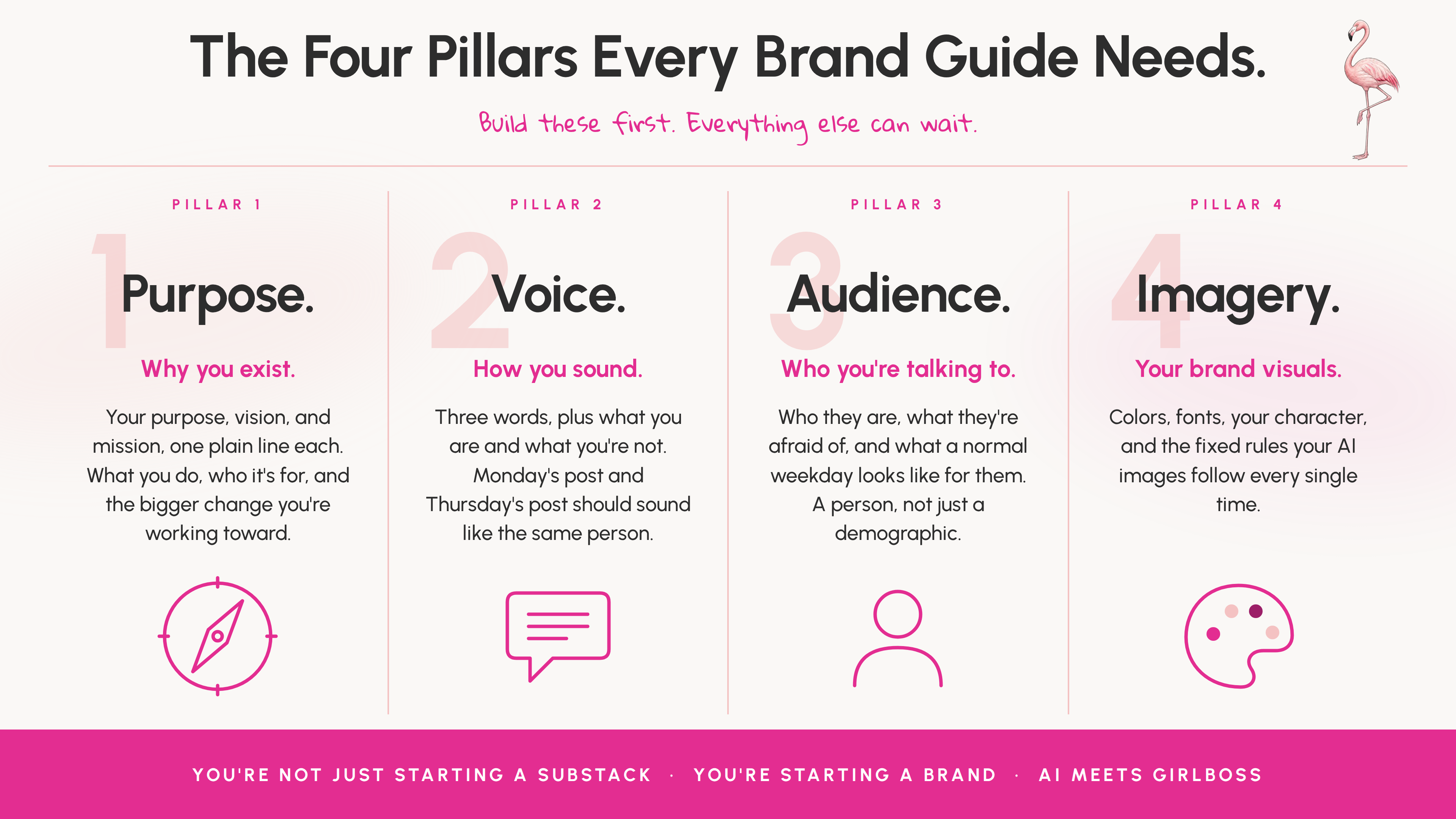 The four brand guide chapters. Infographic generated in Claude by AI Meets Girlboss.
The Four Chapters Every Brand Guide Needs.
My full AI Meets Girlboss brand guide is 34 pages. I stripped it down to four main chapters. Below, each chapter comes with one real page from my guide, so you can see what “done” looks like, plus the table of contents: everything that lives inside it.
Behind the paywall, you get the full Claude prompt that builds the whole deck, every page. It interviews you with the questions that make you actually think it through, and guides you through the process step by step.
One note on the lists: items marked (start here) are the minimum for a working 1.0 brand guide. The rest is the deeper layer that turns it into a guide you can hand to a collaborator, or to AI.
Chapter 1: Purpose. Why You Exist.
This chapter defines why your brand exists and who it's for. It simplifies every "should I?" decision, because a topic, a collab, or a new product either fits your purpose or it doesn't. Keep it to one line per idea, and it keeps you pointed the same way a year from now.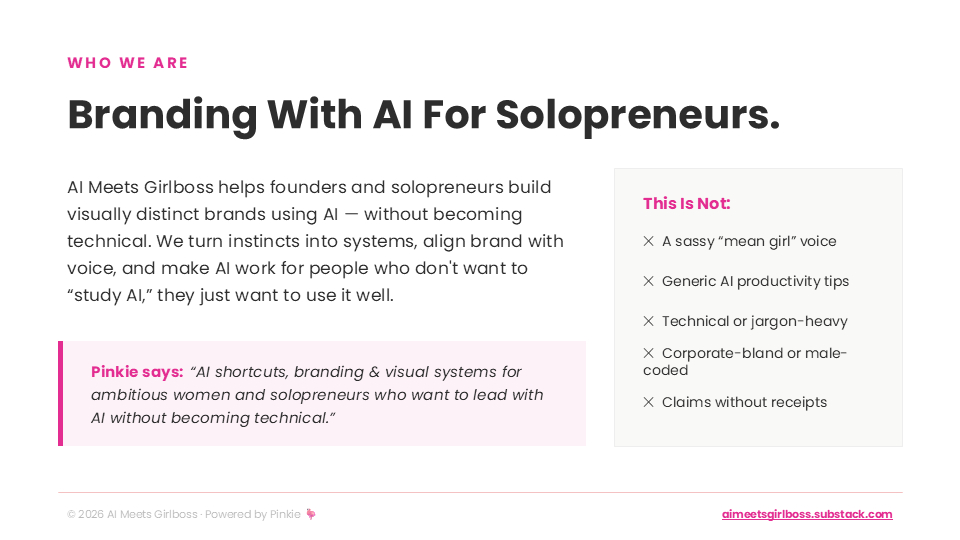 Chapter 1 from my guide: one brand statement and a “this is not” list.
What’s inside:
-
Your one-line brand statement: what you do and who it’s for (start here)
-
Purpose: the problem you solve (start here)
-
Vision: the bigger change you’re working toward (start here)
-
Mission: how you actually get your audience there (start here)
-
A “this is not” list: what your brand will never be
-
Your brand personality: archetype, MBTI, DISC, and narrative role
-
Your tagline
Chapter 2: Brand Voice. How You Sound.
This chapter defines how you sound, so you stop reinventing your voice every time you sit down to write. It settles the small decisions (how to open, how to close, what's too much) and keeps you recognizable across every post and Note. You don't need a full tone-of-voice doc yet: start with three adjectives and a do/don't list. You can develop your full brand voice with a workflow I developed. 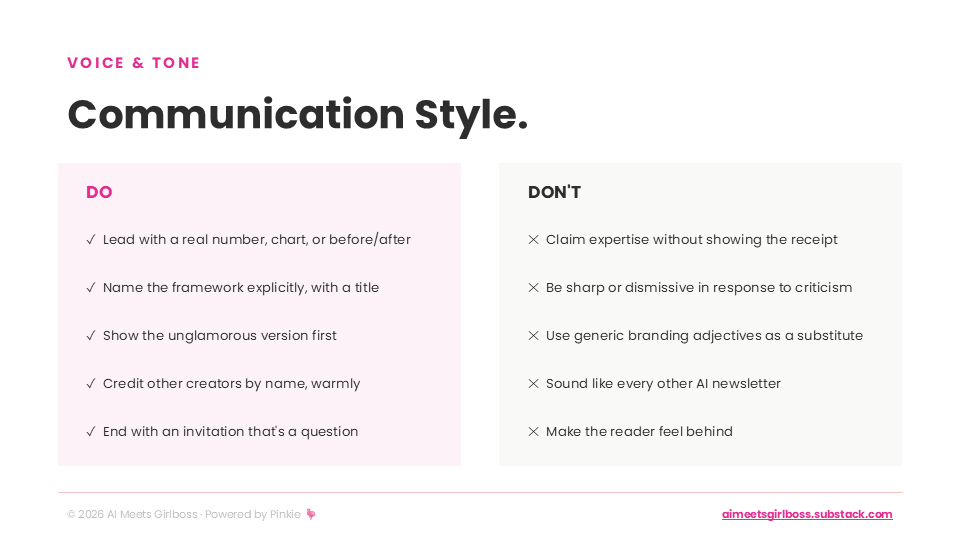 Chapter 2 from my guide: five do’s, five don’ts. The deeper version is build your brand voice with Claude.
What’s inside:
-
Three words that describe how you sound (start here)
-
A do and don’t list: what you always do, what you never do (start here)
-
A one-line voice principle: how your voice relates to your real personality
-
Signature patterns: how you open, how you close, your recurring devices, your section dividers
-
Your sign-off
-
Your origin story: three beats and one line that sums it up
-
The fear behind the brand: what you were afraid of then, what you’re afraid of now, and how it shapes the way you write
-
Your characters, if you have them: who they are, what they symbolize, and how they behave (mine: Pinkie, Flavio, and the Flock)
Chapter 3: Audience. Who You’re Talking To.
This chapter defines who you're actually writing for. It simplifies what to write, what to skip, and which examples to use, because you're talking to one person, not "everyone." It also keeps you consistent as you grow, since a clear reader stops you from chasing every new audience. Start with who they are, roughly, and what they're afraid of.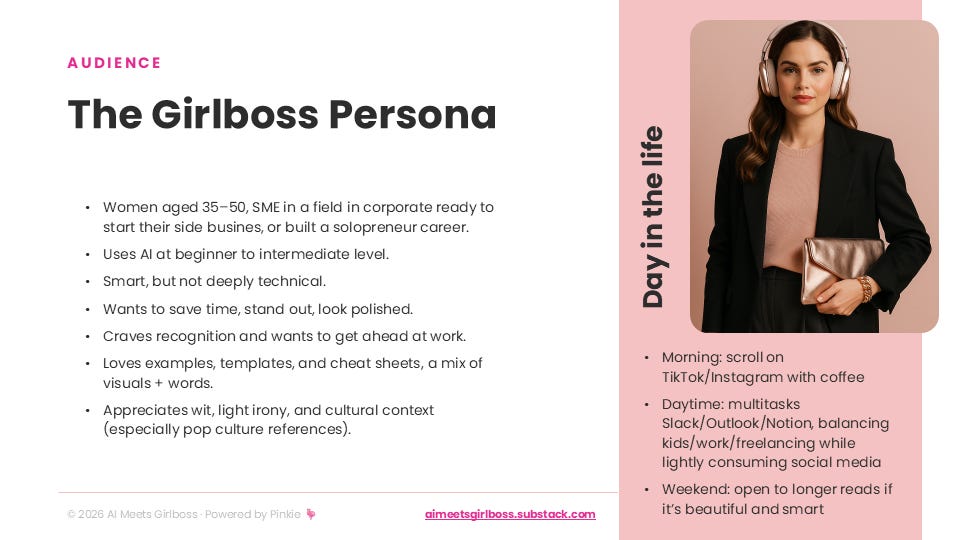 Chapter 3 from my guide: who she is, and what her day looks like.
What's inside:
-
Who they are in a paragraph: age range, role, life stage (start here)
-
Their biggest fears and hesitations (start here)
-
What they want
-
What they don’t want
-
Persona details: their comfort level with your topic, what they save and share, the humor and references they enjoy
-
A day in their life: morning, daytime, weekend
-
The value you give them, in one line (mine: permission plus a usable framework, not just inspiration)
Chapter 4: Imagery. Your Brand Visuals.
This chapter defines how your brand looks, so people recognize you before they read a word. It takes the design decisions off your plate, because the color, the font, and the image style are already locked, and it keeps every visual consistent even when the AI model changes.
One primary color, one secondary, one heading font, one body font. Not a palette to A/B test forever. I broke down how to actually pick these, not just pick pretty ones, in Picking Your Brand Colors for Your Substack.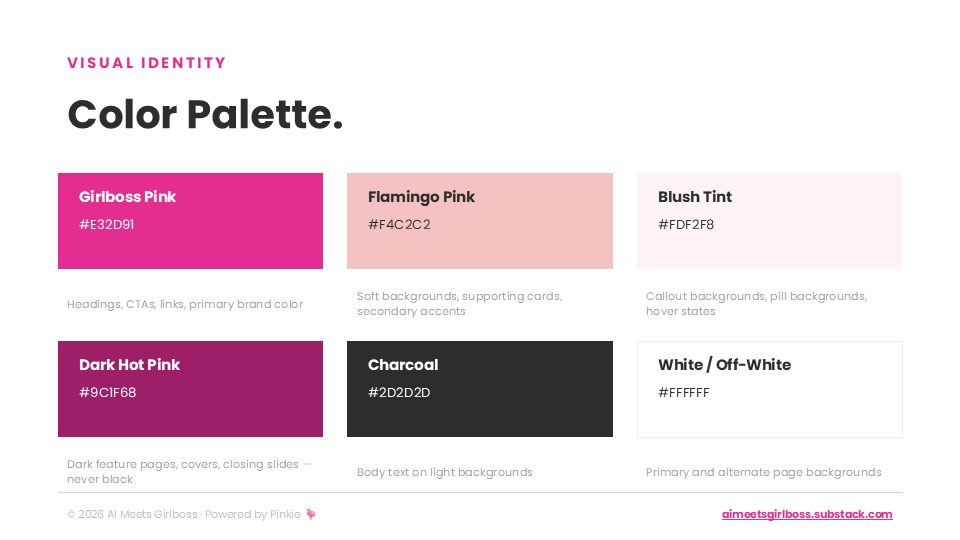 Chapter 4 from my guide: six colors, each with a job. How to pick yours: Picking Your Brand Colors for Your Substack.
What’s inside:
-
Colors: primary, secondary, backgrounds, and text, each with a job (start here)
-
Fonts: heading, body, and accent, plus the rules for using them (start here)
-
Your logo and brand marks: primary, horizontal, profile badge, small corner version
-
Your character or mascot, with the reference sheet that keeps them consistent
-
Fixed style rules for AI image generation: face and body, background, outfit, hidden easter egg, illustration style
-
A visual brand reference sheet: everything on one page you attach to every image prompt
-
Banners, icon set, email signature, and infographic style
-
Brand guardrails: what is always on-brand, what is never
That's it. Four chapters. Do only the items marked (start here) and you already have a working 1.0. The rest is what makes your brand easy to hand off, to a collaborator or to AI, without anything drifting. Anything past these four, like your content pillars, channels, and posting rhythm, is real and worth building later.
In the comments…
Which of the four decisions, purpose, voice, audience, or visual, is still loosest for you right now? Drop it below.
What you’ll get behind the paywall:
You've seen what goes into a brand guide. The kit does the work of getting it out of your head and into a finished deck. Annual paid subscribers get three downloads, and build their brand guides in one conversation in about an hour:
-
The prompt (Word file). Paste it into Claude and it interviews you, one question at a time, across all four chapters. 37 questions, each with an example answer.
-
Two skills. The same interview, installed once. Say "build my brand guide" any time you need to build or update yours. A second skill, the Brand Skill Creator, turns any finished guide into a skill of your brand, with a check step built in. Say "turn my brand guide into a skill."
-
The PowerPoint template. An empty 25-slide deck in my brand style, with the start-here slides tagged. Claude fills it in, or you do.
-
You walk away with your brand guide deck, a reusable Claude skill of your brand, and a 150-word brand brief you can paste into any AI tool.
Or just grab this product from my Gumroad store.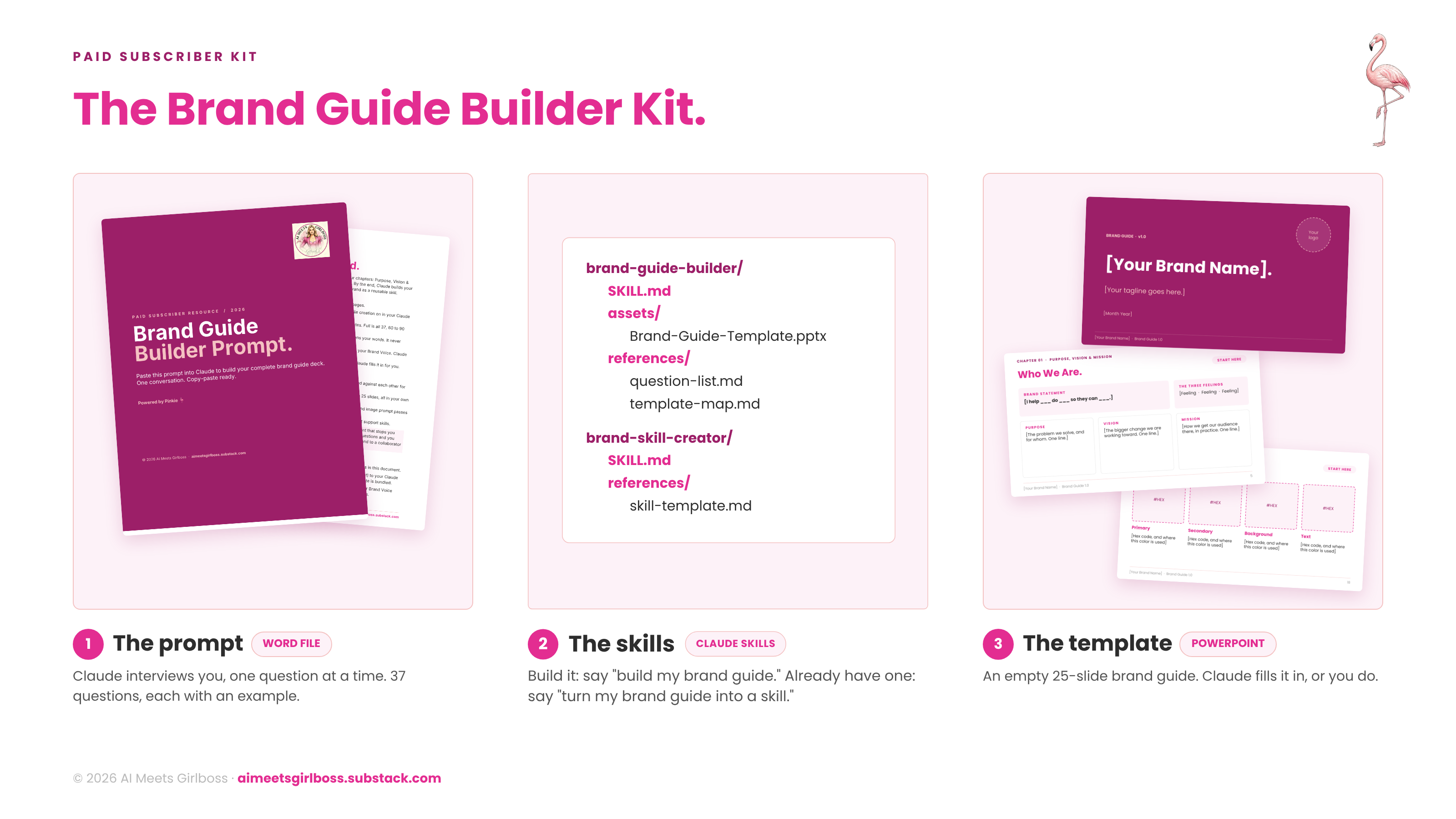 The Brand Guide Builder Kit: a Word prompt file, two Claude skill folders (Brand Guide Builder and Brand Skill Creator), and a PowerPoint template.