A real 2009 experiment (Rob Walker, Joshua Glenn) turned $128 of junk into $3,612 with a story. Steal the free AI prompt to build your own content idea bank.
By AI Meets Girlboss
Published: 2026-07-10
URL: https://aimeetsgirlboss.substack.com/p/a-76-banana-taught-me-to-build-a
TL;DR: In 2009, two journalists bought 100 pieces of thrift-store junk, paired each one with a short fictional story, and sold them on eBay. The junk cost $128 total. With a story attached, it sold for $3,612. This is one of my favorite proofs that everyone has something worth saying — including you. Here’s the experiment, what it means for what you post, and a prompt to start building your own bank of usable stories.
This is one of my favorite stories to tell, because it’s not really about objects. It’s proof that everyone has something interesting to say. There’s a story everywhere, sitting in plain sight, worth nothing until someone picks it up and gives it a frame.
A plastic banana is the most unlikely hero of a branding lesson I’ve ever found. But here we are. 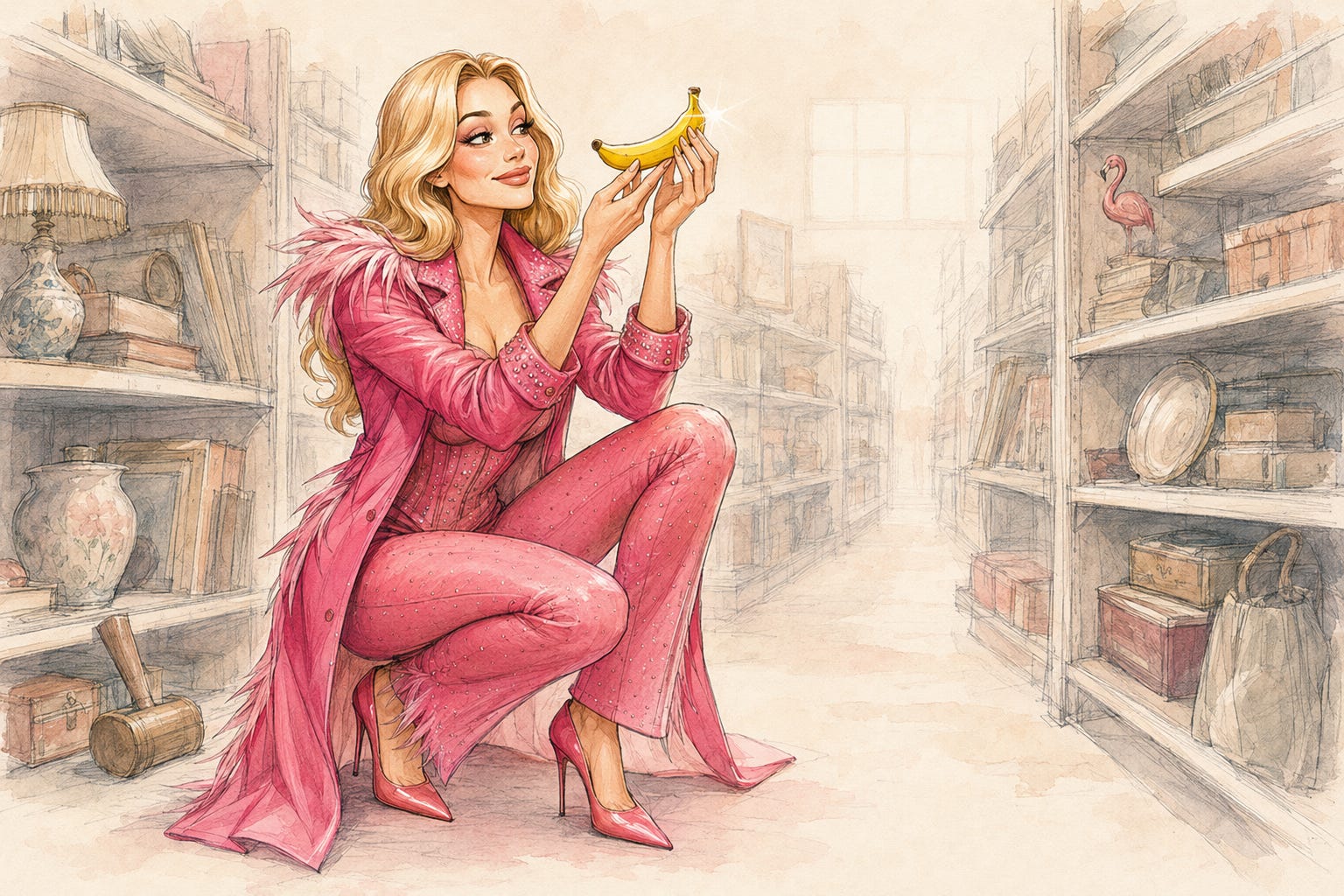 Finding treasures in the thrift store. Image generated with ChatGPT Images by AI Meets Girlboss.
If you've ever lost an hour in a thrift store flipping through someone else's old coats, you already understand this experiment well.
You know the feeling of picking something up — a chipped mug, a weird little ceramic dog, a coat that's clearly seen a decade you weren't around for — and sensing there's a story in it before you know what that story is. That instinct is what the Significant Objects experiment is about.
Hey, I’m Pinkie. I help creators build recognizable Substack brands that drive consistent subscriber growth. I share the exact branding systems, prompts, and workflows I use to transform ideas into distinctive, repeatable output. If you’re new to AI Meets Girlboss, welcome! Honestly, this might be the best time to join. start here! 🩷🦩

What you’ll learn in this post:
-
The real experiment that proves a story can multiply an something’s value by 2,700%
-
Why “I don’t think my life is interesting enough” is never actually true
-
A free Claude prompt that builds your own story bank in one sitting
-
How to know which moments are worth saving before you’ve decided what they’re for

The Significant Objects Experiment.
Journalists and Joshua Glenn had a theory: a story doesn’t just describe an object’s value, it creates value, and that effect can be measured.
So they tested it.
They bought 100 objects from thrift stores and flea markets. A plastic banana. A pottery cow. A secondhand builder’s mallet. Nothing worth keeping. Average cost: $1.28 each.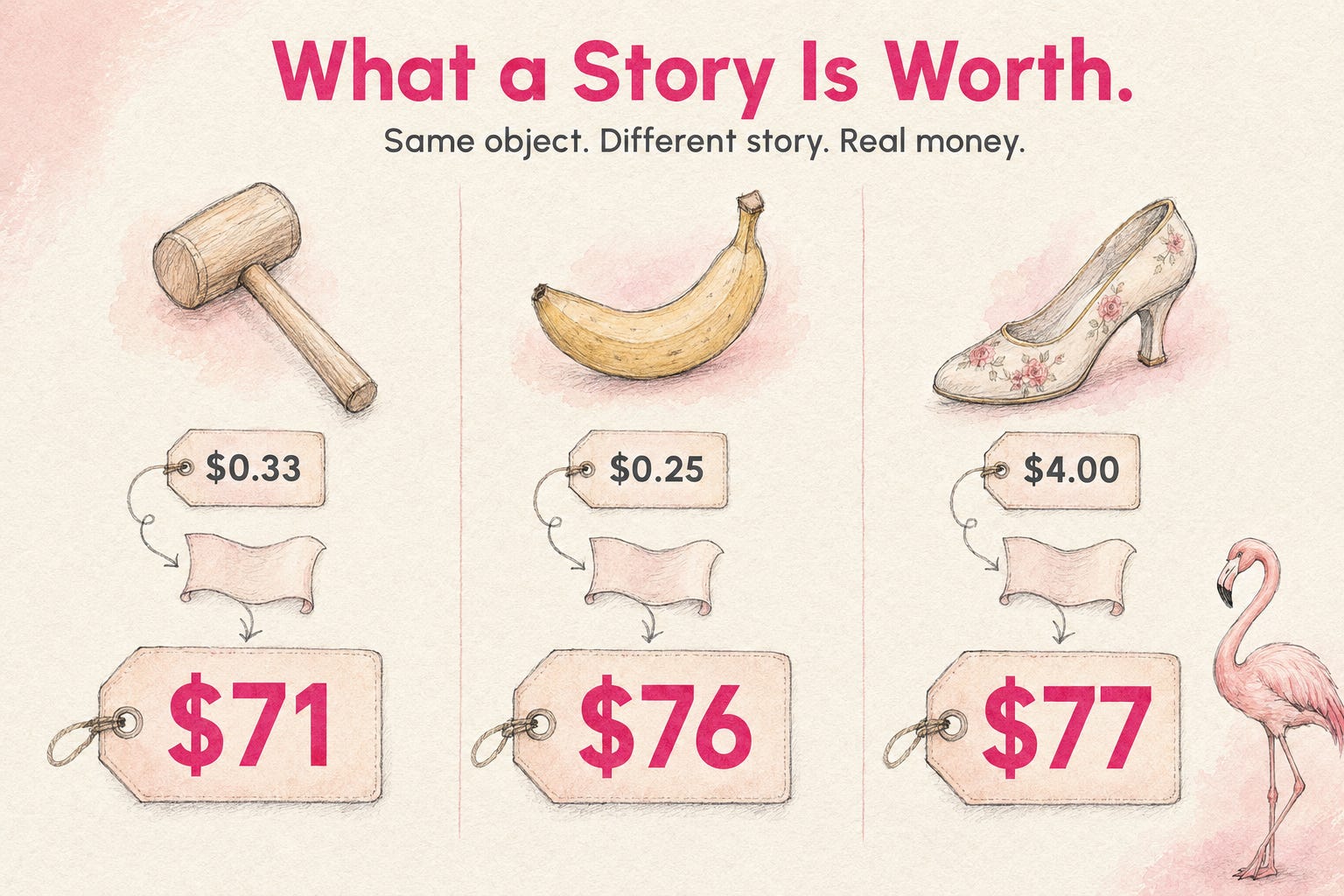 The Significant Objects experiment proves a story is worth more than we think. Image generated with ChatGPT Images by AI Meets Girlboss.
Then they paired each object with a writer and asked for one short fictional story. Not a product description. A story, clearly labeled as fiction, with the author credited by name.
Then they listed every object on eBay, with the story standing in for the listing description.
One account of the auction puts a $0.33 mallet at $71, a $0.25 plastic banana at $76, a $4 porcelain shoe at $77. The aggregate numbers are the part that's well-documented: the full collection, bought for $128, sold for nearly $3,612 — roughly a 2,700% markup, created entirely by narrative.
Video: Rob Walker’s presentation on Significant Objects, a project he launched with author Joshua Glenn aimed at exploring the power of storytelling.
Why Identical Products Can Have Wildly Different Worth.
The objects didn’t change. The price changed because the frame around them changed. I've watched this exact mechanic work on a Substack channel too, one visual system change, 64 to 200 subscribers in two weeks, same story, different asset.
This is the exact same principle behind everything I teach about branding with AI. A generic AI headshot and a fashion illustration of the same person aren’t different in quality. They’re different in story. One says “I generated this in thirty seconds.” The other says “this is a character, built on purpose.” Mia Kiraki's been proving this same point with her images for months, same object, different frame, completely different response.
The same logic applies to a Substack post. Two creators can write about the same launch, the same failure, the same pivot. One gets skimmed. One gets a paid subscriber. The difference usually isn’t better writing. It’s a better frame.
I went deep on that exact idea earlier this year. Your brand voice isn't invented, it's extracted from your personality that already exists. The material is already there, it just needs a system to surface it.
“I Don’t Think My Life Is Interesting Enough” Isn’t Actually True. You're Just Unsorted.
Almost every creator I work with says some version of: I don’t think my life is interesting enough to write about.
It’s never true. The material is already there — same as the plastic banana was already there, sitting in a bin, worth nothing to anyone until someone gave it a frame.
What’s actually missing is a system for noticing the moments worth framing, before they get lost in the noise of an ordinary week.
I built a Story Bank because I kept hearing myself say “I don’t think I have anything else to write about” right before I'd remember some random detail from a decade ago that turned into my best-performing post of the month.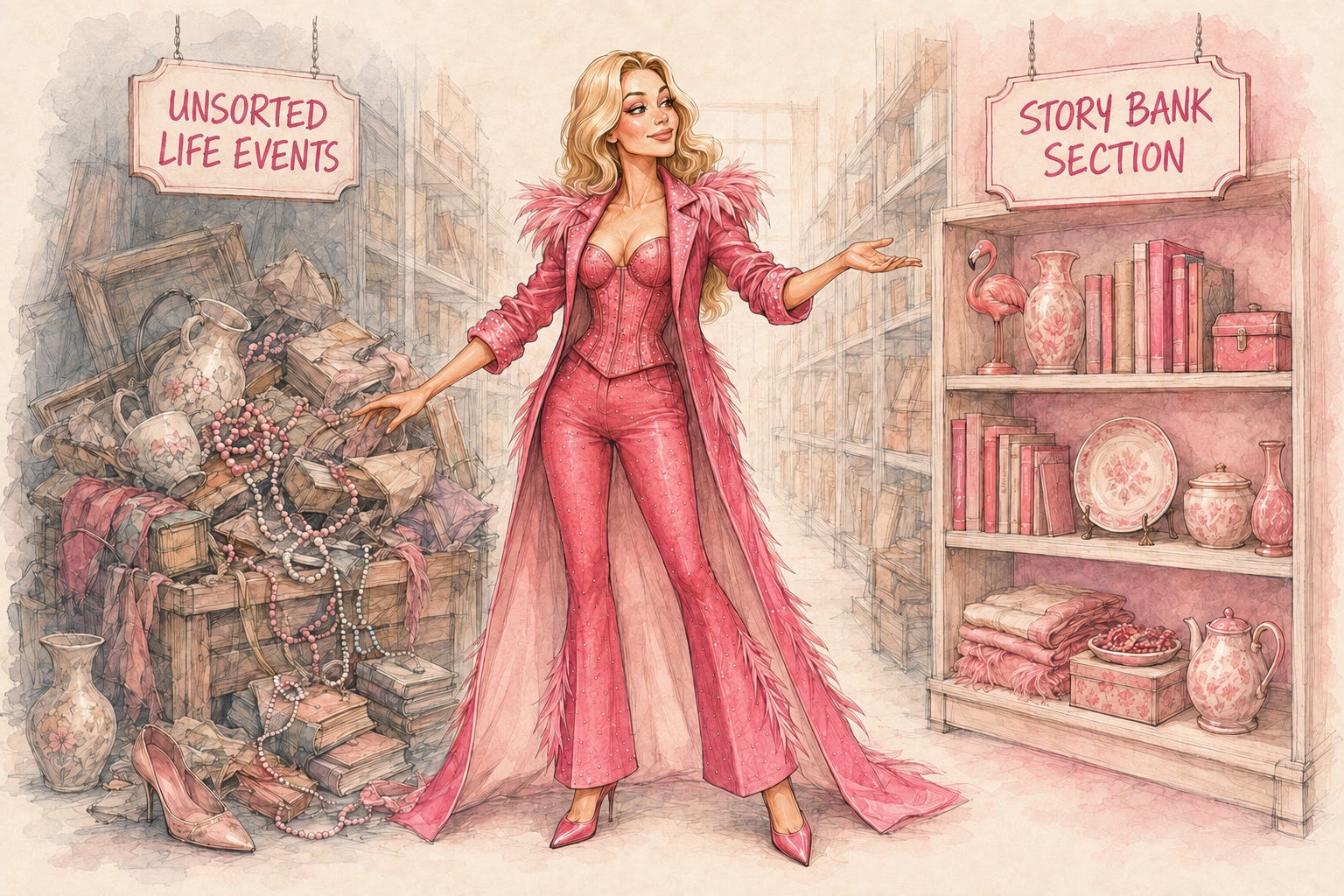 Time to sort through that pile of life events. Image generated with ChatGPT Images by AI Meets Girlboss.
The banana experiment is when it clicked. If a 25-cent piece of plastic could be worth $76 once someone gave it a story, I had no excuse. My life had way more than 100 objects in it. It just wasn’t sorted yet.
So now every post I write starts the same way: not “what should I write about,” but “what’s already in the bank.”
Share this post with one creator who needs to hear this. The $76 banana alone is worth the forward.

Steal My Exact Prompt, Build Your Story Bank.
This takes about 5 minutes.
A story bank is just one place where you collect raw material as it happens, before you’ve decided what it’s for. Not a polished draft. Not yet a post. Just the moment, captured, unsorted.
I built a simple Claude prompt that interviews you and turns the conversation into a structured first batch of entries. Paste it into Claude, answer as it asks, and you’ll come out the other side with real material instead of a blank page.
One tip before you start: don’t type your answers. Say them out loud, using voice mode.
Typing makes you edit as you go. You tighten the sentence before it’s even finished, and the messy, specific detail — the one that actually makes the story land — gets smoothed out before it hits the page. Talking doesn’t let you do that. You ramble, you backtrack, you say the thing the way you’d actually tell a friend. That’s the version worth keeping. Dictate your answers and you’ll notice the difference immediately.
I want you to help me start a "Story Bank" — a collection of raw material from my own life that I can later turn into posts, talks, or content.

Interview me one question at a time. Wait for my answer before asking the next question. Ask about:

1. A moment I chose differently than people expected (a pivot)
2. A moment something I tried didn't work (a failure or a flop)
3. A small moment something suddenly made sense to me (a realization, even a minor one)
4. A specific object, place, or detail I still remember vividly from any of the above, and why
5. A moment someone told me something about myself or my work that surprised me

After I answer each question, do NOT polish or rewrite my answer. Just confirm you've logged it, then ask the next question.

When all 5 are answered, give me back all 5 entries formatted as a simple table with two columns: "Raw Material" and "Possible Use" (a one-line guess at what kind of post this could become).
Copy that into Claude or your AI of choice, switch on voice mode, and answer like you’re talking to a friend, not writing a draft. Save the output wherever you already keep notes — Notion, Obsidian, a plain doc, doesn’t matter. The point isn’t the tool. It’s having one place where the material doesn’t disappear.
In the comments…
What's the story you thrifted with the prompt? Bonus question, fully unrelated to branding: what's the weirdest thing you've ever found in a thrift store?
Thanks for reading AI Meets Girlboss. Subscribe for free to receive new posts.
The objects didn’t change. The frame did. Same is true for your story.
Talk later, flamingos.
Pinkie 🩷🦩
If today’s post made you think about your own visual brand, I am running The Branding Flock, a visual brand & identity program for Substack creators who are done being invisible.
Full breakdown posts, real prompts, real outputs. Your color palette, your logo, your brand character, your content system — built step by step alongside the flock.
25% off your subscription if you are brave enough to look in the mirror, and take the brand maturity test developed by a group of very judgmental flamingos. 🦩👀