Learning how to delegate a small amount of money may become your next AI literacy skill
By Tom Parish
Published: 2026-11-17
URL: https://aiforlifelonglearners.substack.com/p/personal-ai-assistants-are-learning
The Machine Economy Update
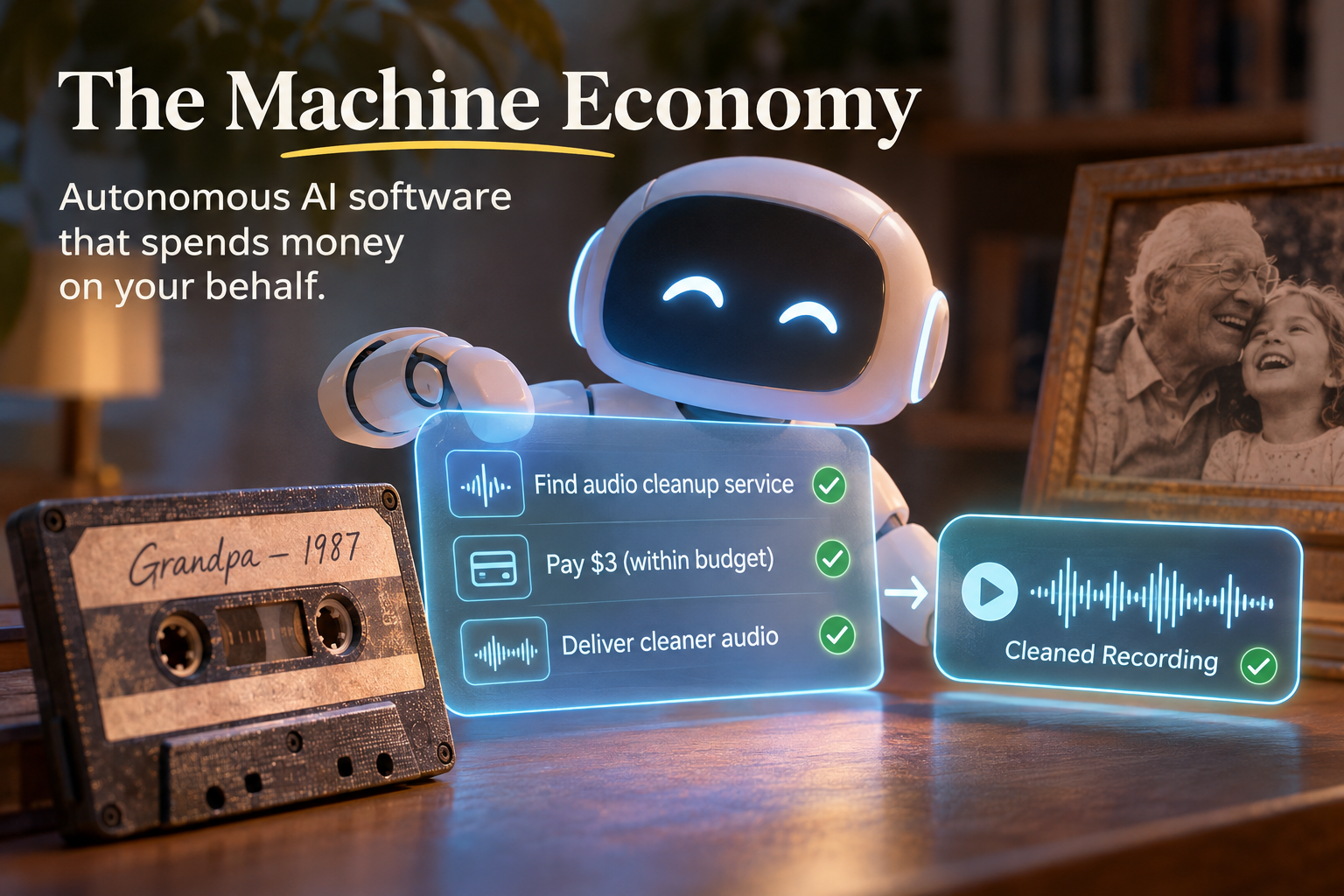
The machine economy is autonomous AI software that spends money on your behalf.
We’ll cover this trend as it emerges with periodic reports at AIFLLL. I’ll call these “The Machine Economy Update.” Most of it happens behind the scenes, so there isn’t much to see. That’s exactly why it’s worth learning about. Big companies and governments are making decisions about how all this will work, and those decisions will shape what your assistant can buy, where it can shop, and who gets paid.
You don’t have to keep up with AI to think clearly about it. That’s what AIFLLL is here to help with. If these stories sharpen your curiosity and judgment, consider becoming a paid subscriber. I’d appreciate the company.
Could this become the next choke point in our lives? And as these assistants learn more about us, will they simply buy what we ask for, or begin deciding what we want? We’ll be watching both. Starting with the first update, these reports will be for paid subscribers.

Here’s a simple example. Say you have an old cassette tape in a drawer with a family member’s voice on it. You ask your AI assistant to help clean up the sound so the grandchildren can hear it. The assistant finds a service that removes the hiss and unwanted background noise. The service costs three dollars. You gave the assistant a small budget for errands like this, so it pays.
Nobody typed a card number. Nobody opened an account or invented another password. The tape got cleaner and you are out three dollars.
That scene is imagined, though pieces of it already exist. In October, a domain-name company called Atom showed a purchase in which an AI agent does the legwork, the buyer approves, and payment is collected only after the domain is registered. If you’ve ever set up a website, you know what a relief that is.
The same month, Mastercard opened a pilot that lets AI agents buy digital services within spending limits set in advance. Both are small, and both are early.
The industry calls this agentic commerce, or the machine economy. I think of it more plainly. We are used to paying for software or content before we use it. What is arriving is software that pays for other things while it works for us.
There’s an important distinction in that little cassette tape example. I decided what I wanted done. The assistant figured out how to do it and paid for the service. I wasn’t asking it to decide what mattered to me. I was asking it to take care of an errand.
Keep that distinction in mind. I think it’s going to matter.
Reading past the press release
In September, Mastercard and Trip.com announced that an AI agent could book your travel. Sounds great, right? Then I kept reading. The agent books tickets to attractions and a few add-ons, not your hotel room. Take note, this is a pilot project that rolls out bit by bit through 2027. Both stories are true. The headline just gets to you first.
You’ll see a lot of this over the next year, so when the next big announcement comes along, keep reading to the fourth paragraph.
That gap between the announcement and what actually works is what I’ll be watching. What can you really buy? What goes wrong? And what should an ordinary person know before handing an AI agent their credit card? I’ll revisit the Mastercard and Trip.com launch in early 2027 and keep an eye on similar projects as they emerge.
What I will be watching
Here are four questions I’ll keep asking, and I suggest you do the same.
Does the limit hold? My budget should cover one errand: a fixed amount, an end date, and no surprise subscription unless I say yes. It should hold even when the task stalls and starts over, which is when a careless system pays twice.
Is there a receipt? I want a record that ties the money to the thing delivered, in words I can read. If my assistant spends three dollars cleaning up that tape, I should be able to see where the money went and what I received.
What happens when it goes wrong? In one recent research benchmark, even the best AI model picked the right product only 57 percent of the time when a shopper’s requirements were scattered across a conversation. Not much better than a coin flip. That was a lab exercise, not anyone’s actual checkout. Still, a purchase can go through just fine and be the wrong thing. And refunds are among the least finished parts of all this.
Do people come back? A demonstration happens once. I’m interested in the second and third time, after the novelty is gone. Particularly when businesses begin relying on these systems for routine purchases.
My expectation for 2027 is modest. Small purchases, inside limits a person understands, will get better and more common. Agents running whole businesses with nobody watching will mostly stay in the demos.
There’s another question I’ll be watching, though it’s harder to measure. When I tell an assistant what I want, that’s one thing. When it starts deciding what I might want, that’s something else. The technology may not make much distinction between the two. I think we should.
The company that runs itself
Not everyone shares that modesty. For some founders and investors, the small errand purchase is just a warm-up. The goal is a company with no people in it: agents that pick a product, build the website, buy the ads, answer customers, and keep the profit.
One platform for launching such companies, run by a single founder with no employees, raised $30 million this year. Another platform reports that of the more than 30,000 businesses its agents have launched, 206 have earned any money at all.
Both figures come from the companies themselves. Read together, they suggest the money so far is in selling the dream to people who want to try it.
Expect that dream to come wrapped in bigger promises about superintelligence as the plumbing matures. So when you read the next announcement like this, ask one question: are they selling a business, or selling the dream?
After four years of big AI promises, I think most of us have learned to ask that question.
But there’s another possibility worth considering. If agents eventually become good at running businesses, they may also become very good at selling to other agents. One piece of software deciding what to offer, another deciding what to buy. Somewhere in that exchange is a person who may never see the choices that were considered, or the ones that weren’t.
That’s a little further down the road, but it’s one reason I want to follow this now.
The effort worth keeping
In “The Meter in the Dark,” I asked who controls the pipes our curiosity runs through. A spending budget brings that question down to pocket size.
The upside is real. An assistant that can pay removes the sign-up form, the file conversion, the fourth password of the afternoon. I’d like to see Substack try it: a post from a writer you read now and then, a small one-off payment, no hunt for your credit card.
The downside is quieter. When paying takes no effort, the cost of curiosity gets harder to see, three dollars at a time. And if agents can only pay smoothly inside a few large platforms, those platforms become the toll booths, the choke point I asked about at the start.
But I’m beginning to think there’s another kind of control here that matters just as much. The machine economy isn’t only about who controls the money. It’s also about who gets to decide what we want.
I’d happily set aside a few dollars in a digital wallet and let my assistant spend it on things I’ve already decided I need. Clean up that old cassette tape. Convert a file. Find a service and pay for it. Those are errands, and I’d be glad to hand them over.
But choosing my next book? The movie I’ll watch Friday night? Tickets to a concert I might enjoy? That’s different. An assistant could learn my tastes well enough to make some very good guesses. Maybe better guesses than I make myself. But just because it thinks it knows me doesn’t mean I want it choosing for me.
Then again, I wouldn’t mind an assistant suggesting a book I’d never heard of, especially one that turns out to be wonderful. There’s a difference between helping me discover something and deciding I should own it.
And that’s where this gets interesting. The same assistant that helps us find things will increasingly be able to buy them. The recommendation and the purchase could become a single step. Convenient, certainly. But what happens to the moment in between, when we get to think about whether we actually want the thing?
Some decisions are part of the pleasure of being human, even when we get them wrong. I’ve read books I didn’t like, walked out of movies disappointed, and bought tickets to things that weren’t worth the evening. I wouldn’t necessarily want to give up those mistakes. They’re part of how I figure out what I like.
So perhaps the question isn’t just how much money we’re willing to let an AI spend. It’s how much of the choosing we’re willing to hand over with it.
I’m still figuring out where I’d draw that line. What would you trust an AI assistant to spend five dollars on? And what would you rather choose for yourself?
Write and tell me.
Tom
For those who want to dig in
And wouldn’t you know it, just as I was about to publish this, I saw the following news update:
- OpenAI ChatGPT Wallet Announcement: Introducing ChatGPT Wallet – OpenAI Blog
- ChatGPT Wallet Support Guide: Making purchases with ChatGPT Wallet – OpenAI Help Center
- Stripe & Anthropic Partnership (Claude Duet, Muse, and Grok Bot payments via Stripe Link): Stripe Newsroom: Stripe and Anthropic help entrepreneurs run their business inside Claude Duet
- Industry Breakdown & Competitor Analysis: The Decoder: OpenAI rebuilt AI shopping from scratch with ChatGPT Wallet
If you’d like to read the sources behind this piece, here they are.
- Atom’s agent domain purchases: Crypto Briefing
- Mastercard’s agent pilot: Let’s Data Science
- Mastercard and Trip.com travel booking: PhocusWire
- The shopping-agent benchmark (EComAgentBench): arXiv
- Polsia’s $30 million raise: AI Weekly
- NanoCorp’s own numbers: Preuve review
You don’t have to keep up with AI to think clearly about it. That’s what AIFLLL is here to help with. If these stories sharpen your curiosity and judgment, consider becoming a paid subscriber. I’d appreciate the company.