Why AI models will never capture who you're becoming
By Tom Parish
Published: 2025-12-29
URL: https://aiforlifelonglearners.substack.com/p/models-describe-who-youve-been
*2026 is upon us, and before moving on, I want you, all of you, to know how thankful I am for subscribing, reading, and contributing. I enjoy writing and learning this year. I want to pass along my insights in hopes you’ll do the same.
Many of the posts this year were directly inspired by personal conversations with my subscribers. Keep reaching out, keep contributing. In 2026, I’m going to post my progress with Claude Code for a bespoke writer’s portal. Keep in mind that nearly every piece of software you use is being written or rewritten to incorporate the use of AI software techniques. Let’s keep learning. Onward we go!*
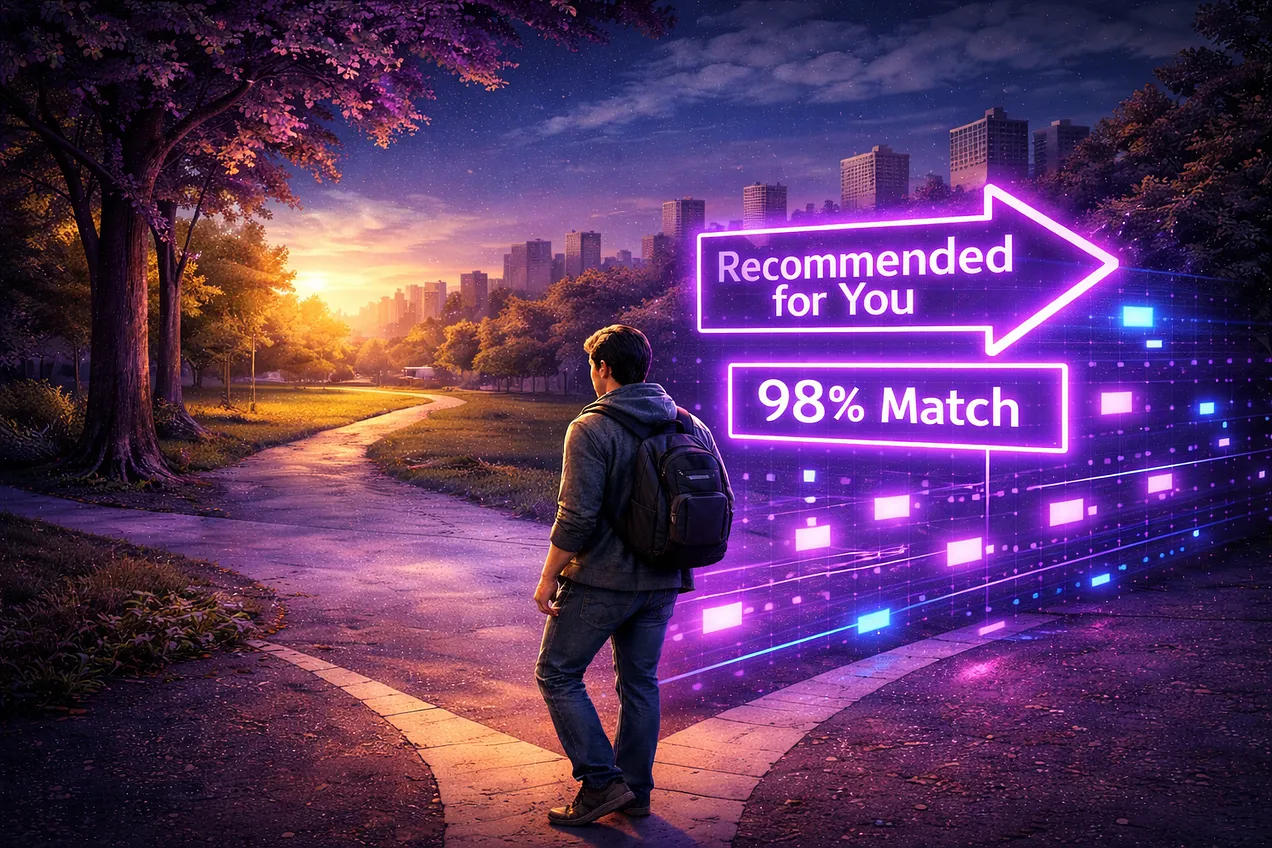
Last week I wrote about compression: how massive amounts of raw information get squeezed into dense patterns. Today I want to follow the trail of that compressed data into models. All kinds of models, all around us, all the time.
Specifically, into models that influence you.
This is not a warning. Hold off on “is this good or bad.” Just notice.
Where your data goes
If you live any kind of modern life, you produce what I think of as data exhaust. An invisible trail that keeps accumulating.
Your car broadcasts its location. Your phone logs movement and proximity. Your credit card records purchases. Your streaming service tracks attention. Even a basic phone pings cell towers. If all you do is check your bank account, that’s all in the models the banks use, along with your ISP knowing where you go.
That exhaust gets compressed into patterns. Then those patterns build and tune models.
Here’s the part worth remembering, because it’s simple and it scales: models predict.
Given inputs about your past behavior, models calculate what you’re likely to do next. Some are spectacular, like the large language models behind ChatGPT. Most are quiet and mundane, and they still shape your life: which ads you see, which job postings reach you, what credit limit you get, what insurance premium you pay, how fraud gets flagged, what “kind of customer” you’re assumed to be.
A model doesn’t need to “know you” in any rich human sense to be consequential. It only needs to be good enough at prediction to steer outcomes. Because that’s what models do: they predict.
Infrastructure becomes psychology
In the 1990s, when I was helping a large corporation move onto the Internet, I watched something subtle happen. We weren’t just connecting computers. We put PCs on every desk, networked them together, and built an environment that would later define what “normal work” even meant. Before that, we used phones, pencils, and paper. If you were lucky, maybe a typewriter.
At the time, it felt like progress, and it was. But even then, you could see how the pipes shape the possibilities. Once identity, access, logs, and network policy become the way reality is administered, people start adapting to the system without realizing it. Not because anyone is evil, but because friction trains behavior.
Years later, when I hear “models of you,” part of me hears that older lesson: infrastructure quietly becomes psychology.
Two kinds of ground
In machine learning, “ground truth” means verified reference data. The dataset label. The logged event. The recorded outcome. It’s the stuff that can be pointed to, tabulated, and optimized against.
Your GPS location at 3:47 PM. Your grocery purchase. Your streaming history at midnight. Your swipe, your click, your pause.
The data from your use of devices and computers is data exhaust and this is what becomes someone else’s ground truth (the models owned by corporations and government agencies).
But ground truth has a limitation built into the name: it only covers what can be cataloged and captured.
There’s another kind of ground: what theologian Paul Tillich called the “Ground of Being.” I’ll put it more simply: the living center from which attention, conscience, and genuine change arise. Not a dataset. Not a profile. The part of you that decides. Your lived experience.
Ground truth can be stored in a database.
The other ground can only be inhabited.
What models can do, and what they can’t
Models operate in ground-truth territory. They’re built from what can be measured, labeled, and correlated. They infer patterns, cluster people, forecast likelihoods, and recommend interventions.
They can also nudge.
If “nudge” sounds soft, that’s the point. Nudges are small, often invisible. Scaled across millions of people, they reshape markets, politics, attention, and self-understanding.
But models have a hard boundary. They can model your preferences as probabilities. They cannot model the moment you decide to become the kind of person who refuses a preference you used to obey.
They can estimate what you’ll do based on your history. They cannot touch the inner turn where you decide your history will no longer be your authority.
A life that broke the model
In 1959, I was one of the earliest children to survive a major corrective heart surgery called Tetralogy of Fallot. I was a blue baby, a death sentence past 10 years old, if you made it that far.
I don’t remember the operation itself; I was 5 years old, and the surgery was on Friday, May 1959. I grew up always being told you’re lucky or, my gosh, you’ve lived how long? I was told that somewhere in a hospital archive, there was a file describing my future in clinical terms. No one had ever undergone the surgery before, so no one knew my chances of a successful outcome. If you had only that data, you could build a reasonable model: limited activity, careful management, a life shaped by constraint.
That model would have been wrong.
Seven decades later, I’m still here. I’ve spent years lifting weights several days a week, building strength patiently, set by set. I practiced Aikido. I raised a family. I pivoted from engineering into writing and teaching. I’m watching eight grandchildren grow up.
I’m not telling this as triumph. I’m telling it as evidence. The medical file was real. The predictions it implied were reasonable (though depressing). And they couldn’t see the part where a person decides, over and over, to keep becoming.
Bodies and lives are not spreadsheets. “Health trajectory” is a model. Useful, sometimes. But it can’t capture the moment you choose to defy the curve, not out of denial, but out of something quieter. A kind of stubbornness that doesn’t show up in the data.
That’s what I mean by the ground beneath the ground truth.
What this means for 2026
As AI expands, more decisions that touch your life will flow through more models, trained on more data, making more predictions about more aspects of who you are.
You won’t entirely escape that without real sacrifice. Most people can’t, and many shouldn’t have to. The goal is not purity. The goal is lucidity.
The question is whether you’ll stay awake to the difference between what can be captured and what can transform in you.
Models optimize for patterns, typically defined as averages, risk reduction, and expected value. When reality violates their assumptions, models fail in ways that matter: credit decisions, insurance claims, fraud flags, hiring filters, and content ranking.
And here’s the point that matters most in a model-saturated world:
You are not your ground truth (data).
The compressed version of you living in a thousand databases captures the illusion of something real. It just doesn’t capture the essential thing: your capacity for surprise, your ability to grow, your power to choose a different story than the one your past behavior suggests.
The pause where choice lives
In Aikido, someone grabs your wrist hard. Your first instinct is to yank away or freeze. What I learned instead was quieter: soften, find center, notice that the grab doesn’t decide where my feet go or where my weight settles. The force is real, but it doesn’t get the final vote.
There’s a tiny pause between moments, a two-second reset where you return to awareness before the next move arrives. That pause is where choice lives.
Stay awake. Ask questions. Make choices that confound the algorithm: not as theater, not out of paranoia, but out of aliveness.
One small practice
Decide to do something different. Leave without your phone or any other electronic device. Turn them off for a day. Get some cash. Buy a coffee. Sit in a different place, a different way, with different people around you. Consider what just 15 minutes totally alone can do for you; let time and beingness accept you for who you are.
What’s my next move? Something stubbornly old-fashioned: I read long pieces that don’t optimize for engagement. Think of it as personal attention training. The algorithm wants me to skim, react, and consume. A long read puts me back in touch with my own rhythm. I can feel the difference.
It’s not anti-tech. It’s pro-depth. It reminds me there’s a ground beneath the data. You are accepted for who you are. The machine never gets that.
This post will be like many of my future posts: I will include an appendix with additional content for paid subscribers. If you’re short on cash or out of work, tell me, and I’ll see that you get added. My goal with paid subscriptions is to offset the monthly costs of AI subscriptions that inform my writing of these posts. I want everyone to benefit, and I’ll help out. Send a private chat on Substack or visit my website <https://tomparish..com>