I re-ran April's TPM posting scan four months later. AI governance did not become a default line item. It became a permissions problem with a lower salary band.
By Sumaiya Shrabony
Published: 2026-09-15
URL: https://aibyshrabony.substack.com/p/whats-actually-new-in-tpm-job-postings
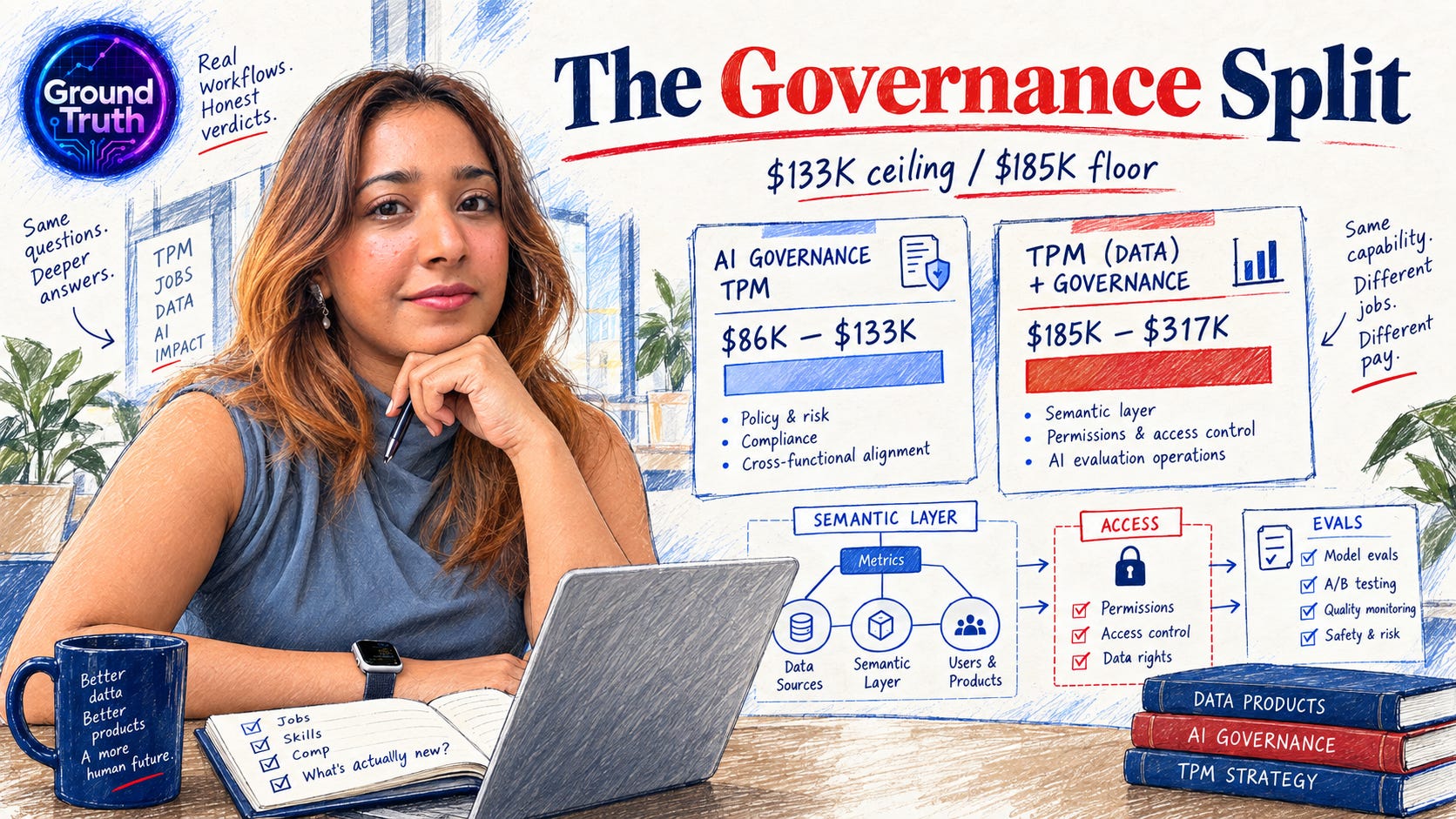
Image created using ChatGPT
In May I told you the governance bridge was the highest-leverage move a data practitioner could make, and then I spent four months taking my own advice: rewrote my resume summary to lead with the AI Working Group seat, published a whole essay in July arguing AI governance is a TPM problem, not a legal one.
Last week I re-ran the scan. The governance-titled role in my coded set tops out at $133,055. The role that actually wanted what I already do pays up to $317,000, and asks for one thing I have not built. Four months of positioning, aimed at the lower-paid half of a split I drew myself.
TL;DR
→ AI governance did not become a default line item in senior TPM postings. Coded sets went 2 of 5 in April to 3 of 5 in September. At this sample size that’s not a trend, and I’m reporting it as a disconfirmation of my own prediction.
→ What changed is the shape. April’s governance language was policy-shaped (Office of Responsible AI, AI-and-society analyses). September’s is permissions-shaped: data access policies, PII guardrails, access controls, provider approvals, ISO 42001, EU AI Act readiness.
→ Evaluation became a named program function. Zero of 5 April postings named eval as TPM scope. Two of 5 September postings do, plus three more roles whose titles are built around evals.
→ The governance job split into its own family, and it pays less. AI-governance-titled role: $86,800-$133,055. The TPM role that owns governance as one work stream inside a data program: $185,000-$317,000.
✦ ✦ ✦
Hi, I’m Sumaiya. 🐾
I’m a Technical Program Manager running enterprise data and AI adoption at a public research university (200+ ADF pipelines, 10+ departments, 530+ Power BI users), and I sit on the institutional AI Working Group. Ground Truth is where I test AI tools on real enterprise workflows and report where adoption actually breaks. One issue a week, every Tuesday. No hype, real receipts. Subscribe so the next tear down lands in your inbox.
If you’re new here, welcome! ♡ Here’s what you might have missed:
↳ The TPM Skill Stack for the AI Era: What to Build, What to Buy, What to Skip
↳ The Eval You Cannot Trust Is Your Own
✦ ✦ ✦
What’s Inside
-
What this scan can and can’t support
-
Finding zero: April’s receipts are gone
-
What appeared: evaluation became a named function
-
What did not appear: governance as default (and what I got wrong)
-
What governance turned into instead
-
Where the governance job went, and what it pays
-
What “golden SQL” actually costs
-
What the analysts say, and where they diverge
-
When to build what, and what it costs
-
Testing this further
-
Final thoughts
-
FAQ
What this scan can and can’t support
A one-off posting scan tells you what a market wants on one day. A follow-up tells you which of your conclusions survived four months, the uncomfortable, useful part.
The labor market moves, so the company set isn’t the same set, and postings expire, so April’s evidence isn’t there to compare against. Both bit this scan.
What this comparison can support: a change in the language used inside senior TPM roles at AI-forward companies. What it cannot support: a frequency claim, a market-size claim, or a salary curve.
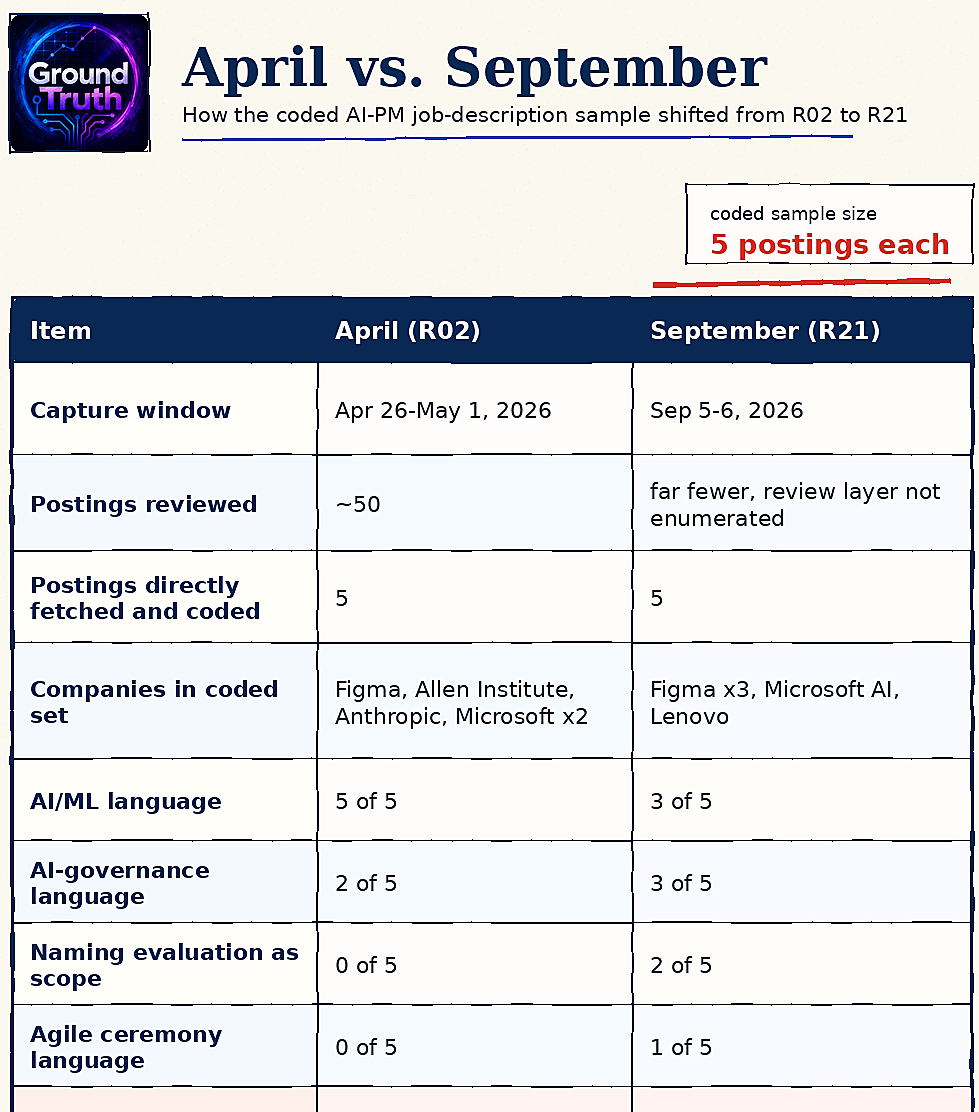
Image created using ChatGPT
What changes in your week: probably nothing this month. What changes is which of two doors you walk toward next quarter. September says those doors lead to different rooms with different pay bands; April said they were the same door.
Finding zero: April’s receipts are gone
Every one of the five postings I cited in R02 is dead. Three Greenhouse-hosted ones return 302 redirects to an error page. Both microsoft.ai postings return 403 to a command-line fetch, and the Responsible AI one, the most governance-explicit posting in the April set, also 404s. Four months. Five for five.
The May 2 Wayback snapshots all still resolve, the entire reason this follow-up was possible.
If you cite a job posting anywhere, you’re citing a page with roughly a one-quarter half-life.
Smaller version of the same problem: the Lenovo posting reaches me through an Indeed shortlink that rotated three times in one session, same job each time. The only durable identifier is the requisition number, WD00104834. That’s what I cite, no Indeed URL appears in the reference.
What appeared: evaluation became a named function
The cleanest delta. In April, not one of five coded postings named evaluation as something a TPM owns: inference latency yes, GPU budget yes, model governance yes, evals no.
In September, Figma’s TPM Data posting puts an “automated eval framework” directly in core scope, alongside semantic layer expansion and a Data Assistant. Microsoft AI’s Health AI Research TPM in London owns “the operational health of training and evaluation runs, including compute and resource planning”.
Precision matters: running the eval framework is core scope, having built one before sits under “added plus.” The requirement is softer than the responsibility. That gap is the opportunity, more below.
Title-level corroboration, not treated as evidence since I didn’t directly fetch these: a DeepMind “TPM, Gemini Evals,” an NVIDIA “Senior TPM, LLM Safety,” a Microsoft AI “TPM, Human Evaluation Operations” (URL already 404s). Three roles whose titles are the word, not a pattern I saw in April.
What did not appear: governance as default (and what I got wrong)
My prediction, from my AI Working Group seat: that “responsible AI” or “AI oversight” would migrate from specialist postings into the standard requirements block, the way “data-driven decision-making” did between 2023 and 2025.
It didn’t, visibly. Coded governance language went 2 of 5 to 3 of 5, noise at n=5.
The clearest evidence is the control case: Figma’s generalist TPM posting, same company, same hiring cycle, contains zero AI or governance language: Asana/GSuite/Zoom/Notion, PMP/Scrum as a plus, $140,000-$245,000. The Infrastructure TPM there is denser still with compliance language, all non-AI: FedRAMP, SOC 2, encryption key management, 8+ years, same $185,000-$317,000 band.
A TPM posting in September 2026 can be saturated with compliance work and contain no AI at all. Governance is not a synonym for AI governance.
One correction: R02 said agile coaching was fading, 11 of 50 and dropping. My April coded set had it in 0 of 5, September has it in 1 of 5, up, not down, and only in the AI governance role. At n=5 either reading survives, but I’d redo the framing: what I coded as disappearing was more likely relocating, into the compliance-and-intake roles created underneath the platform roles.
What governance turned into instead
The count barely moved. The vocabulary moved completely, and that’s the finding.
April’s language was policy-shaped: Microsoft’s Responsible AI TPM wanted “foundation model governance processes” and Office of Responsible AI partnership. September’s is permissions-shaped. Figma’s Data TPM: “Lead the governance and security work stream: work with Security and IT on LLM data access policies, PII guardrails, access controls, and LLM provider approvals.” Lenovo coordinates “Responsible AI intake, assessments, approvals, and remediation” against ISO 42001 and EU AI Act readiness.
Access policies. Guardrails. Provider approvals. Intake queues. That’s not an ethics function. It’s an entitlements function, describable in a ticket.
I recognize it because it’s what the room sounds like. When our AI Working Group settled the ChatGPT Edu question, the model was never the argument. The arguments were who owns the post-rollout support queue and how FERPA holds at the edge of an interface a student might paste an identifier into. Four months ago I’d have called that “governance” and stopped. September’s postings are more specific: they call it access control, next to the data platform work, not legal.
Governance did not spread across the postings. It changed from a philosophy into a permissions problem, and permissions problems live with the data team.
Where the governance job went, and what it pays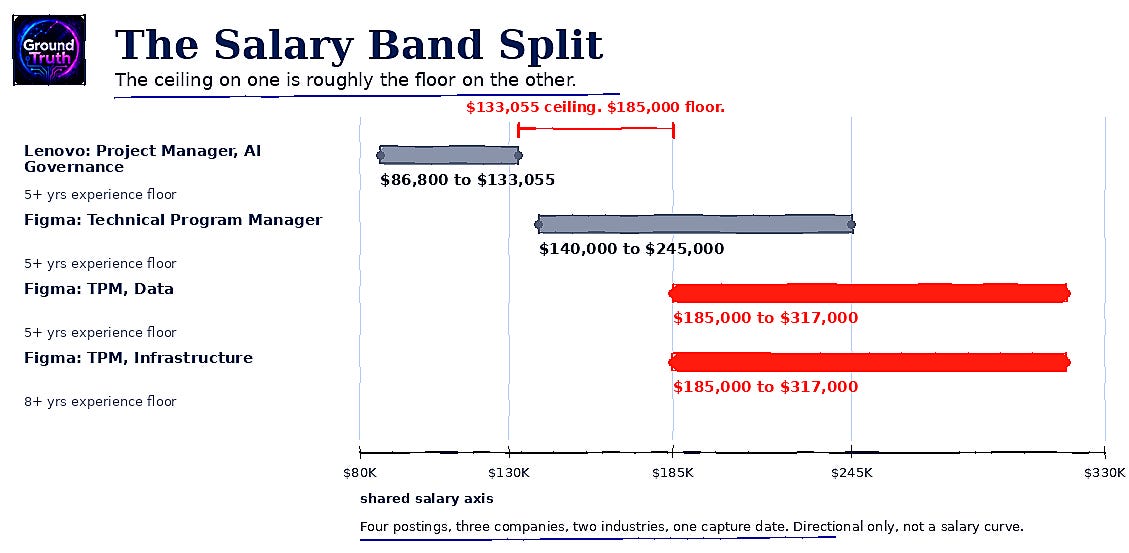
Images created using ChatGPT
Governance also left. It walked out of the TPM requirements block and set up its own job family, with its own titles and salary band.
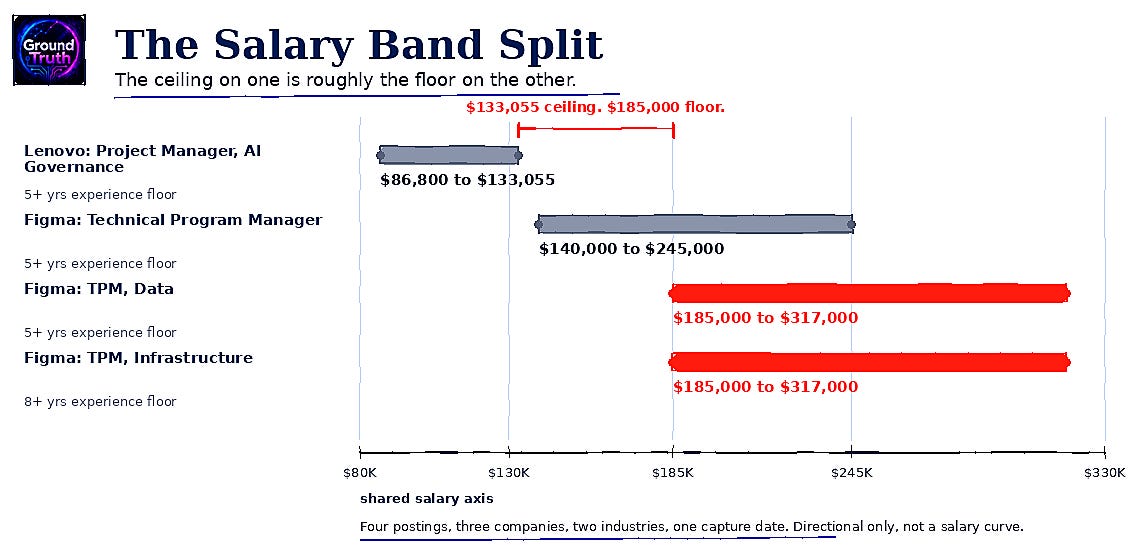
Lenovo’s is the specimen: requisition WD00104834, posted August 31, 2026, titled Project Manager, AI Governance, not Technical Program Manager. Senior IC, 5+ years, $86,800-$133,055. Figma’s Data TPM owns governance as one work stream inside a program also covering semantic layers and data catalogs: $185,000-$317,000. Same seniority floor, overlapping responsibility. The ceiling on one is roughly the floor on the other.
Two postings isn’t a salary curve, and I won’t pretend otherwise. But the directional read is uncomfortable enough to say: governance appears to be worth considerably more as a work stream you own inside a technical data program than as the whole of your job title. The premium attaches to the technical scope, not the governance: precisely the half of the split I spent four months walking away from.
What “golden SQL” actually costs
The Figma posting names its eval artifacts precisely: golden SQL, accuracy dashboards, regression detection. Anyone who’s run one against a production model knows those words hide a maintenance bill.
Golden SQL means a fixture set: a question, an expected result. The naive read is you write it once and rerun it forever. Wrong in any Kimball warehouse: your eval suite decays on the schedule of your dimension change rate, not your model release cadence. Every SCD Type 2 dimension is a clock running against your golden answers: when a department reorganizes, the expected value shifts and your regression detector fires on a change in the business, not the assistant. Chase enough of those and the team quietly stops running the suite. That’s fixture maintenance, and I’ve never seen it costed in a pilot plan.
Two more ceilings shape what an eval can measure. Power BI enforces a 225-second visual-rendering limit, and a refresh “causes the memory used by the semantic model to more than double” while the original stays live for active queries. An eval run during that window scores a capacity fighting itself. Azure Data Factory caps a factory at 5,000 total entities, default and maximum. I run 200-plus pipelines against it, headroom until something starts generating pipelines on your behalf.
That’s the bridge: an eval question, a capacity question, and an access-control question at once, and September’s postings are the first I’ve read that price all three into one role.
What the analysts say, and where they diverge
The analyst layer is bullish on AI governance hiring, and describing a different thing than the postings are.
Forrester predicts 60% of Fortune 100 companies will appoint a head of AI governance in 2026. Gartner expects $5B in compliance investment by 2027, both via CIO Dive, December 2025, no primary link. Axial Search, a recruiting firm’s own weekly US scrape, reported ~71 new AI-governance postings weekly, median pay $169,000, cited only because no bigger name publishes a countable figure here.
These describe a real, separate job family, not governance spreading into TPM postings. Consistent with my small set: the work grows sideways into its own titles, not upward into everyone else’s.
The counterweight: LinkedIn’s Jobs on the Rise 2026 US list is topped by AI engineer, AI consultant/strategist, AI/ML researcher. No program or project management role anywhere on it, though that list is a baseline for my April scan (published Jan 2026), not a same-window check.
The demand pressure underneath is real: Deloitte Australia found 69% of organizations already using autonomous AI agents against 22% with advanced agent governance models. Australia-scoped, but a 69-to-22 gap is a hiring signal anywhere.
When to build what, and what it costs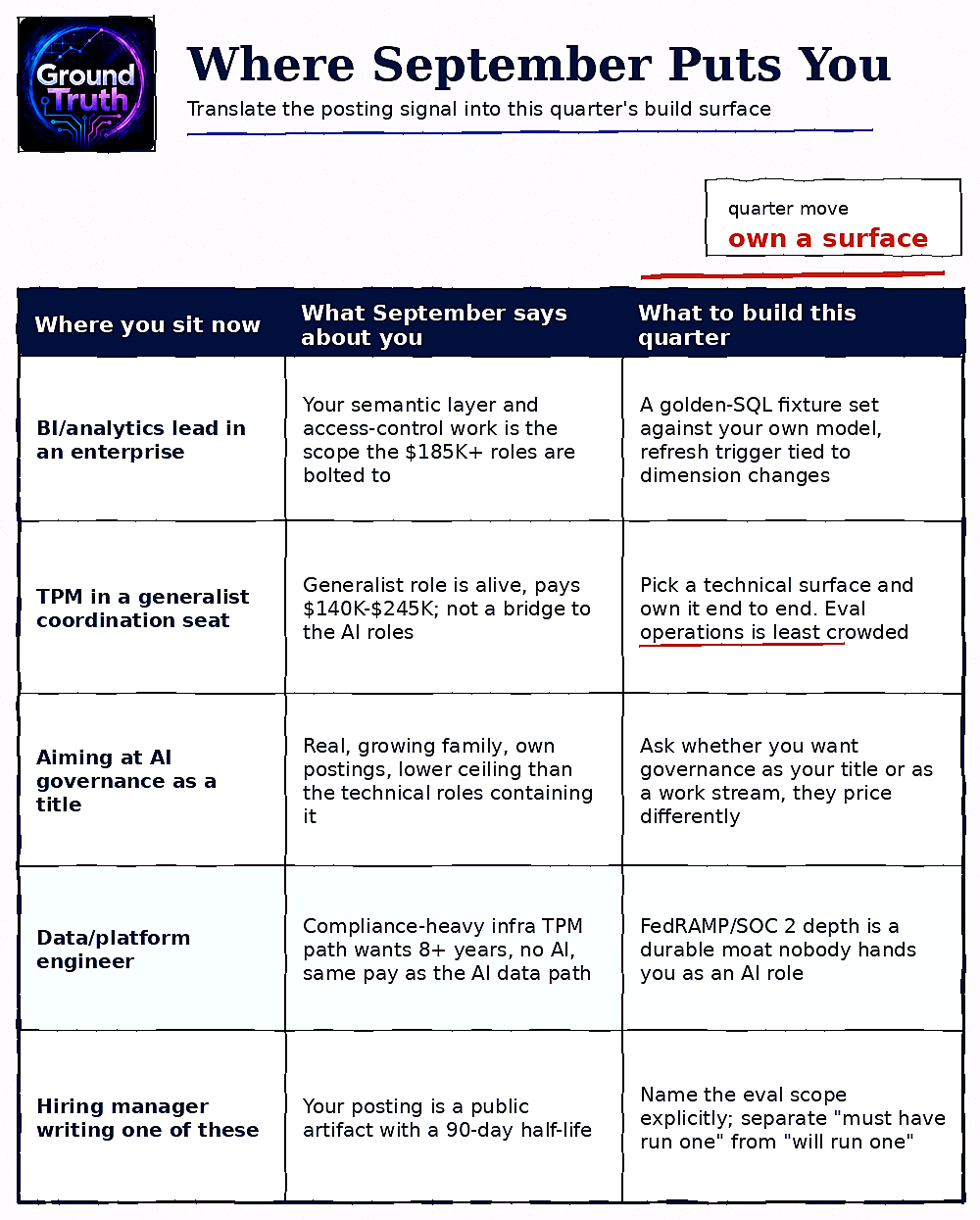
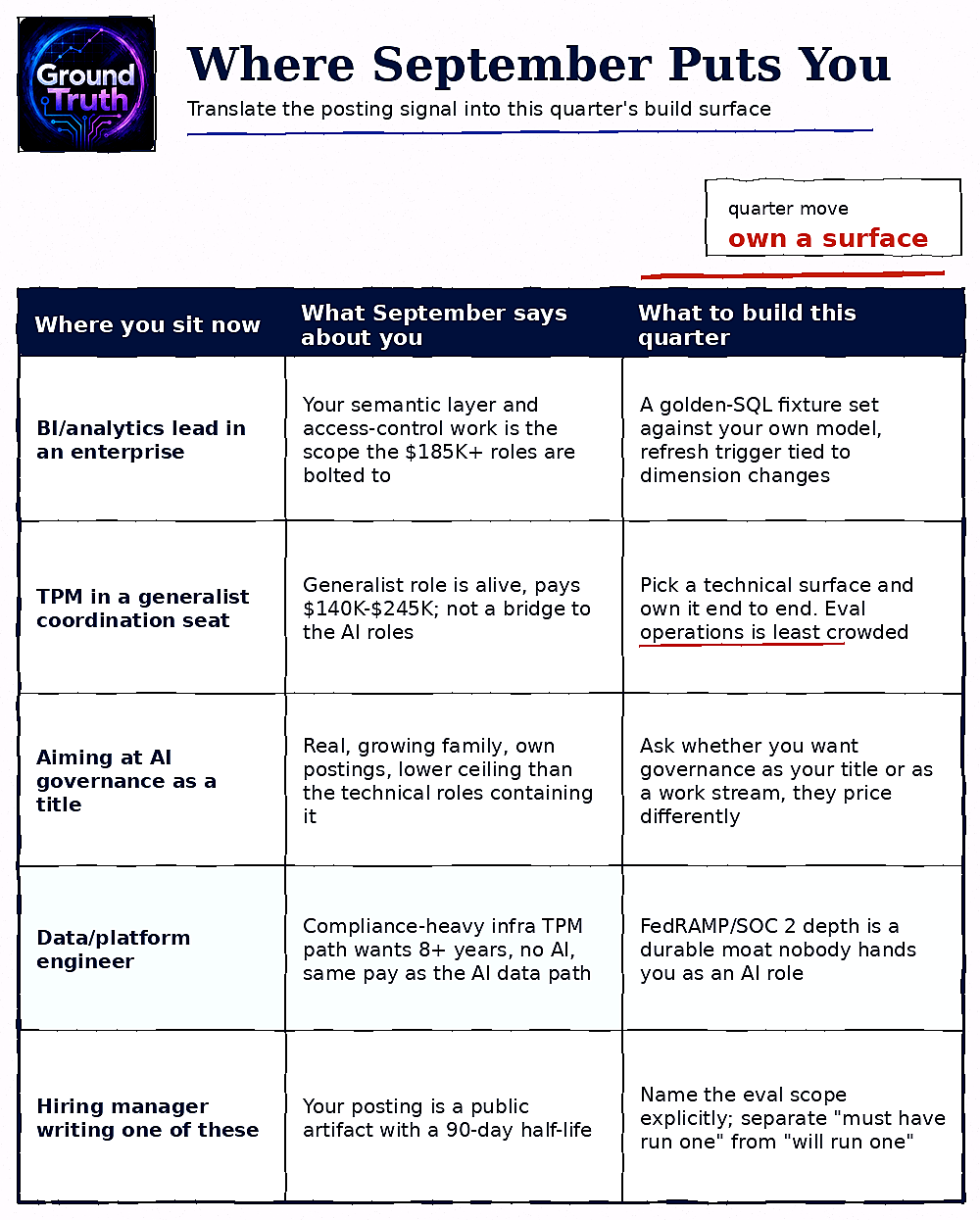
Image created using ChatGPT
This is a time bill, not a money bill: a golden-SQL fixture set runs roughly 8 hours for 40 questions, documenting the decay trigger, 2 hours once, the step everyone skips. Against that, you’re buying the ability to answer “have you built an eval framework” with a yes and an artifact, in a market where 2 of 5 coded postings put that work in scope and only 1 asks you to have done it before. That window closes.
Testing this further
The pay-gap claim is the one worth doing properly, and my sample can’t carry it. Next quarter: 30 postings across three title patterns (“AI Governance” in the title, “TPM” plus AI scope in the body, generalist TPM), restricted to postings with a stated salary range, every URL archived same-day.
To replicate this yourself: filter to postings under 30 days old on the company’s own ATS, not an aggregator. Archive each URL before reading. Record the requisition number; shortlinks rotate, requisition numbers don’t.
Final thoughts
The honest headline: I predicted a trend, went looking for it, and found something adjacent and more useful. Governance isn’t seeping into every TPM posting. It’s hardening into a permissions discipline next to the data platform, and splitting into a job family that pays less than the technical roles containing the same work. Evaluation, unmentioned in April, is now core scope in the highest-paying posting I coded, and required in almost none of them. That asymmetry is the whole opportunity, and it won’t last a year.
I’m going to stop describing myself by the governance seat and start describing myself by the thing the governance sits on top of: a semantic layer 530 people query and 10+ departments argue about. If you rewrote your positioning around a trend piece this year, mine included, this is your reminder to check whether the trend held. Mine mostly didn’t.
FAQ
Is this really a fair comparison to April?
No. April reviewed roughly 50 postings and coded 5, September coded 5 with a much thinner review layer. Every count here describes my coded set, never the market.
Does “3 of 5” mean anything at all?
Only as a disconfirmation. Nowhere near enough to establish a trend, which is exactly why it’s enough to say my predicted trend isn’t visible.
Should I take an AI governance role if the pay is lower?
Depends what you want it to lead to. The question I’d actually ask in the interview: is this role a work stream inside a technical program, or an intake queue? Those lead to very different next jobs.
What would change your mind about the pay gap?
Thirty postings with stated ranges across the three title patterns. That scan is scheduled, and I’ll publish the result whichever way it lands.
Sources
- Figma, Technical Program Manager - Data: the highest-signal posting in the set; automated eval framework in core scope, governance and security work stream covering LLM data access policies and provider approvals, $185,000 to $317,000.
- Figma, Technical Program Manager: the control case; a generalist TPM role at an AI-forward company with zero AI language in scope, $140,000 to $245,000.
- Figma, Technical Program Manager - Infrastructure: compliance-dense and entirely non-AI, FedRAMP, SOC 2, encryption key management, 8+ years at the same band as the Data role.
- Microsoft AI, Technical Program Manager - Health AI Research: Responsible AI, Compliance and Legal partnership alongside ownership of training and evaluation run health.
- Dice, “AI-related Jobs Top LinkedIn’s Fastest-growing Roles List for 2026”: the Jobs on the Rise role list with no program or project management entry, plus the MLOps-governance quote. Published January 14, 2026.
- CIO Dive, “5 CIO predictions for AI in 2026”: Forrester’s 60% of Fortune 100 and Gartner’s $5 billion, both reported without a primary link. Published December 16, 2025.
- Deloitte Australia, State of AI in the Enterprise: 69% using autonomous agents against 22% with advanced agent governance. Australia-scoped.
- Microsoft Learn, What is Power BI Premium?: 225-second visual rendering limit and refresh memory doubling.
- Microsoft Learn, Azure subscription and service limits: the 5,000-entity ADF factory ceiling.
- Microsoft, Technical Program Manager - Responsible AI: the April set’s most governance-explicit posting, cited here to show what April’s policy-shaped language looked like.
- Axial Search, AI governance hiring analysis, published June 17, 2026.
♡ ✦ ♡
If this was useful
→ Subscribe to the Ground Truth newsletter for free weekly enterprise-AI tool tear down from the TPM + data practitioner seat. One AI tool. One real workflow. One honest verdict.
→ Forward this issue to one TPM, BI lead, or data engineer who’d want it.
→ Reply with the AI tool you’d like tear down next. I read every reply.
Written by Sumaiya Shrabony, TPM running enterprise data at a research university (200+ ADF pipelines, 10+ departments, 530 BI users). Each issue is one AI tool tested on one real enterprise workflow. 🐾
Ground Truth ships every Tuesday, 7 AM MDT (9 AM ET).